


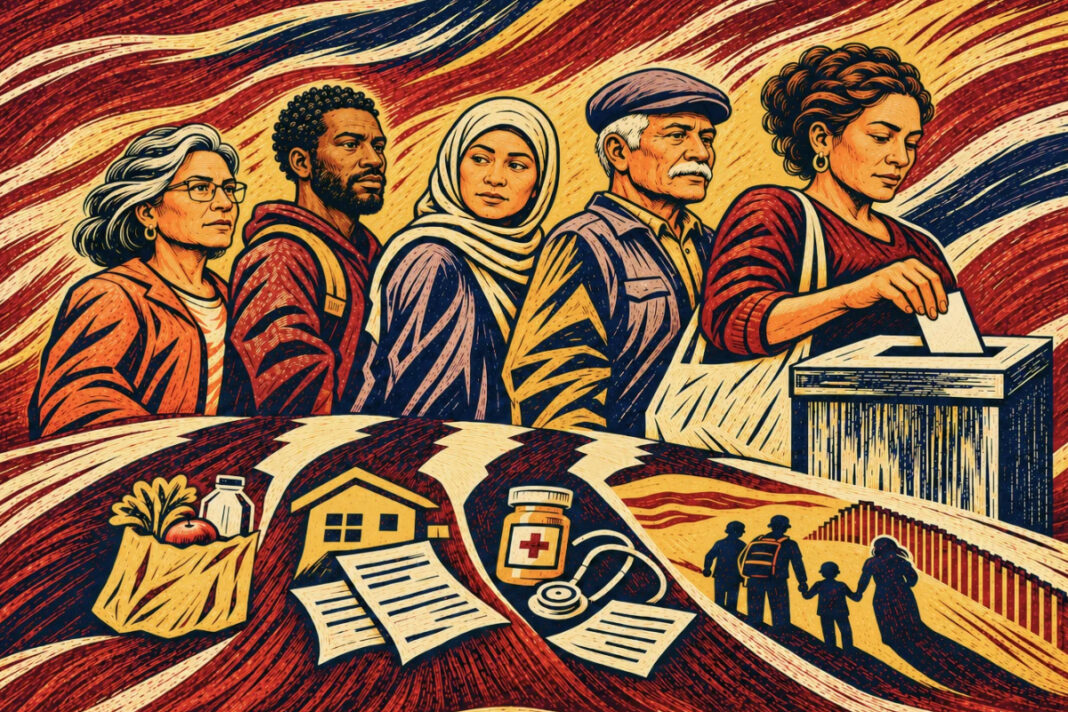

On the eve of the Nov. 3 midterms, economic anxiety, immigration enforcement and civil rights concerns are shaping voters’ priorities across the country, say ethnic media journalists.
Across communities — Indian Americans in Silicon Valley, Native Americans in Idaho, Latinos in Los Angeles, Chinese New Yorkers, Black Mississippians and Arab Americans in Michigan — accounts converged: affordability is the top concern, including the high cost of food, housing, healthcare, gas and wages, followed by immigration policy and civil rights protections.
Economics and immigration are the top issues among Latinos in Los Angeles and California more broadly, said Nestor Fantini, co-editor of the Spanish-language outlet HispanicLA.com, at an Oct. 30 American Community Media briefing.
The affordability squeeze
Nestor Fantini, Co-Editor of Hispanic LA, shares data on ICE operations and how they are impacting the Latino vote in Los Angeles.
A UCLA study released a day before the briefing found that 76% of registered Latino voters in California were very worried about keeping up with the cost of living, compared with 61% of non-Latino voters. Forty percent of registered Latinos reported cutting back on groceries or food quality in the two months before the survey, compared with 28% of registered non-Latinos.
“Affordability is the central complaint that they have,” said Fantini, “and they know that that’s connected with Washington more than with the mayor.”
Historic summer heat waves and rising electricity rates have pushed many Angelenos’ utility bills up by hundreds of dollars, from around $250 to $500 or $600.
The squeeze extends even into an affluent Silicon Valley “often presented as a place of limitless opportunities,” said Vandana Kumar, publisher and CEO of San Jose-based India Currents.
In a tech job market shaped by layoffs and artificial intelligence, “the anxiety is even greater” for H-1B workers, she continued. “A job loss isn’t just a financial setback; it can put their immigration status, their family’s future in the United States at risk.”
Indian nationals receive about 71% of approved H-1B visas, the skilled worker program on which Trump imposed a $100,000 fee on new petitions in September 2025. Although federal judges in California and Massachusetts have since struck the policy down, the administration issued a proclamation last month renewing it through September 21, 2027.
Alongside “expensive housing, childcare, education,” Indian American families particularly face “the responsibility of caring for aging parents,” Kumar added.
Nationally, 90% of Asian American registered voters say they plan to vote in the midterms, according to AAPI Data — with 90% of these voters citing the cost of living and inflation as “very or extremely important” to their vote.
Vandana Kumar, Publisher and CEO of India Currents, discusses the unique challenges Silicon Valley residents face.
In Mississippi, these costs tend to fall on communities with far less financial cushion, said Edelia Carthan, a contributing writer for the Mississippi Link: “Gas is $4 here in Mississippi. I remember when gas was 99 cents. Mississippi is already a food desert, and to have grocery prices as high as they are is a real concern.”
The strain extends to the state’s healthcare system, she said, as Mississippi, since 2014, has refused billions in federal Medicaid expansion funds under the Affordable Care Act that would help residents obtain coverage.
Had expansion started in 2022, about 123,000 uninsured adults would qualify, which would have brought Mississippi a net $690 million over two years, according to KFF.
Healthcare costs weigh even on those with coverage, said Osama Siblani, publisher of The Arab American News in Dearborn, Michigan. Though he is on Medicare, he said, his premiums are unaffordable: “I still pay $1,000 a month for me and my wife.”
‘People are appalled’
For immigrant communities, these concerns are compounded by enforcement fears and intimidation.
In New York, deportation fears are directly hurting businesses in Chinese neighborhoods, said Sing Tao reporter Rong Xiaoqing: “In Sunset Park or Flushing, these Chinese-concentrated areas, a lot of restaurants don’t have as many customers anymore, and the long-distance buses don’t have as many passengers anymore because people stopped traveling.”
“Two-thirds of Asian voters are foreign-born,” she said, “so all these policies really affect their everyday life, affect their families.”
The impact is also everyday for many Latinos: A Pew survey last November found that about one in five Latinos personally know someone who was deported or detained.
“The consequence is anxiety. Anxiety on two fronts: the wallet and ‘la migra,’” said Fantini. “For many, it’s anything but Trump, although ironically, Trump is not on the ballot.”
At least 52 people died in Immigration and Customs Enforcement custody in the first 500 days of President Donald Trump’s second term, and at least 31 have died this year alone.
“People are appalled by the level of brutality and cruelty of this administration’s federal agents,” Fantini said.
Fights over H-1B visas have also made South Asians feel targeted, Kumar said, adding that she sees some eligible Indian voters in Silicon Valley responding by turning out at the polls, while others on temporary visas or waiting for green cards “may hesitate to speak publicly or draw any attention to themselves.”
In Michigan, Siblani described unprecedented hostility aimed not only at Democratic U.S. Senate candidate Abdul El-Sayed but at the Arab American and Muslim community more broadly, including online attacks and threats against Siblani himself.
“On Sept. 11, 2001, we were not subjected to this kind of hate,” he said, “and it is coming at us from the highest level. People are attacking us because of our religion, because of the way we pray, because of what our names sound like.”
The Council on American-Islamic Relations logged 8,683 civil rights complaints in 2025, the most in a single year since it began issuing reports in 1996.
‘Pushing citizens to the polls’
For some communities, these hostilities represent longer histories of threats to hard-won rights.
“We have a unique relationship with the federal government, and they have a trust responsibility,” said Lori Ann Edmo, editor of Sho-Ban News, the weekly newspaper of the Shoshone-Bannock Tribes on Idaho’s Fort Hall Indian Reservation. “They have an obligation to provide funding for a lot of our programs for our people, and it’s because of all the lands that were taken from us.”
Tribal members are watching a proposal to drop race and ethnicity questions from the 2030 census — data that drives the formula for the Indian Housing Block Grant, the main federal housing program for tribes.
They are also wary of proposals to sell off federal public lands or transfer them to state control, including one floated late last year by Idaho Rep. Russ Fulcher.
Under its treaty, the tribe has “the right to hunt and fish on unoccupied lands in the United States,” Edmo said, yet “we’re constantly having to fight to protect our natural resources.”
In Mississippi, Carthan — a cousin of Emmett Till, whose 1955 murder ignited the civil rights movement — pointed to the U.S. Senate race, in which Democrat Scott Colom, who is Black, is challenging Republican Sen. Cindy Hyde-Smith.
Trump carried Mississippi by about 23 points in 2024, yet a Change Research poll conducted in late October showed Hyde-Smith ahead of Colom just 43% to 40%, within the margin of error.
Mississippi has the largest Black population share of any state, yet no Black candidate has won statewide office there since Reconstruction.
“That’s not by accident,” Carthan said. “It has been politically manufactured.”
These daily pressures, from grocery prices to voting rights, “are pushing citizens to the polls on Nov. 3,” she said.

SELEN OZTURK
ACoM editor and research director Selen Ozturk was born in Istanbul and raised in the Bay Area. She holds a philosophy degree from UC Berkeley. Her work has been published in the San Francisco Chronicle, SFGATE, Bay City News, PopMatters, and Senses of Cinema, among many other outlets.