


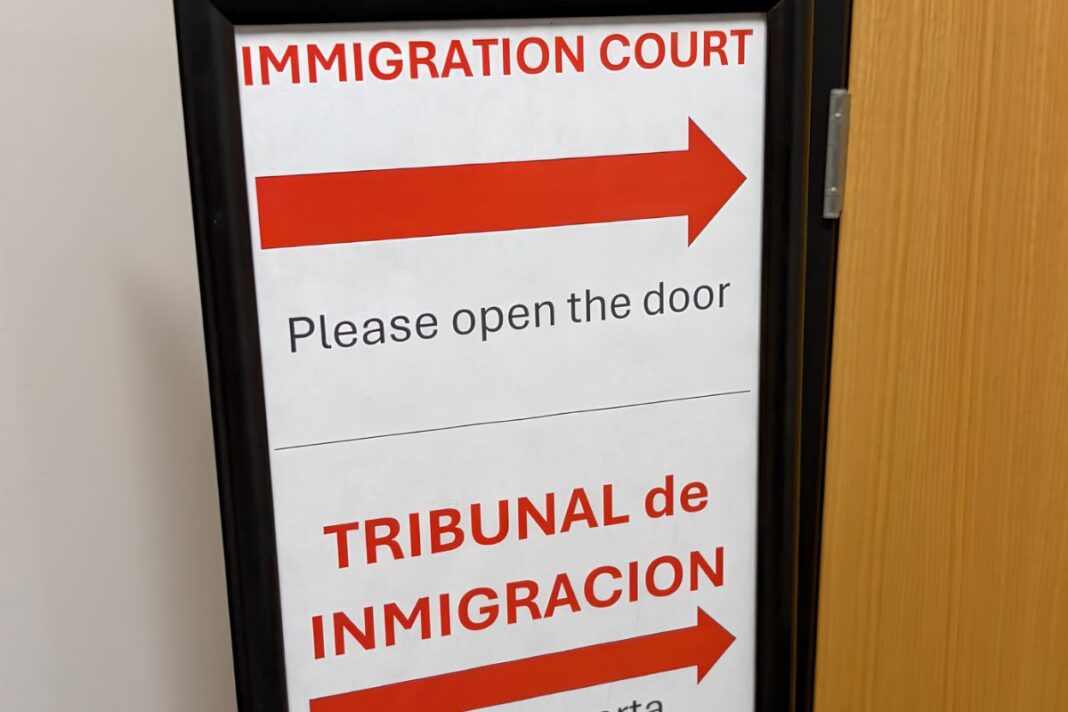

LOS ANGELES — Ever since two women from the volunteer organization Court Watch LA began to accompany Lupita to her immigration court hearings in Los Angeles, she says she has begun to feel more secure and less alone.
“They pick me up at my house, take me to court and wait for me to come out,” said Lupita (not her real name), speaking in Spanish. “Every time I have to go to a hearing, I get a panic attack. For that reason, their company makes me feel supported, calmer.”
Lupita, who has a pending asylum case, adds that beyond giving her much-needed company to hearings, the two women have also acted as interpreters for her. “They call me every other day, and if I need anything to eat, they bring it to my home.”
The woman-led advocacy organization La Defensa launched its Court Watch LA program earlier this year, training U.S. citizens to become voluntary companions for immigrants attending immigration court dates or making appearances before Immigration and Customs Enforcement (ICE).
“The way this current administration detains people every day, harming our communities, that was the motivation for us to start this program,” said Titilayo, among those who helped start Court Watch LA.
Fears of retaliation
Despite being a U.S. citizen, Titilayo says she fears possible retaliation for the work she does and has therefore asked to remain anonymous.
Karen Garcia, a spokesperson for La Defensa, explained. “If conservative groups recognize us, they might seek out our private information, track us down, and cause us harm.”
In August, California Governor Gavin Newsom signed legislation that would allow immigration service providers, employees and volunteers who face documented threats to apply for substitute addresses.
The law, AB 2624, takes effect in Oct. 2027. It was authored by Assemblymember Mia Bonta (D-Oakland), following an increase in death threats, online abuse and anti-immigrant vigilante activity.
“Right now, our immigrant service providers are living in fear because of extremists looking to demonize the work that they do and the populations they serve,” Bonta said in a statement after the bill was signed into law.
Victor Narro is project director with the UCLA Labor Center. He says the threats to those working on behalf of immigrants — citizen or otherwise — are coming not only from fringe extremist groups but from the White House itself.
“In reality, we are all at risk, whether we are citizens or not,” Narro told ACoM, noting the Trump administration’s record of targeting immigrant advocacy groups, going so far as to describe them as domestic terrorists.
“Many people are trying to help and support immigrants,” said Narro. “The reason they choose not to reveal their names, even though they are citizens, is the danger that they could be investigated, persecuted, or harassed.”
‘Solidarity and support’
Four years before launching Court Watch LA, La Defensa took over a similar observer program previously run by the National Lawyers Guild of LA for people going through the criminal justice system. In June of this year, responding to multiple requests from the community, the organization expanded the program to cover immigration courts as well.
As part of that decision, La Defensa partnered with legal experts at UCLA to help train volunteer observers on aspects of the immigration system.
Bryanna, also with La Defensa, explains that each courthouse has its own set of rules; in some cases, for instance, volunteers are not allowed to go into the hearings, so they remain outside the courthouse entrance to make sure people get home safely after their appointments.
As for the volunteers, they come from all walks of life. Many are university students, others are lawyers or community members who want to offer their support, said Titilayo.
“To date, we’ve trained more than 200 people. The main goal is to offer solidarity and support,” she said. But, Titilayo continued, “We always make it clear to people that we are not there to offer legal advice or assistance of any kind.”
Preparedness plans
What they can do, however, is help sound the alarm in cases where someone is detained.
According to Titilayo, volunteers regularly encourage immigrants they accompany to have an emergency plan ready detailing what to do in such cases. The national nonprofit Immigrant Legal Resource Center (ILRC) offers step-by-step guidance on how to create preparedness plans.
In those instances when volunteers are allowed to enter the court, explains Bryanna, they typically observe and take note of the proceeding while watching out for potential irregularities.
She noted one instance where a court appointed interpreter was mistranslating portions of the proceedings. The La Defensa volunteer at the time, a fluent Spanish speaker, noticed and alerted the lawyers involved in the case.
In cases where an immigrant is required to appear before ICE, volunteers are prohibited from accompanying them. In these instances, La Defensa will send two volunteers, one to wait at the entrance and another at the exit
“The goal is to ensure that the person is not discreetly abducted through that exit, something that sometimes happens in these types of appointments. Once the person exits the building safely, the volunteer ensures that they leave the area and returns to their home,” said Bryanna.
Expanded services
La Defensa plans to continue expanding its immigrant support program, and with the launch of a new telephone hotline — (323) 872-0411 — they estimate they will be able to reach and assist many more people across Los Angeles County.
The group also hopes to extend assistance to neighboring counties, as they have already received requests for support from communities in Orange County.
“Ultimately, our growth is focused on expanding the reach of our program and providing support, while always maintaining collaboration with those working directly on the ground,” Titilayo noted.
Bryanna says despite the challenges, the experience of being a volunteer court observer has been deeply rewarding.
“There were two of us, someone who spoke Spanish and me,” she recalled, describing a recent court appearance she attended. “We met outside the courthouse and went in” with the individual. “We were able to sit next to him. He said he felt very safe.”
Upon leaving, she said, “His whole family was waiting for him by the car, visibly anxious. They hugged us and thanked us for making sure he left safely.”
This story was produced as part of “Aquí Estamos/Here We Stand,” a collaborative reporting project of American Community Media and community news outlets statewide.
ARACELI MARTINEZ
Araceli Martinez is a veteran reporter with more than three decades covering the Latino community in California. Her journalism career began in Sonora, Mexico as an agriculture reporter. She emigrated from Mexico to Northern California in 2001. Before working with La Opinion, she worked for Univision San Francisco and Radio Bilingüe.