


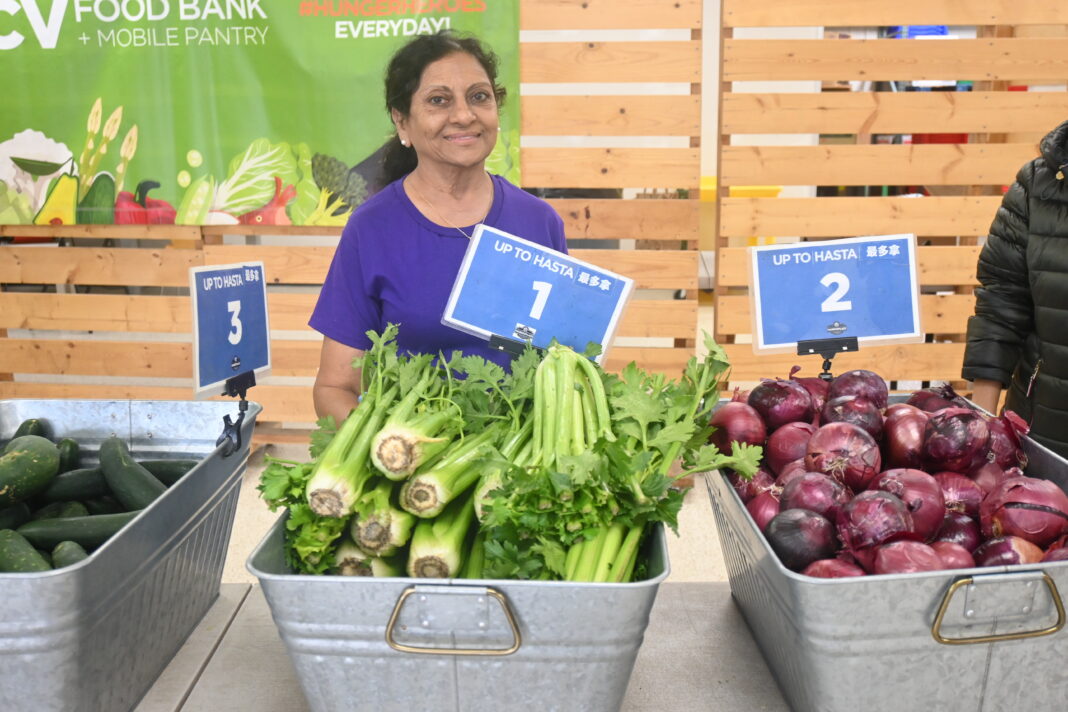
FREMONT, California — On Nov. 3, as voters across the US waited for mid-term election results, Sarah Miller stood in line at the Tri-City Volunteers Food Bank to get two bags of free groceries.
The $23 per month she receives from CalFresh, California’s version of the Supplemental Nutrition Assistance Program does not stretch far. “I have to rely on the food bank. It is troubling to me, as a person who has worked her whole life,” she told American Community Media.
Voters across the country changed the makeup of the House and Senate, heavily favoring Democratic candidates for Congress and in several gubernatorial races.
Miller has several ailments, including chronic back pain due to a bad disc, and knee pain. She is currently on MediCal, but worries that — despite her chronic illness — she will not be able to meet new work requirements mandated by HR1, the 2025 federal budget law, which cuts almost 1 trillion from Medicaid and $287 million from SNAP over the next decade. MediCal, California’s version of Medicaid, will soon require most recipients to prove they have worked at least 80 hours per month. Miller said she has received a letter from MediCal, requiring her to document her employment, but is unsure how to respond, as she currently does not meet the minimum work requirements. Her ailments prevent her from getting a full-time job, she said.
MediCal’s new work requirements exempt adults 65 and older and those who are medically frail or have a serious or chronic condition that limits daily activities, including work. New requirements mandate MediCal recipients to re-prove their medical exemption every 6 months.
‘No more wishy washy’
Access to health care and food security were very much on Miller’s mind as she completed her mail-in ballot last week. “I want credible candidates who will stand up and do the right thing for seniors, low income families, and people with disabilities. They must support us.”
”No more wishy washy stuff of saying one thing and doing another,” said Miller who strongly declared she did not vote for President Donald Trump, and blamed him for the high cost of food, gas, and other necessities.

Linda Leu, executive director of the Tri-City Volunteers Food Bank and Mobile Pantry, told ACoM that a family of four must earn at least $175,000 a year to afford life in Fremont. “The cost of food, the cost of housing, has just outpaced what anyone on a fixed income or no income, or a low-wage working person can keep up with.”
Older adults lack safety nets
Over 40% of the clients at TCV’s food bank are seniors, the fastest-growing segment for being food insecure or unhoused. “It’s particularly cruel looking at HR1 and the regulations that have gone into place that tell people that in order to be deserving of food, which you need to stay alive, you need to work.”
“The groups of people that have been losing their CalFresh benefits include those older adults, the unhoused, and former foster youth that don’t have a safety net to fall back on. We are supposed to be their safety net and we are failing them. I see that every day when I come to work.”

“We are lucky to be in the state of California and in Alameda County because I know that the social services folks have been working really hard to try and get everyone that should be exempt from work requirements exempt. So they have actually significantly cut down the number of people that are impacted,” said Leu. “However, I don’t know what’s going to happen come January 1st when the work requirements for MediCal go into effect. A lot of this is going to be the same groups of people.”
“And so I am very concerned, not just about people using us for their sole source of food, but how they’re going to survive, how they’re going to get healthcare. It’s all connected. Being able to eat healthy and nutritious food is an important part of how you stay healthy, but so is having access to healthcare,” said Leu.
Will Democrats save health care, food security?
Last August, all 47 Democrats in the Senate signed a letter urging the Administration to reverse work requirements for Medicaid. Several House and Senate candidates have called for full or partial repeal of HR1.

Abigail Guzman, who works at an Amazon warehouse, while also caring for her cousin, who is disabled and uses a wheelchair, sheepishly told ACoM at the food bank that she did vote for Trump in 2024. She now regrets that decision.
“No more,” she said, noting that her family of 5 people have all turned against the President, and voted for candidates that do not support the current Administration.
Currently, Guzman receives a small stipend for caring for her disabled cousin. She is afraid of losing that small stipend — a critical lifeline to keeping her family fed.
Cuts for special needs adults?
Lilian, a single mother and survivor of domestic violence, said that the alarming rise in costs of basic necessities was definitely on her mind as she cast her ballot. “Everything is so expensive now: rent, food, gas, medical care. It is a constant worry to meet my family’s needs.”
Lilian has a special needs adult son, who is 20 years old. He receives $900 per month in SSDI benefits. Lilian worries that his support will be cut. “We are struggling to keep a place to live, and have some food in our stomachs. Who is looking out for us?”
Lisa Magleby, a food bank volunteer, said medical benefits were on the top of her mind when she voted by mail-in ballot. Magleby, a live video producer, was laid off a year ago. “I’m paying for COBRA right now, but next year, I will have to go to the private market for health care. It’s scary,” she said.
Health care premiums rose by 25% for 2026, and are expected to rise another 15% for 2027, according to data from Families USA. Magleby said she worried about being able to afford health care in the private market.‘
‘Get out of this chaotic Administration’
”We need to get out of this chaotic administration. We need to take back the House and the Senate, and get rid of this President.”
”I’m not partial to either party, but I do want people in office that care about people. I’m looking forward to (midterm) results,” she said.

Across the bay in Mountain View, California — another affluent community that sits on the edge of the Silicon Valley — Simone Berkowitz, development director at Community Services Agency, told ACoM that her organization is closely monitoring demand. “SNAP is a very successful program. Food pantries cannot meet the demand left by cuts to this program,” she said.
CSA serves up to 200 families, 4 days a week, and about 3000 families annually. The organization runs a “groceries rescue” program, sourcing perishables and other goods from grocery stores, the Second Harvest Food Bank, and individuals who come in with fresh fruits and vegetables from their gardens.
“We are very much the city of the very well off, but also the city of people living on its margins,” said Berkowitz.