


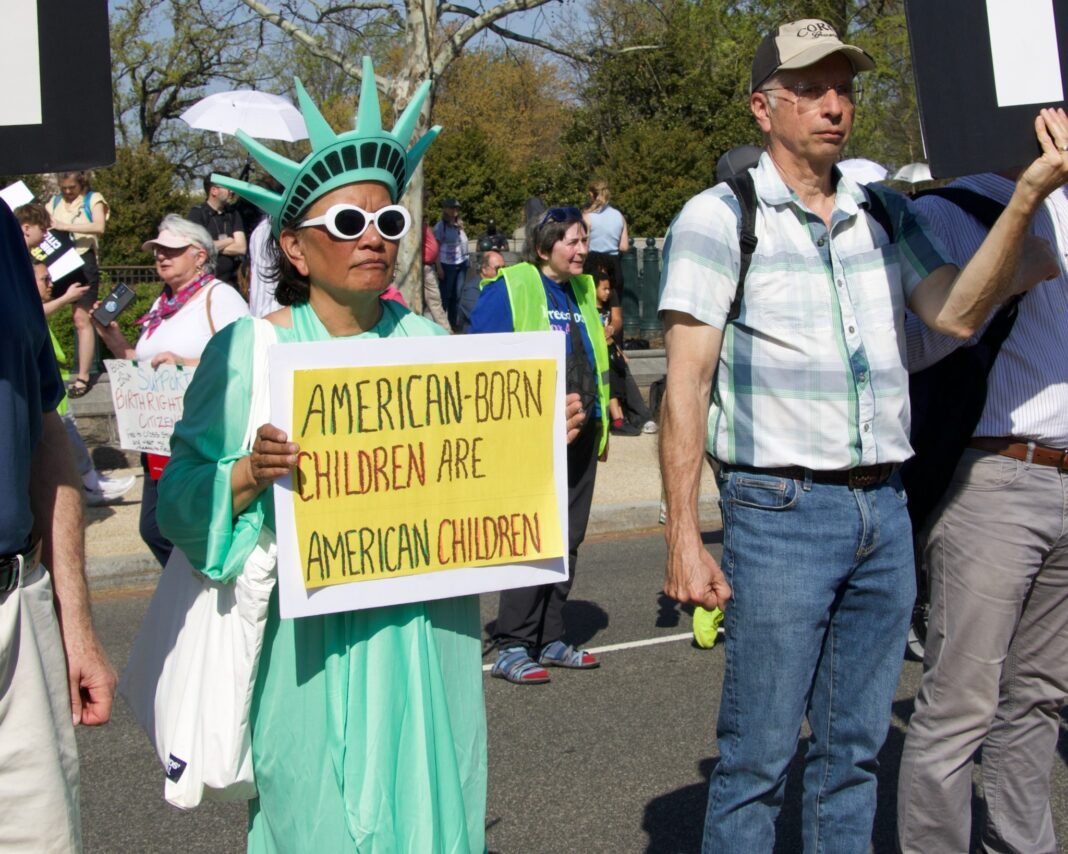
A proposed ban on birthright citizenship could trigger sweeping economic losses, by expanding the unauthorized population and discouraging highly-skilled global talent from coming to the United States.
Those are the findings of a new study quantifying the contributions of current and future birthright citizens. Beneficiaries of birthright citizenship, it notes, will have contributed $7.7 trillion to the U.S. economy through their income between 1975 and 2074.
This includes a projected $1 trillion by future children not yet born. Their economic contributions would be most at risk if President Donald Trump’s executive order is upheld this June by the Supreme Court.
Shortage in skilled labor force
Dr. Phillip Connor, Research Fellow, Center for Migration and Development, Princeton University. Connor shares data from a study on the economic impact of birthright citizenship.
“We found that basically about two thirds are [working] or will work in occupations that typically require at least some college,” said Dr. Phillip Connor, research fellow at the Center for Migration and Development at Princeton University.
“That gives us a sense of the fact that they are able to make these gains as U.S. citizens into the post-secondary education sphere, gains that probably would not be permitted if they did not have U.S. citizenship.”
Connor co-authored the study alongside his colleagues Matthew Hall of Cornell University and Francesc Ortega of Notre Dame University. He spoke at an April 10 American Community Media news briefing
The study estimates at least 4 million beneficiaries of birthright citizenship since 1960 and into the coming decades. Connor called the figures conservative, adding: “They have contributed enormous sums of money.”
Future losses could be substantial if the policy changes. The labor force is expected to be shorted by 400,000 skilled workers, estimated Connor.
“Our working age population is only growing through immigration today,” he said. A ban on birthright citizenship would diminish the working age population even further, said the researcher.
Challenge to the 14th Amendment
On his first day in office Jan 20, 2025, Trump signed an executive order titled: “Protecting the meaning and value of American citizenship.”
In issuing the executive order, Trump challenged the 14th Amendment, which guarantees citizenship to anyone born on U.S. soil. Trump argued that the children of undocumented immigrants, along with those on temporary work or student visas, were not entitled to birthright citizenship.
The Supreme Court heard oral arguments April 1 on a challenge to the executive order. The Court is expected to render its ruling this June. Court watchers say the Trump Administration faces an uphill battle in convincing the justices, who seemed skeptical of Solicitor General John Sauer’s arguments defending the ban.
Cecillia Wang, National Legal Director of the American Civil Liberties Union, represented the case for the respondents. Wang herself received birthright citizenship. Her parents immigrated from Taiwan in the late 1960s to attend graduate school. In court, Wang argued that a president cannot overturn a constitutional provision and a century of legal precedent through an executive order to redefine citizenship.
Stateless babies
Dr. Julia Gelatt, associate director, U.S. Immigration Policy Program, Migration Policy Institute. Dr. Gelatt explains why the undocumented immigrant population will grow if the United States repeals birthright citizenship.
Dr. Julia Gelatt, associate director of the U.S. Immigration Policy Program at the Migration Policy Institute, said the proposed ban could expand, rather than reduce, the unauthorized population by creating generations of people born in the US without legal status.
“The unauthorized immigrant population would actually grow significantly by 2.7 million more over the next 20 years and 5.4 million more over 50 years,” she said.
She added that about 255,000 children per year could be born without legal status.
“The broader reality of this is that repealing birthright citizenship would create a self-perpetuating class excluded from social membership,” Gelatt said. She added these children would face significant barriers throughout their lives.
Permanent underclass
“This means that kids would be growing up in the United States without access to Medicaid, to food assistance, to other public benefits,” Gelatt said. “They would have constrained access to higher education, and more importantly, they would grow up knowing that they aren’t able to work legally in the United States.”
“This would lead to lower educational aspirations because what is the value of striving towards a college degree if you can’t use it to work in a professional job?”
Gelatt also noted legal and policy risks tied to education access. She referenced a 1982 Supreme Court ruling — Plyler vs. Doe — that guarantees public education regardless of immigration status. Currently, Tennessee, Oklahoma and Ohio, are trying to pass legislation that would prohibit undocumented children from attending public school. Four other states have tried but so far failed to implement similar legislation.
“Without birthright citizenship, we would have a much bigger pool of children who could potentially be excluded from the public education system,” said Gelatt.
Highly-skilled workers will go elsewhere
Xiao Wang, CEO of Boundless Immigration, said the policy could also reshape how highly skilled workers view the United States, potentially reducing immigration of talent.
“A ban on birthright citizenship is not just about changing the legal rule,” Wang said. “It changes how talented people around the world think about building a life in the United States.”
He said uncertainty about children’s status could discourage professionals from relocating.
“You’re asking the bigger questions: can I build a stable life in that place? Can I raise my family there? Will my children be secure there?” he said.
Rural hospitals
The United States’ already-strained healthcare system is likely to face further challenges. as a result of Trump’s anti-immigration policies, says Xiao Wang, CEO/Co-founder, Boundless Immigration.
Wang warned that the effects would be especially pronounced in sectors already facing shortages, such as health care.
“If even a modest amount of international physicians and nurses decide that America is becoming too unstable of a place to raise their family, the first place facing labor shortages will be rural hospitals already struggling to recruit,” he said.
He added that other countries are actively competing for that talent. Canada is simplifying pathways to doctors. The United Kingdom has a dedicated health and care visa. New Zealand offers permanent residence pathways for in-demand medical roles. Australia also has skilled visa programs to fill health care worker shortages.
“Other countries are leaning in, when the US is leaning out,” Wang said. “Does America want to continue to be the place where the best people around the world come and build and discover and heal and stay? Or do we want to be the country that tells a gifted physician: we welcome your labor, but your family’s future is still up for debate?”
Who belongs?
One of the goals of Trump’s immigration policy is to send a message about who belongs in America and who does not, says Dr. Hiroshi Motomura. Motomura is Susan Westerberg Prager Professor of Law at the UCLA School of Law.
In remarks kicking off the April 10 News briefing, UCLA law professor Hiroshi Motomura, a leading scholar of American immigration, said the debate around birthright citizenship ultimately reflects a broader question about national identity and belonging.
“Fundamentally we are debating what kind of country the United States is meant to be,” he said.
He described birthright citizenship as central to an inclusive vision of the country. “It embodies a rejection of hereditary or inherited citizenship from your parents,” Motomura said. “Citizenship is a vehicle for belonging.”
He warned that restricting citizenship could create a large population excluded from full participation in society. “The message sent by the executive order is very profound,” he said. “It’s about who belongs to America and who doesn’t.”