


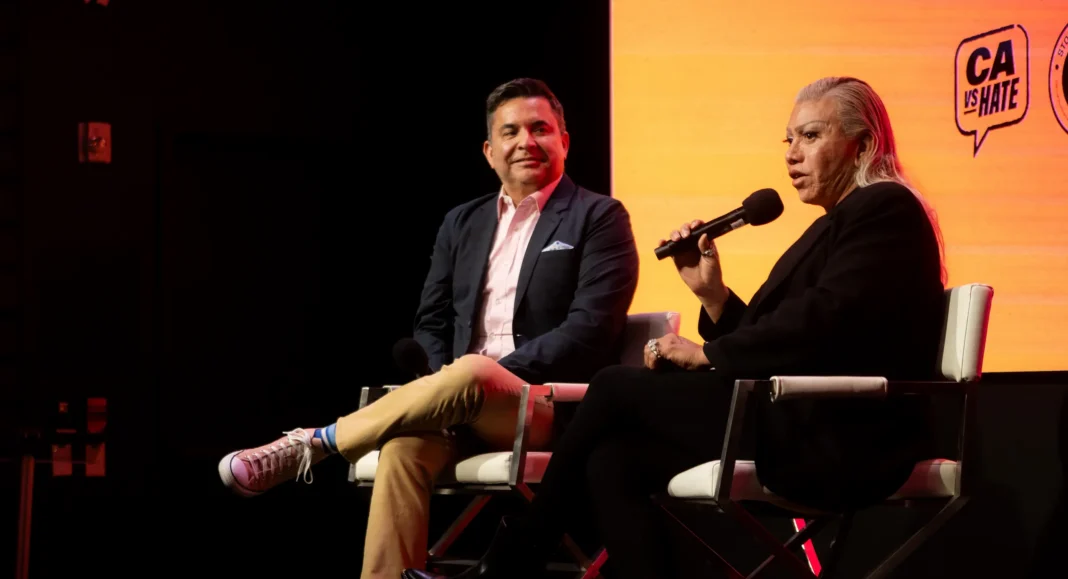
As the federal government moves to strip transgender rights, the California Civil Rights Department’s first-ever California Civil Rights Summit had a different message.
During a fireside chat at the May 11 event titled “From Hate to Healing,” Bamby Salcedo — president and chief executive officer of the TransLatin@ Coalition — reminded the audience that the first executive order signed by President Trump in his second term stated that the federal government would only recognize two sexes.
California Commissioner on the State of Hate Russell Roybal echoed those concerns at the event — held by the commission, CA vs Hate and Stop the Hate at San Francisco’s Commonwealth Club — saying that “gender is under attack, there are anti-gender forces, and that’s not just about trans and gender expansive and non-binary folks. It is about gender at large,” adding that “it is unfortunate that a lot of this is coming from our own government.”
Among the many challenges facing the trans community is the immigration crackdown, said Salcedo, explaining that many people do not fully understand the specific difficulties trans women face in the immigration system.
For many trans women fleeing their countries to save their lives, their first experience after seeking asylum in the U.S. is immigration detention.
In detention, Salcedo said, trans women often suffer violations of their civil rights, including being denied necessary medications like hormonal treatment. She also noted that some trans women have died while in immigration custody, underscoring the dangers they face even after fleeing violence in their home countries.
She also recalled that last summer, when Immigration and Customs Enforcement (ICE) raids began in Los Angeles, 12 of her clients from the TransLatin@ Coalition were detained. Some of them have been deported to the home countries they fled.
Asked about her motivation to found the organization, she recalled her transition at 18, in the 1980s, when few support systems, resources or safe spaces existed for trans women like her. Without that support, she said, the street economy became the only option.
Surviving the streets, and later a 15-year incarceration, she saw that other trans women were living through the same struggles and began doing social justice work. In 2006, she was detained in an immigration detention center, where she witnessed firsthand the conditions that trans women face inside the system.
Those experiences deepened her commitment to advocacy. In 2009, she founded the coalition “to support our sisters who were in immigration detention,” Salcedo said. “We were doing visitations, and we would fundraise to put money in their books. We would do campaigns to get them out. We would pick them up.”
She did this work as a volunteer for six years, until receiving her first grant in January 2016. Since then, she has focused on building the organization into a nationally recognized institution that provides multiple services to the trans community.
She is looking to the future with excitement and optimism.
The organization has acquired a 24,000-square-foot space at Hollywood and Western in Los Angeles, where it is developing an ambitious project: The new space will include a gender family health center and operate under a social enterprise model, featuring a cafe, a restaurant, a beauty salon and a rooftop available for events — with the restaurant serving as caterer for those gatherings.
For Salcedo, the project represents more than a physical expansion.
“Our community has always been displaced,” she said, “so having the opportunity and the ability to have a space that is owned by the community, that is also supporting our community, it’s affirming.”
The building will also include a large performance space and room for approximately 120 staff members; the coalition currently employs 68.
“We wanna be the reflection of the possibilities to our people,” she said.
Beyond its physical expansion, the coalition is investing in leadership development through “Angels of Change,” a program designed to prepare community members to advocate for themselves and pursue positions of power.
Salcedo said the program aims to shift “the way society sees us. We’re going to shift the way policymakers see us, and we’re going to make sure that we assert ourselves into our society the way we should and deserve.”
Her broader goal is to ensure that the people most affected by these issues are the ones leading the work and shaping the decisions that affect their communities.
“We’re going to be training our community to learn how to run for office, and we’re going to put our people into office,” she said. “We’re going to build trans power.”
The audience erupted in applause.