


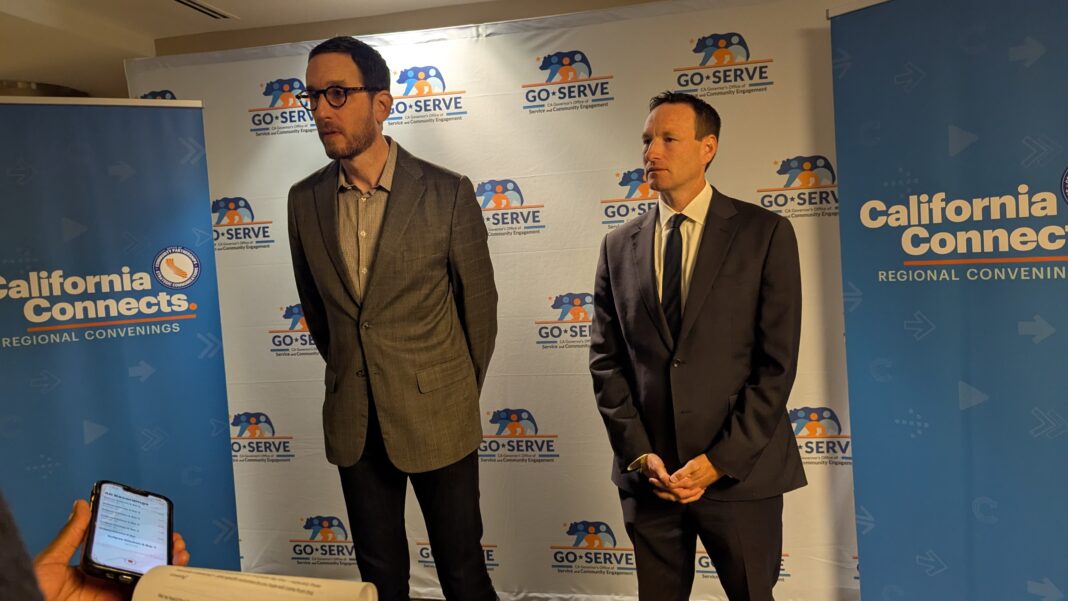
Amid growing division nationwide, California is urging its residents to create stronger connections in their own communities.
On Wednesday, Oct. 8 in San Francisco, the Governor’s Office of Community Partnerships and Strategic Communications kicked off the first of eight convenings aiming to battle this societal division through community engagement in cities throughout the state.
Approximately 250 people representing 100 local community organizations, nonprofits and government attended the event at the Hyatt Regency
The “California Connects” convenings are part of the state’s GO-Serve program, established last year to encourage paid service and volunteerism for residents to meet the most pressing issues in their communities, including climate change, health and mental health care, elder support and immigration help.
”We are living in a different moment in our history. People feel divided, isolated, polarized. We are asking you: How can we bring together the 40 million people that call our state their home?” said California Chief Service Officer and GO-Serve head Josh Fryday, who kicked off the day-long event. “As the federal government shuts down, California is powering up. That’s what this day is about.”
State Senator Scott Weiner, who chairs the Senate Budget Committee and represents San Francisco, was the keynote speaker.
“People have become super disconnected, propagandized and even brainwashed in some respects. And that is so deeply unhealthy for society,” he said. “We need to continually strengthen infrastructure and connections at the local level so people don’t feel disconnected.”
“The work that California Connects does is so important. We need to replicate this all across the country and rebuild the social infrastructure that’s been around for so long and that has been deteriorating in recent years,” he continued, thanking the audience for “fighting for a better society.”

Serving communities in San Francisco
The GO-Serve initiative is backed by $225 million from the state this fiscal year.
Last year, the San Francisco-based nonprofit Self-Help for the Elderly received a $300,000 grant from GO-Serve.
“We did one-on-one phone banking, and also getting out into the community and doing street fairs, health fairs and workshops. It was a very successful year,” said Anni Chung, president and CEO of the organization, which helps seniors citywide — particularly Chinese Americans — maintain independence in all areas of their lives.
This year, with a slightly smaller budget, Self-Help for the Elderly will prioritize mental health resources for Chinese American seniors, many of whom live with trauma associated with fleeing their country of origin.
“There are 200,000 Chinese Americans living in San Francisco alone, but just eight clinicians to support them,” said Chung. “Depression, anxiety and suicidal ideation and attempts go unaddressed.”
“No one can really address it because we are so short of bilingual, bicultural clinicians,” she continued. “So this year, we hope that with state support, we can bring back a couple of our clinicians who are retired but still hold their license. We can give them a stipend, so they can provide some of these desperately needed services for our seniors.”
The San Francisco regional convening also highlighted the Men’s Service Challenge, a $5 million investment through the GO-Serve initiative, announced by Governor Newsom last month, seeking to recruit 10,000 mentors, coaches and tutors for boys and young men.
“Civic society is in need of men to step up and serve in their communities while also understanding the various challenges that they might be facing,” said Luis Jimenez Romo, deputy director of external and legislative affairs at GO-Serve.
In partnership with organizations including Big Brothers, the YMCA and Mentor California, this new initiative will “help young boys who are finding their way in life,” he added. “We’re encouraging this generation to get off their screens and to get out in the community and make a difference.”
“By making these relationships, by creating this change, they can find rewarding benefits in terms of mental health and personal health. And not only that, but it could also lead to career outcomes or opportunities that can open their horizons,” continued Romo.
He also highlighted the California Service Corps (CSC), which recruits young people to improve societal and environmental issues in low-income and other vulnerable communities.
Karina Lopez, program manager at the Oakland-based CSC partner Frontline Catalysts, said three fellows recently completed the program with her organization by working on Frontline Catalyst’s Eco-Healing the Town initiative.
In this program, the fellows worked with youth leaders along the I-880 corridor in East Oakland to promote urban greening, land stewardship, hazardous waste and air quality monitoring through workshops, research and hands-on community events.
“These are usually the communities most affected by the climate crisis, but also the ones that are usually kept out of the spaces where we discuss solutions and how to react to a changing climate,” said Lopez. “Thanks to GO-Serve, we’re helping to foster a sense of stewardship for the land in connection with that land.”
The next California Connects convening will take place in Los Angeles on October 15 before future events in Sacramento, Fresno and southern California.
More information about GO-Serve is available at serve.ca.gov.