


Four unions have joined the first lawsuit that fights back against President Donald Trump’s executive order, which slaps a $100,000 fee on new H-1B workers.
The case, Global Nurse Force et al v. Trump et al was filed Oct. 3 in the US District Court of Northern California. The 4 unions named as plaintiffs in the case include: UAW International, along with its local union, the UAW 4811; the Service Employees International Union-AFL-CIO, which includes the Committee of Interns and Residents; and the American Association of University Professors. The UAW 4811 is the union for University of California graduate students and represents research assistants, teaching assistants, and post-doctoral fellows. The CIR represents medical professionals.
About 70% of H-1B workers hail from India. China is the 2nd largest country of origin for H-1B workers. 85,000 H-1B visas are granted each year.
US ‘Closed’
“This edict makes clear the U.S. is no longer open to the world’s most brilliant and hardworking scientists,” said UAW Region 6 Director Mike Miller in a press statement. “It prioritizes wealth and connections over scientific acumen and diligence and tells the world that the U.S. is no longer a place to pursue scientific inquiry to solve some of the major diseases and other problems confronting us.”
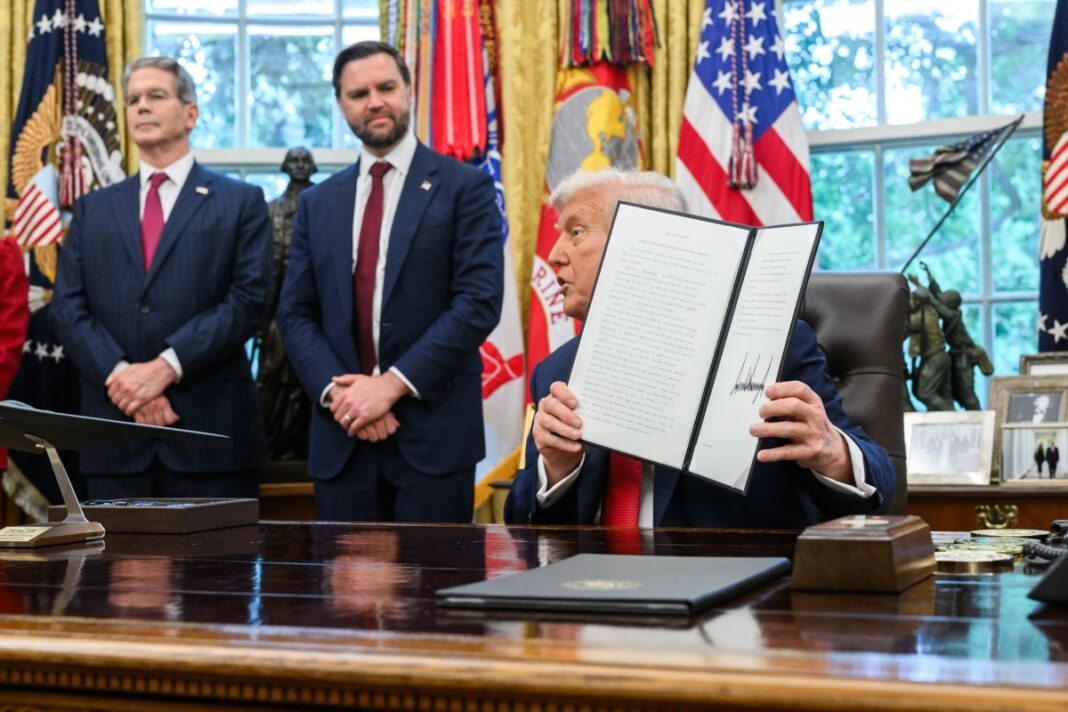
President Donald Trump late Sept. 19 afternoon signed an executive order requiring tech companies to pay $100,000 per year for each H-1B working in their company. Chaos ensued after the vague language of the order was announced. USCIS released a memo Sept. 20, attempting to clarify some of the mandates of the new EO, stating that only new H-1Bs who were currently outside the country would be impacted, but confusion has persisted nonetheless.
Rafael Jaime, president of UAW 4811, characterized the executive order as “xenophobic,” and stated that it harasses and intimidates essential workers contributing to the growth of the US economy.
Trump Lacks Authority to Levy New Tax
The lawsuit was jointly filed by Democracy Forward, the Justice Action Center, the South Asian American Justice Collaborative — SAAJCO — Kuck Baxter LLC, Joseph & Hall, P.C., and IMMpact Litigation. The suit claims that Trump’s order is a “power grab,” and is unconstitutional and unlawful under the Administrative Procedure Act.
Plaintiffs noted that Trump does not have constitutional authority to levy what is essentially a new tax; Congress has that sole authority.
In an Oct. 7 interview with American Community Media, Kalpana Peddibhotla, executive director of SAAJCO, discussed the lawsuit and its possible outcomes.
Unlawful Overreach
“This was a Herculean effort by multiple attorneys and organizations across different parts of the country with different missions. We all came together because we very quickly saw that this was an unlawful reach of executive power and very harmful to our nation,” said Peddibhotla.
“I would like to see us build an America that believes that immigrants are a contributing part of our economy because all the evidence says that they are.”
“We did this in two weeks, sourcing plaintiffs and organizations willing to step forward during a time where there has been extreme chilling of voices in the country and where people feel less secure to exercise their right through the court system to protest government actions and government overreach,” said Peddibhotla. “I’m very proud of the plaintiffs that were able to come along with us.”
Here are portions of the interview, edited for brevity.
Ms. Peddibhotla, why did unions join this fight? What is their interest in protecting the H-1B population?
KP:So they all had an interest because many of their members include people who would benefit from the H-1B program. Their careers would be at jeopardy and the institutions that rely upon them would have experienced significant harm. Ultimately, we as America would lose.
These are people who have agreed to go to our medically underserved areas or health practitioner shortage areas where there’s a real significant need for doctors. They have made that as part of their immigration commitment: that they will go and serve in those areas.
So the unions came in because they saw how their members were being impacted. We are just very grateful for their leadership.
Should we expect to see a drop-off in skilled talent applying for H-1B visas?
If this executive order is not vacated, which it should be, and I believe it will be, it could indeed drive private employers away from looking at H-1B workers. And I don’t think that then results in more opportunity somehow for American workers. I think it actually possibly diminishes the opportunities.
There’s a harm that can be done to our economy when businesses lose the ability to hire quickly. The competitive edge that it gives us over other countries is at risk.
Often, these are workers who have studied in the US, correct?
Yes. We train these workers. Many come to the US as international students. And the next step for them is to take what they’ve learned and put it back into the US economy.
The message of this executive order is: “Take all this information that you’ve just learned from our great institutions and go back to your home country.” In that sense, America loses.
Wouldn’t we want the people that we’ve trained to then stay back and build off of what they learned and build and contribute to the US? H-1B workers contribute to building the economy. They become job multipliers and benefit the economies which they are in.
Why is SAAJCO participating in this lawsuit?
SAAJCO is the first nationwide South Asian civil rights organization. Our perspective is that these narratives of job stealing, fraud, misuse reflect a sort of xenophobic rhetoric. That’s also the language that was used to target other immigrants over the last 100+ years.
SAAJCO was incorporated last year with the mission to fight for the civil and human rights of the South Asian diaspora in the United States. Given the disproportionate impact of this proclamation on South Asians, in particular Indian nationals, we felt that it was very important that we have a role in this lawsuit.
The action itself is illegal. It violates the president’s authority. The reality is the executive order has so many holes in it. And that’s evidenced by the fact that there were immediate rollbacks through memos to try to reinterpret what the executive order said.
It’s clear that the Administration hasn’t thought this through. And I believe that we’re ultimately going to prevail because of that.