


Hear full interview | SoundOnSight Podcast on Spotify and Apple:
SoundOnSight IS A NEW PODCAST INITIATIVE BY ACoM. CHECK OUT MORE EPISODES HERE.
SAN FRANCISCO — A tidy assembly line of bins, machines, an assortment of paper and packaging line this brightly lit SOMA warehouse. As efficient and pragmatic as a German auto plant, it isn’t engines being manufactured here.
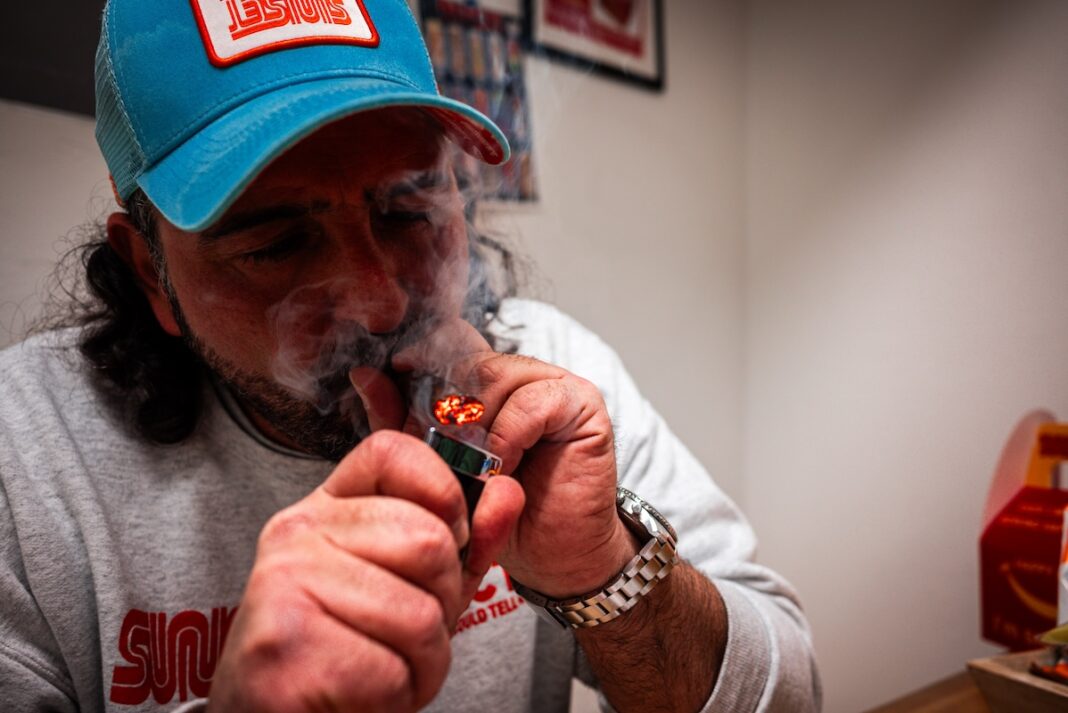
Standing in his weed factory, Ali Jamalian talks about the business of joints.
“What we’re seeing with rescheduling, it hasn’t hit yet,” says Jamalian, referring to a Dec. 18 executive order from President Trump directing federal agencies to accelerate rescheduling of marijuana.
Jamalian, born in Iran and raised in Germany, is the founder of Sunset Connect, one of California’s most widely distributed cannabis pre-roll brands.
Over decades, Jamalian has navigated the arc of a once-underground plant from garage-grows to regulated dispensary shelves. Like many of his peers in the industry, he says it remains unclear what this latest turn will mean for his business and for the country’s evolving relationship with weed.
“I’ve seen announcements like this from different administrations before,” notes Jamalian. “Until it’s law, it’s speculation.”

Reclassifying cannabis
Under the executive order, marijuana will go from being classified as a Schedule I controlled substance — the strictest category under the Controlled Substances Act — to Schedule III. The new categorization recognizes a drug’s medical use and carries lower regulatory burdens.
Legal experts describe the executive order as the most significant federal cannabis policy shift in more than half a century. Many see it as a potential catalyst for industry growth, tax relief, and expanded research.
The order does not instantly legalize cannabis, a $32 billion industry, however. Nor does it immediately change federal criminal or regulatory frameworks. Instead, it initiates an administrative rule-making process at the DEA, which must propose and finalize new regulations – a process that may stretch well into 2026 and beyond.
Video: ACoM reporter Christopher Alam takes a tour of the Sunset Connect facility with founder and CEO Ali Jamalian.
‘Since before we could tell’
The first stirrings of what would become Sunset Connect began while Jamalian was studying at San Francisco State University in the 1990s. Long before states like California legalized cannabis, he ran a successful side-hussle out of home garages across the city’s largely residential Sunset District.
All that was cut short when Jamalian was arrested in 1999 for possession in the Presidio, a former military base turned national park on the northwest edge of the city. His arrest on federal property meant likely deportation. Jamalian was put on probation and eventually re-litigated the case. It was tossed out after four years.
Jamalian moved back to Germany then returned to San Francisco in 2011 specifically to get back into the then-budding legal cannabis industry.

Sunset Connect’s original strategy covered all mediums of cannabis, from topicals and edibles to flower and concentrate. The company soon found its niche in pre-rolled joints.
Jamalian bet on a simple, affordable product: a single-gram indoor-grown joint priced at about five dollars. Package it in retro wrapper inspired by San Francisco’s Five Fulton bus line and you have the now-ubiquitous Fulton Fiver.
“A lot of people made fun of us,” he says. “They were like, ‘You really want to be the king of the two-dollar pre-roll?’ And we said yes, we really think that’s the market.”
The ‘Bud Light’ of weed
Today, Sunset Connect produces an estimated 30,000 to 35,000 joints per week, selling over 1.5 million units annually across approximately 300 dispensaries statewide.
“We automate packaging and sealing, but the actual pre-rolls are still made by hand in small batches,” Jamalian says. “That’s why they smoke well.”
The company has no formal marketing budget, relying instead on word of mouth and product consistency. The iconic hyperlocal packaging is designed by a friend’s partner.
“Using the Muni ticket design language was a no-brainer,” Jamalian says, referring to San Francisco’s public transportation system. As for the ubiquity of his brand, he likens it to another popular intoxicant.
“We’re like Bud Light to the retailers,” he adds. “We’re everywhere, and if people like it, they keep coming back.”

What rescheduling does (and doesn’t) mean
One of the most anticipated changes from reclassification is potential relief from Section 280E of the Internal Revenue Code. That provision currently prevents cannabis businesses from deducting ordinary expenses such as payroll, rent, and marketing, which translates to higher taxes.
For Sunset Connect, the impact would be “relatively modest,” says Jamalian. Retailers—as opposed to manufacturers like himself—stand to gain far more.
“The rescheduling news impacts us in ways that aren’t just about tax code,” says Nina Lay, co-owner of Fig & Thistle, a POC-women owned dispensary. “As a small retail shop, being able to finally write off marketing, security, payroll—that actually matters.”
She adds, “Cannabis taxation has been brutal; because of 280E, you get taxed on gross, not profit. If that changes, we could reinvest in our business, in our staff, in better experiences for customers.”
Fig & Thistle has built a reputation as a space not just to buy weed, but for community events and educational efforts. They installed a dedicated smoke lounge, and host neighborhood gatherings that help destigmatize cannabis in a social setting.
“I want people to see this as a normal business,” Lay says. “When we opened during COVID, some neighbors were unsure. But when people saw security out front, saw that we care about safety, they thanked us. We’re not some shady operation; we’re part of the neighborhood fabric.”
Lingering challenges
Both operators stress that rescheduling does not automatically solve cannabis banking. Traditional banks may feel more comfortable servicing cannabis businesses under Schedule III, but without explicit legislation, many operators will still rely on credit unions or workarounds for capital and credit access.
“We still can’t get SBA loans or traditional credit lines,” Jamalian adds. “We work with local credit unions, but they have very specific compliance programs. We literally run this business off debit cards. That’s not normal for a company doing millions in revenue.”
Lay adds that limited access to capital has quietly destroyed otherwise healthy businesses.
“A lot of brands that customers loved didn’t fail because demand wasn’t there,” she says. “They took really bad loans. That’s what wiped them out. I’m hoping rescheduling helps remove some of that stigma and gives cannabis businesses better financial options.”
And still, a thriving street market continues to add pressure to legal dispensaries, as increased regulation has led to increased compliance and taxes. Lay says some products, like cannabis-infused beverages, have been marked up as high as an extra $5 to cover the cannabis excise tax.
“I think when you raise the prices or the taxes too much, well, there will be consumers that just naturally go, ‘I just get to stretch my money out more. I’ll just roll the dice,’ you know.”

Medicine, research, and new markets
Rescheduling is expected to ease barriers to medical research. Universities, hospitals, and pharmaceutical companies could pursue clinical trials, dosage studies, and therapeutic product development that were previously off-limits or extremely burdensome under federal rules.
“For me, the de-scheduling brings a lot of excitement around research,” Jamalian says. “My wife has severe epilepsy. She used to have over 100 seizures a year. When she stops using cannabis even a little bit, her seizure activity goes up.”
Over the past decade, Jamalian developed a medical product for his wife; a dehydrated formulation derived from cannabis water that looks like nori seaweed flakes. He calls it Dragonglass, and he credits it with managing his wife’s condition. He has since patented the innovation, and is hopeful about the idea of researchers developing it further for clinical use.
“The only thing that really got me excited about rescheduling was talking to pharmaceutical companies about licensing my patent,” he says. “Now that research barriers are coming down, I think we’re going to see some very real science—isolating compounds for sleep, appetite, epilepsy. That’s where I think the future is.”
Cultural, generational shifts
Despite its growing popularity—daily marijuana use is now more common than alcohol—stigma persists, particularly in immigrant and older communities.
As an Iranian-American, Jamalian says it took years for his own family to come around. “I had to explain to my parents that cannabis isn’t heroin,” he says. “There’s a very strong stigma in the Middle East.”
He adds, “Now my mom asks me for pre-rolls for her friends—which is a trip compared to 20 years ago.”
Lay’s family came to the US fleeing political violence in Cambodia shortly before she was born. Growing up in a traditional immigrant environment came with extra weight, she says.
“The family expects something from you, to be so lucky as to be born in America,” she explains. “So to find myself in the weed business… it’s not necessarily what they had expected. But I think that explaining to my mom, like, ‘Hey, can you please watch the kids? I need to go to work.’ My mom understands it because it’s just like any other business. She gets it and she supports it now.”
Lay says neighborhood resistance softened over time as well.
“Some neighbors didn’t support us at first,” Nina says. “Today our customers look like everyone—from grandparents to professionals. That diversity is a testament to how far the culture has shifted.”
Chris Alam is a California Local News Fellow with the UC Berkeley Graduate School of Journalism.
*Correction: An earlier version of this story incorrectly stated that Jamalian returned to San Francisco after the statue of limitations on his case had expired. Jamalian had re-litigated the case, which was eventually tossed out. We regret the error.