


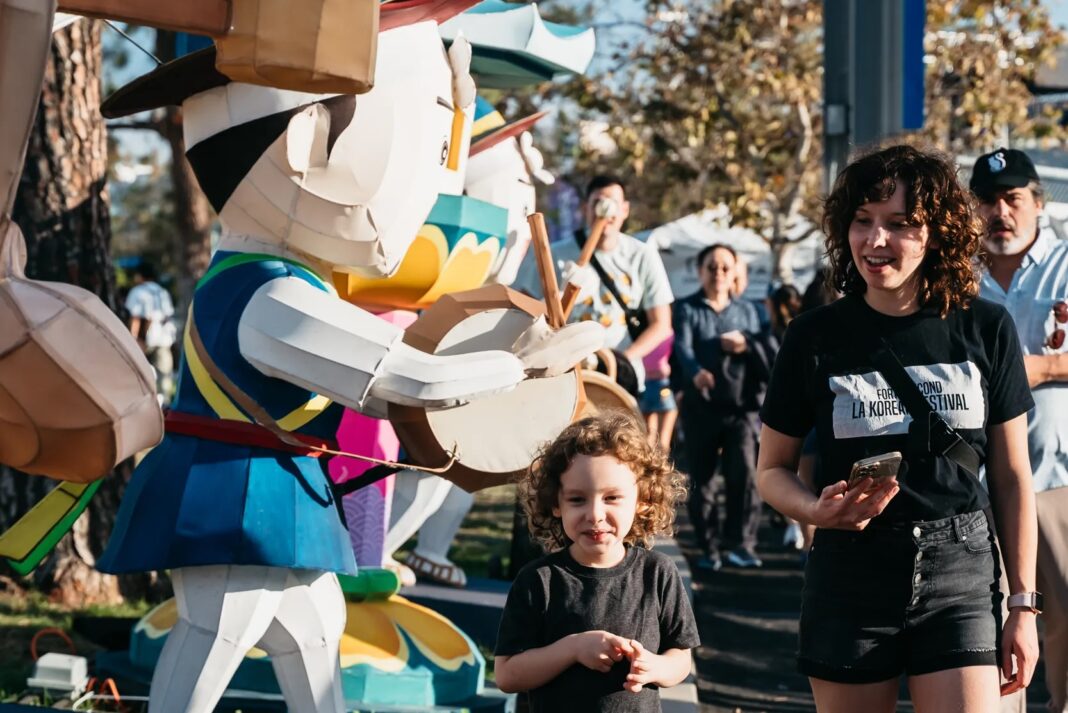
LOS ANGELES — On October 17, at Seoul International Park in Los Angeles, the second day of the city’s popular Korean Festival transformed the park from an everyday walking path into a vibrant performance venue.
Under shimmering stage lights, more than 30 seniors dressed in black leggings and T-shirts danced energetically, while backstage, other seniors — elegantly dressed in traditional Korean hanbok — waited for their turn to step onto the stage.
The performers were members of the LA Koreatown Senior & Community Center, including students from the Janggu-Korean drum class (instructor Hyeryun Choi), K-Senior Dance class (instructor Jungah Seo), and Korean traditional dance class (instructor Soohee Koh). After three months of preparation, they presented an hour-long performance to the public that afternoon. Their average age was 80. Yet on stage, age lost its meaning.
From the graceful hand movements of Korean traditional dance set to classical music, to a modern reinterpretation of the Janggu drum, to seniors moving joyfully to disco rhythms, Seoul International Park became a place where longing and memories accumulated over years of immigrant life were expressed through art.


Image credit Nicole Chang
The power of parks as open, civic spaces was evident from the festival’s opening day as well. On October 16, when a senior harmonica ensemble took the stage to perform the U.S. national anthem at the opening ceremony, the audience responded with spontaneous cheers. The moment—created by more than 40 senior performers—went beyond a simple pre-ceremony performance, symbolizing a shared community experience formed in a public space. Los Angeles Mayor Karen Bass, who attended the event, remarked that “the passion and culture of the Korean American community were powerfully conveyed.”
For these seniors, parks are not merely places for exercise or rest. They are open stages accessible to everyone—cultural spaces where personal stories are transformed into performances.
The harmonica ensemble had already drawn national attention earlier this year. In March, they performed the U.S. national anthem at the Los Angeles Kings’ “K-Town Night,” prompting a packed arena of spectators to sing along. Videos of the moment spread widely on social media, sparking widespread interest. Since then, invitations to perform at major games have continued, and the group has grown from just 12 members to 55.
Their performances will continue into the new year. The ensemble has already been invited to perform at the opening of an NHL game between the LA Kings and the New York Rangers on January 20 at Crypto.com Arena.

Hyunok Lee, president of the LA Koreatown Senior & Community Center, said he was proud that the group had been invited by the LA Kings for a second consecutive year. “Korean American seniors performing the U.S. national anthem on a European instrument like the harmonica symbolizes Los Angeles’ multicultural identity,” he said, adding that he was grateful the senior center could help promote cultural diversity in the city and would continue efforts to engage with the broader community.
Kwanil Park, executive director of the center, noted that the Janggu, Korean dance, and K-senior dance classes all began with just two or three students. “As performance opportunities increased, enrollment grew,” he said. Today, about 30 students are in the Janggu class, 40 in Korean dance, and 70 in the K-senior dance class. He added that competition for selection in each performance has become increasingly intense.
“Once a performance is scheduled, participants begin looking forward to it weeks in advance, much like children anticipating a school field trip,” Park said. “The opportunity to appear on a public stage gives seniors a deep sense of pride.”
He added, “Art is only complete when it meets an audience. Open spaces like Seoul International Park allow seniors to share the results of their learning with the broader community.”
The cultural role of parks is expanding across generations.
Nicole Han, 21, is one example. In July, she took the stage in a hanbok at the Lotus Festival held at Echo Park, representing the Korean American community and introducing Korean culture to the public.
Reflecting on her outdoor performance experience, Han said, “Exchanging energy directly with the audience in nature feels very different from performing indoors. Parks are where culture can reach people in the most natural way.”
A second-generation Korean American born in Los Angeles, Han is currently studying human physiology and public health at Boston University. While she aspires to become a dentist, she is also a dancer with more than 15 years of experience. “Performance and creative expression are an essential part of my life,” she said, adding that despite a demanding academic schedule, she leads a K-pop dance team and pursues modeling work.
These diverse cultural experiences played a significant role in her being selected as Miss Asia USA California at the Miss Asia USA pageant held last month at the Redondo Beach Performing Arts Center.

Han explained that she viewed Miss Asia USA not simply as a beauty pageant, but as “a gateway to opportunities across health, business, and civic engagement.” She said she wanted to show that Korean American women raised in the U.S. can pursue diverse interests without being confined to a single mold.
Over the next year, she will represent Asian Americans in California at various events. “Beauty doesn’t come from appearance alone,” she said. “It comes from gratitude, kindness, and strong character. Maintaining grace and integrity in any situation is what truly makes a woman beautiful, and that’s the value I hope to share.”
For Han, who often runs across a nearby bridge in Boston while taking in the city skyline, open spaces are more than transit routes. They are points where individual lives intersect with urban culture.
“Cultural events in open spaces like parks turn even passersby into participants,” she said. “For someone, that experience can become the first step toward expressing who they are.”
This story was produced by American Community Media in collaboration with the Laboratory for Environmental Narrative Strategies (LENS) at UCLA as part of the Greening American Cities initiative supported by the Bezos Earth Fund. Read more stories like this by visiting the Greening Communities homepage.