


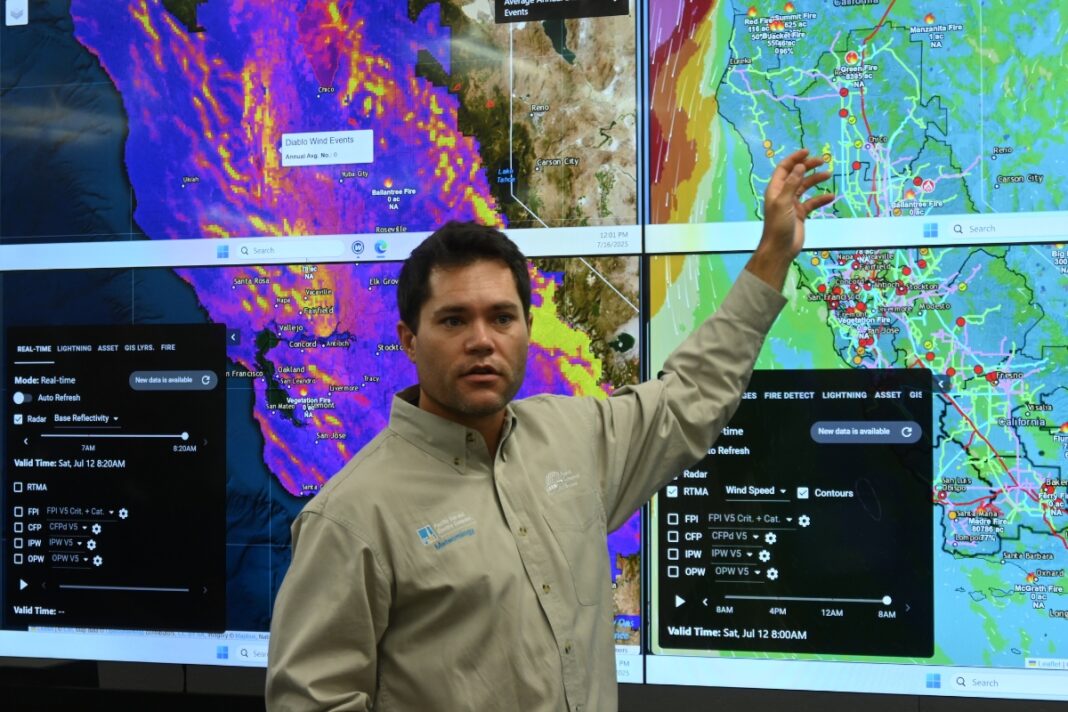
SAN RAMON, California — Using new artificial intelligence and machine learning models, PG&E is predicting an ‘above normal’ wildfire season, with more fires than in the past 30 years.
The company, which provides both gas and electricity to more than 16 million California residents, has over 2,000 weather stations and high definition cameras throughout the state, which can survey 90% of high-risk fire areas. “We’re getting new readings every 10 minutes,” said Scott Strenfel, Senior Director of Meteorology and Fire Science at PG&E. “And we’ve got a lot of layers of protection,” he added.
Climate Change
“Humans are altering the climate,” Strenfel stated, noting that higher levels of carbon dioxide are creating warmer temperatures across the globe. He also noted the disparate impacts to affluent versus low-income communities.
For Californians, temperatures are predicted to be a bit lower this August and September as compared with 2024, noted the meteorologist at a July 16 media briefing at PG&E’s Hazard Awareness Warning Center in San Ramon. The HWAC is staffed 24 hours a day, 7 days a week, and can detect a number of catastrophes, including wildfires, flooding, and earthquakes.

California has already experienced 4,758 fires this year, which destroyed more than 228,000 acres of land, according to Calfire. The state has earmarked over $31 million for wildfire prevention, said Shawn Boyd, Manager of Public Information & Media Relations at the California Office of Emergency Services, which serves as the state’s resource hub for wildfire mitigation.
Wildfire Alerts
The state has rolled out a new “hi-lo” siren to signal an impending wildfire. This special, alternating high-and-low tone siren signals an immediate fire threat to a neighborhood, said Boyd. “When you hear the hi-lo siren, it’s time to evacuate immediately,” he said. California uses two systems to monitor impending fires: the Fire Integrated Real Time Intelligence System — FIRIS — and the Wildfire Forest and Threat Intelligence Integration Center – WFTIIC. Both are used in collaboration with the National Weather Service.
Tom Smith, Senior Manager of Customer Emergency Planning and Operations at PG&E, discussed wildfire prevention efforts undertaken by PG&E, which manages 60% of forested areas in California.

Key to preparedness is undergrounding power lines, said Smith, noting that PG&E has taken on the task of undergrounding 10,000 miles of power lines. Overhead lines are prone to sparking fires, as they brush with vegetation, fall down, and many other factors. Undergrounding lines is expensive, but can reduce fire risk by 98%. In 2025 thus far, PG&E has undergrounded 330 miles of powerlines in 26 counties, said Smith.
PG&E also plans to remove or trim 1 million trees that are near power lines, said Smith. Cutting trees and hauling away debris is an important tool in wildfire mitigation, he said.
Preventive Power Shut Offs
As a public safety measure, PG&E shuts off power in wildfire prone areas when there are high wind forecasts, explained Smith. “We want to be proactive rather than reactive,” he said. If a power shutoff is expected, PG&E will notify local food banks. Erica Padilla-Chavez, Chief Executive Officer at the Second Harvest Food Bank of Santa Cruz County, discussed her organization’s partnership with PG&E.
Boyd noted the proposed cuts to NWS and to the Federal Emergency Management System, which — he said — will inhibit the state’s ability to manage fires and the aftermath. Los Angeles County is still dealing with recovery efforts after 5 separate fires raged through the region in early January. “FEMA has had such a drastic number of cuts, but its employees are really dedicated. They are continuing to do their work, despite the cuts,” he said.
Strenfel noted the staffing cuts at the National Weather Service. “We’ve lost a lot of really good knowledge. Our weather forecasting ability is compromised because of those cuts,” he said, noting that bulletins from the NWS have dropped from 4 per day to just 1.
”Our forecasting accuracy is just not there. Now more than ever, we need that accuracy, because we’re seeing more catastrophic flooding, and more wildfires,” said Strenfel.