


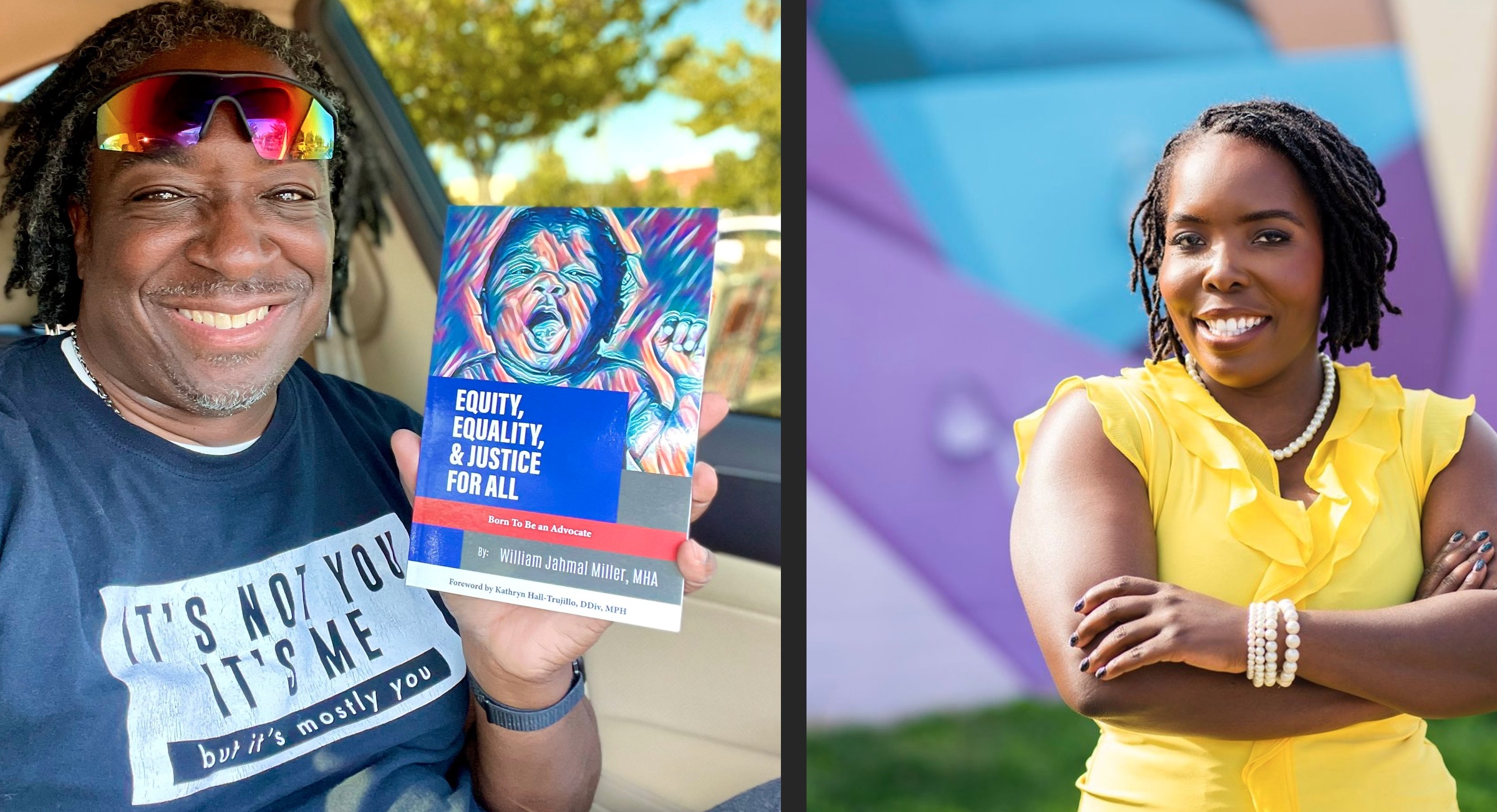
Above: William Jahmal Miller, MHA, the Chief Administrative Officer of Mercy Medical Group and Dr. Flojaune Cofer, an epidemiologist and 2024 candidate for Sacramento Mayor.
SACRAMENTO, Calif. — In the context of increased social unrest in recent years, addressing the impact of hate-motivated behavior on African American health is critical, physicians and community leaders shared at the 13th annual virtual Black Physicians Forum.
The event was hosted by Sac Cultural Hub Media Foundation and the UC Davis Health Office for Health Equity, Diversity and Inclusion. The forum featured keynote speaker Dr. Flojaune Cofer — an epidemiologist and 2024 candidate for Sacramento Mayor; and moderator William Jahmal Miller, MHA — the Chief Administrative Officer of Mercy Medical Group.
Social Determinants of Health and Trauma
Data show African Americans fare worse than their white counterparts across a range of health indicators, including infant and maternal mortality, as well as rates of asthma, diabetes and Alzheimer’s.
Social determinants of health are key to improving these trends across African American communities, said Dr. Cofer.
These determinants not only “include the physical factors in our environment, like safe housing, areas for recreation, and the availability of nutritious foods, and clean air and water, but also the social and economic factors like racism and poverty… job opportunities, and community or family violence,” she added.
She presented these determinants in terms of five domains: economic, educational, health, neighborhood and built environments, and social or community contexts. Although hate-motivated behavior can cross domains, it often fits most squarely in a social and community-based context, in terms of “the experiences that we’re having and our connection or disconnection with one another.”
African Americans remain among the groups most targeted for racially motivated hate crimes and hate incidents, both of which have been trending upward in recent years, according to data from the FBI.
The perpetuation and experience of hate-motivated behaviors is effectively examined through a lens of trauma, Cofer said. She defined trauma as an event or series of events “that are experienced by an individual as physically or emotionally harmful, or even life-threatening,” leaving a “lasting and perpetual adverse effect on their ability to function [and] their mental, their physical, their social, their emotional or spiritual well-being.”
Forms of Racism
Racism critically underlies hate-motivated behavior which adversely impacts the health of African American community members. Racism can take many forms beyond personally mediated actions involving “an acute stressor, an individual insult or a discriminatory act,” Coffer said.
Beyond this individual scale there’s cultural racism, “which determines which group qualities and characteristics are valued or devalued” in a society; internalized racism, “when we accept the negative things that are said about our own abilities [and] our worth”; and institutional racism, which are “discriminatory race- or class-based policies or practices that can be formal or informal, that can continue to perpetuate themselves long after they’re formally in place because of the way that they shape the foundation of how we operate.”
To discuss hate-motivated behavior, she continued, is to discuss the intersection of two or more of these forms of racism, and the way in which economic, educational, health, environmental, and social systems amplify or mitigate the harm caused by this racism.
Forms of Hate-Motivated Behavior
Coffer went on to discuss various forms of hate-motivated behavior, which she defined as intentional “verbal or nonverbal expressions of discrimination.” Examples include hate speech in-person or on social media; hate crimes directed toward individuals based upon their actual or perceived racial group; and societal hate-based discrimination in the form of white supremacist ideology.
These forms of hate-motivated behavior against African Americans are a “public health threat … shaping the context in which we’re living,” she said. When perpetrators of this behavior act “in ways that are threatening … with impunity, that really challenges our ability to be able to be healthy, because one aspect of safety is our emotional safety [and] our physical safety. And when that is violated, we are deeply challenged [against being] able to live the lives that we should be able to live.”
Liberation and Healing
Just as each of the above levels of “dehumanization and distress” contribute to the institutional systems which encourage these behaviors, so does every level of “liberation and healing,” said Coffer.
To challenge hate-motivated behavior from the perspective of public health, she added, practitioners and policymakers “need to be able to call out as a sector that this is wrong, that this is harmful, and that there are serious consequences to it. And when we don’t do that, that’s not a neutral position; it is … offering an on-ramp for a risk factor that we know is harmful.”
“We need to think about how we center the people who are most harmed” by hate-motivated behavior, she continued, and “the ways in which we are making sure that we are providing comprehensive and appropriate services, especially related to the assessment of our physical and mental well-being, and making sure that we are doing so in a way that affirms … that what they’re experiencing is a very normal response to abnormal conditions.”
Otherwise, Coffer concluded, the above-mentioned forms of hate-motivated behavior can be reinforced through personally, culturally, and institutionally perpetuated racism, “and then we begin to think that, once again, something is wrong with us, that we are the problem, instead of being able to rightly identify the external cause of some of the things that are happening.”

This resource is supported in whole or in part by funding provided by the State of California, administered by the California State Library in partnership with the California Department of Social Services and the California Commission on Asian and Pacific Islander American Affairs as part of the Stop the Hate program. To report a hate incident or hate crime and get support, go to CA vs Hate.