



When Ester Muñoz woke on New Year’s day of 2026, she was full of plans for the new year, never imagining that she would end the day in detention facing deportation and the loss of everything she’d worked for over the past 6 years.
She also never believed that it would all come at the hands of a man with whom she had shared the new life she was building in Seattle.
“We were up late the night before, so we got up around midday,” recalled Muñoz, who was with her boyfriend at the time. “I suggested we go out to eat. We headed toward Bellingham (about 90 miles north of Seattle) … If we couldn’t find a restaurant, we’d come back home.”
Instead, the couple found themselves at a Customs and Border Protection (CBP) station along the US-Canada border.
‘I was terrified’
Born in Argentina in 1973, Muñoz first came to Seattle on a tourist visa in December of 2020, when much of the world was on Covid lockdown. Argentina’s economy at the time was in a deep recession, having shrunk by as much as 14%.
“While there, some friends offered me a job,” said Muñoz, speaking from her home in Argentina, “so I decided to stay.”

She soon found herself working three jobs in Seattle: as a janitor in a local school for adults, at a restaurant, as well as starting her own business selling empanadas and Argentinian food.
Her decision to stay also meant that Muñoz began a long-distance relationship with her then-boyfriend, Raúl (we are not using his real name out of concerns for Muñoz’ safety). The pair met in Argentina almost two decades earlier. Raúl, 68, would travel from Buenos Aires to spend months in Muñoz’ Seattle apartment during annual visits.
As they drove that afternoon, she remembers suggesting places they could stop to eat. But Raúl ignored her and continued driving, she recalled. “After about an hour and 20 minutes on the road, I panicked, realizing that we were at the [U.S.-Canada] border.”
It was too late; the pair had crossed over into Canada. After turning around they were stopped by CBP agents and escorted into a nearby office.
“I was terrified. My boyfriend had no problem. He showed his tourist visa, and his return ticket to Buenos Aires for March. They let him go quickly. All I had to show was a Washington State driver’s license,” Muñoz said.
Her fingerprints were taken after which she was told to provide a sworn statement. Muñoz ended the first day of 2026 locked in a cubicle with a cement seat for a bed, a mattress and a blanket.
“I knew they would detain and deport me,” she said, “but I wasn’t aware of what I was about to live through.”
‘Full of anguish’
Muñoz remembers feeling disoriented that first night in detention. “It wasn’t me who was there; my body was there, but not my mind.”
After about two hours, she was handcuffed and put in a vehicle to be transported to the Northwest Detention Center in Tacoma, an Immigration and Customs Enforcement (ICE) jail operated by the private group GEO.
“When they came, I began to cry. I couldn’t speak… I was full of anguish,” she said. At the detention center, she found herself alongside some 200 other women, all, like her, slated for deportation. “They helped, they hugged me, encouraged me,” she said of her experience.
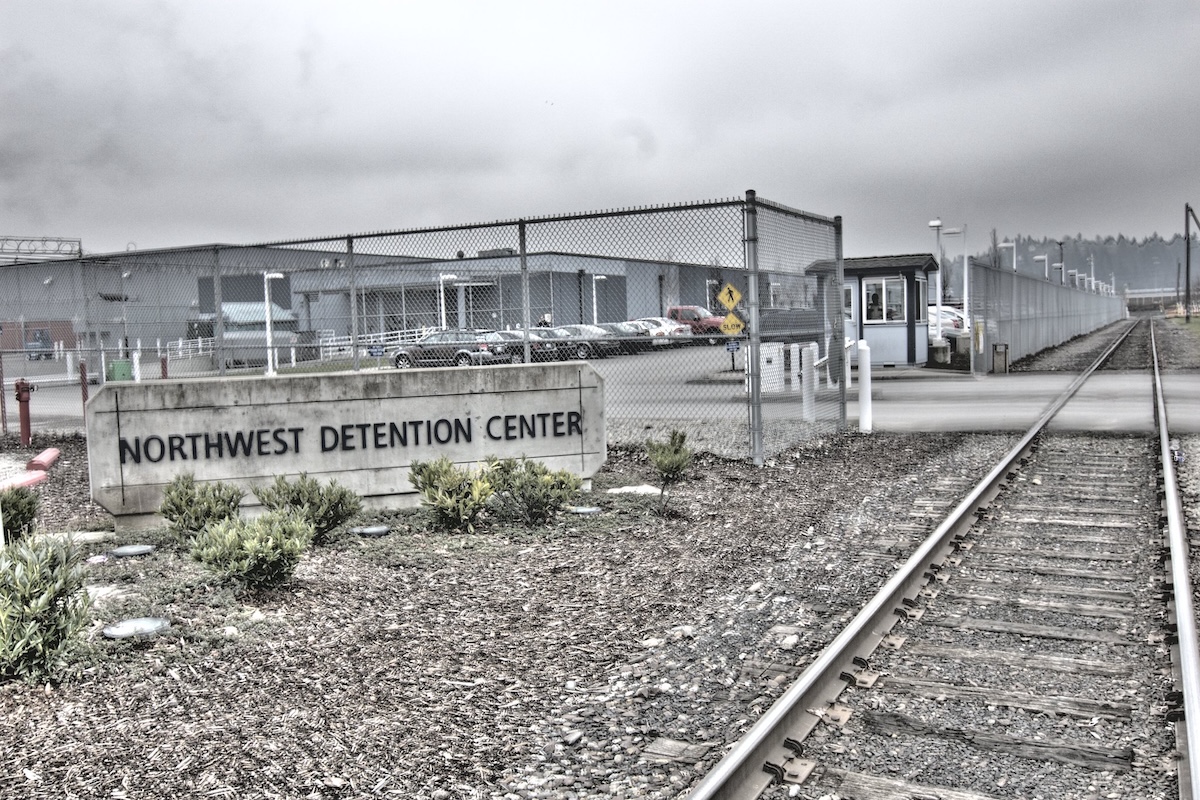
While precise figures are unavailable, estimates from earlier this year suggest that women make up approximately 40% of the more than 70,000 people currently in immigrant detention. Many, including pregnant women, face medical neglect, as well as physical and sexual violence, and the trauma associated with family separation.
Undocumented women in the US are also more vulnerable to exploitation, often at the hands of their partners, for fear of deportation and being separated from their children.
Muñoz says she met women from Russia and Cuba who had been held for as long as 20 months as officials sought third countries where they could be sent. (The US has no diplomatic relations with either Cuba or Russia.)
It was another 7 days before Muñoz was able to reach her boyfriend. The couple eventually hired a lawyer, and despite paying $5,000, Muñoz remained in detention. On January 31, she was informed that she would be deported to Argentina.
Raúl, however, refused repeated requests to bring her Argentinian passport to the detention center. “He was rude, told me he didn’t want to hand over my passport, and gave me excuses that the lawyer had it,” she recounted. “My friends intervened… They forced him to go to the detention center and bring the document.”
‘I cried a lot’
The coming week would see Muñoz transported halfway across the country and back over five different flights, spending nights in detention centers where conditions were dismal.
“On January 31, they put several women on a plane, but instead of going to Argentina, they took us to El Paso, Texas, where we spent the night on the floor in makeshift rooms made of tarps. Before 24 hours had passed, they put us on another plane,” she explained.
Then, on another aircraft, they transferred her to Arlington, Texas, where she says they were locked up in overcrowded conditions in small cubicles.
“It was filthy there, and I was desperate. I cried a lot. I thought they were going to leave us in that place for two or three years. They gave us a soggy sandwich and an apple or a tangerine.”
She says her appetite vanished; she felt a knot in her stomach. She was terrified.
Muñoz later boarded a third plane, this one bound for Fresno, California. “The guards there were Latino, they were kind, and they let us use our phones. I felt calmer, and I fell asleep, thinking that now they were finally sending me back to Argentina.”
The next day Muñoz boarded a fourth plane. After several hours of flying she opened her eyes as the plane began its descent.
“I saw Mount Rainier,” she recalled, the iconic summit 90 miles south of Seattle. “I’m back,” she thought to herself, considering that perhaps her lawyer had managed to win her release. “I felt some relief.”
‘Panic attacks’
In total, Muñoz spent six days flying, from Seattle to Texas, from Texas to Arizona, from Arizona to California, and from California back to Seattle.
Immigration lawyer Alex Gálvez says Muñoz’ treatment is not an accident but is intended to compel immigrants to self deport. “When people find out about this story, they’ll say, ‘If I have to go through all this for a voluntary deportation, I might as well deport myself.’”
Immigration attorneys also contend that ferrying detainees to far flung detention centers limits their ability to provide legal aid.
That was the case for Badar Khan Suri, a Georgetown professor originally from India who was subjected to a week-long ordeal spanning several states and culminating in a rural jail more than a thousand miles away from his home in Northern Virginia. The ACLU is currently suing the government on Suri’s behalf.

While ICE claims the practices are not punitive, that’s small comfort for Muñoz, who says that more than a month of confinement began to take its toll.
“When they brought me back to the Tacoma Detention Center, I had two panic attacks. Sitting on the bunk, I started rocking, crying, and feeling claustrophobic. A staff member came over to give me water and held my hands, trying to calm me down.”
On Wednesday, February 18, staff at the center informed her that she would be leaving for Argentina on Friday, February 20, on a commercial flight. That morning, two ICE agents took her to the airport, put her on a flight from Seattle to Houston, and from there she boarded another plane from Houston to Buenos Aires.
“When they left me in the care of the flight crew, they told me I was free.”
Disbelief
Muñoz left behind a fully furnished apartment, two cars, a motorcycle, and $20,000 in savings. She had given Raúl power of attorney during her detention, hoping he could sell her belongings and withdraw her money. When he finally returned to Buenos Aires, he handed her $92.
“When I asked him for the money, he threw me to my knees and hit me on my head. I had to go to the hospital,” she said.
Thinking back to that fateful New Year’s Day, Muñoz now believes Raúl deliberately crossed into Canada, knowing that her tourist visa had expired. “I have no doubt that his intention was to leave me locked up in ICE detention so he could keep my money.”
Muñoz has since contacted a domestic violence NGO in Argentina, which is helping her file a lawsuit against her former partner.
As for her time in detention, she says that as traumatizing as it was, it pales in comparison to the sense of betrayal that she felt at being turned over to immigration by a man with whom she had built a relationship of more than 20 years.
“I never thought it would happen,” she said.
This story was first published in the print edition of the Spanish language newspaper, La Opinión. It was produced as part of Aqui Estamos/Here We Stand, a collaborative reporting project of American Community Media and community news outlets statewide.