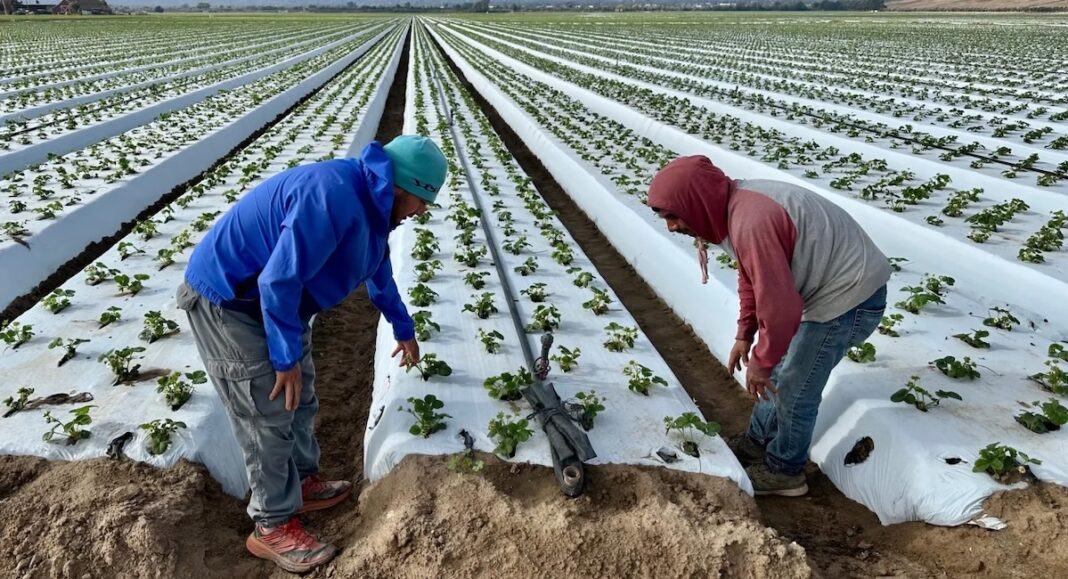
OXNARD, Calif. – One month after federal immigration agents conducted the largest enforcement operation in California history, targeting farms along the state’s Central Coast, immigrant workers here say they continue to live in fear
“We are very afraid,” said Julio (not his real name), a local farm worker. “The field where we work is close to the immigration office, and they can come and take us away any time.”
On July 10, Immigration and Customs Enforcement (ICE) agents descended on the towns of Camarillo and Carpinteria, arresting 361 individuals, according to the Department of Homeland Security (DHS). One farm worker, Jaime Alanis, died after falling from a 30-foot ladder while attempting to flee.
Many of those detained live in Oxnard, an agricultural community and immigrant enclave some 60 miles north of Los Angeles.
“We saw ICE patrols pass by on their way to La Tomatera,” said Julio, 40, recalling the events of that day. La Tomatera is the name locals use for Glass House Farms, a licensed cannabis grower that operates two fields, one in Camarillo and another in Carpinteria. Both fields were the target of the ICE raids.
“Despite our fear, we didn’t stop working,” Julio said, adding, “Four friends of mine were caught.”
A father of four, Julio and his wife have worked in the strawberry fields in and around the Central Coast for more than two decades. Originally from San Martín Peras, a small town in the mountains of Oaxaca, he speaks Mixtec as his native language.
Eighty percent of Oxnard residents work in the fields; 50% are Indigenous Mixtec and Zapotec from Oaxaca and Guerrero. In Santa Paula, a city in Ventura County, about a 20-minute drive south from Oxnard, the community is largely Purepecha, Indigenous people from the state of Michoacán, Mexico.
Like others here, Julio and his wife have come to rely on services provided by the non-profit Mixteco Indigenous Community Organizing Project (MICOP), which notifies residents of pending operations in the area.
“They help us find out what’s happening. That’s the only way we have to protect ourselves,” said Julio, adding that he and his wife have also started discussing plans for care of their children, the youngest two of which were born in the U.S., in case they are detained.
“There’s a woman who takes care of my children. I always tell her that if anything happens to us, she should take care of them. I’m not afraid to return to Oaxaca. I worry about my children,” he said. “It’s very sad. All this makes me very sad.”
‘Things got ugly’

Félix Vázquez López is a 42-year-old Mixtec farm worker and father of four children, all born in California. He says during the presidential election he believed Donald Trump was the better candidate, and that he might even go so far as to grant work permits to migrant farm workers like him.
He no longer feels that way.
“Things got ugly. We’re always scared. We don’t know who’s waiting for us outside the house. When we leave in the morning, it’s dark. We don’t know where they’re coming from,” he said. “When we go to the store, we head straight back and stay inside.”
Vázquez, who emigrated from San Miguel de las Peras, Oaxaca, has worked the same fields alongside his wife for decades, but says the pair are now considering working on different fields.
“We work on the same strawberry farm. We go to and from work together in the same car. If they catch us, they’ll take us both, and then who’ll be left with the kids,” he said.
According to Jorge Toledano, a community organizer with MICOP, the uncertainty makes the situation that much more difficult.
“One day Trump might say not to touch the farm workers, but then agents raid stores, bakeries, and places where people go to buy their things. Those are the same people who work in the fields. So even if ICE doesn’t go to the fields, they do go to where the workers shop,” he said.
“Activists have a network that monitors ICE. The way they’ve been operating is that they wait for those with a deportation order outside their homes; or if you go to the courthouse in Ventura, they’ll grab you there,” explained Toledano.
The first ICE attack came on June 10, one month prior to the July raids, when agents entered strawberry fields and some agricultural warehouses in Oxnard.
“That day, the farmers called MICOP to ask if they were arresting anyone. I said no,” recalled Toledano, explaining that ICE agents visited about nine ranches in the Oxnard area, but because they didn’t have a search warrant, they couldn’t enter. Some activists estimate that around 35 immigrants were arrested in the surrounding streets.
Toledano says that was the prelude to what would come one month later.

A light in the darkness
“Anything that happens, whether workers aren’t paid, are fired, or are involved in a crime, everything is reported here,” said Toledano, describing the role that MICOP has come to play in the area.
Much of the organization’s work these days is focused on informing residents of their rights.
“We help them fill out a family plan so they can talk to their partners and decide who they will leave their children with in case of an arrest; and when they return to school, we want them to update their information at the schools,” noted Toledano.
The common denominator across all families, he adds, is fear.
“There are people who don’t want to leave their homes; for those affected by the Glass House and the June 10 raids, we have food supplies,” he said.
For those detained, MICOP offers interpreters in both Spanish and Indigenous languages. “We have a detained person who only speaks Mixtec, and his lawyer needs someone to interpret for him.”
Still, despite their best efforts, Toledano admits it is hard to offer words of encouragement under the current climate.
“We just ask them to have strength and courage, because our farmers are brave people who are fighting and making this country great. We tell them that if there’s an opportunity to tell their stories, they should speak out, even though we know the fear is strong and only necessity makes them go out to work.”
Vázquez says that despite the fear of being detained, he and his wife continue to go to work, though they always keep an eye on ICE’s actions through MICOP’s radio broadcasts or on Facebook.
“We have no choice. If we stay home, we don’t have money for rent or food,” he said, adding it gives him some peace of mind knowing his oldest daughter is now 18. “They already know that if we were to be gone, they can seek help and take care of each other.”
As for Trump, he says that if he were standing in front of the president, “I would invite him to come and see how we’re working. Days of rain, we’re there; days of snow, we’re there; no matter what the weather, we’re harvesting.”
And when we’re not there, who’s going to farm the land, he asks.
“Some American citizens say we’re taking their jobs, but since I arrived in Oxnard more than 20 years ago, I haven’t seen Americans working in the fields, picking strawberries, cutting celery, or lettuce,” said Vázquez.
“We’re not everything the president says we are. We’re not murderers, drug traffickers, criminals. None of that. We just want to work and have your support to harvest the crops that come to your tables.”
This story was first published in Spanish by La Opinión. It was produced as part of Aquí Estamos/Here We Stand, a collaborative reporting project of American Community Media.