


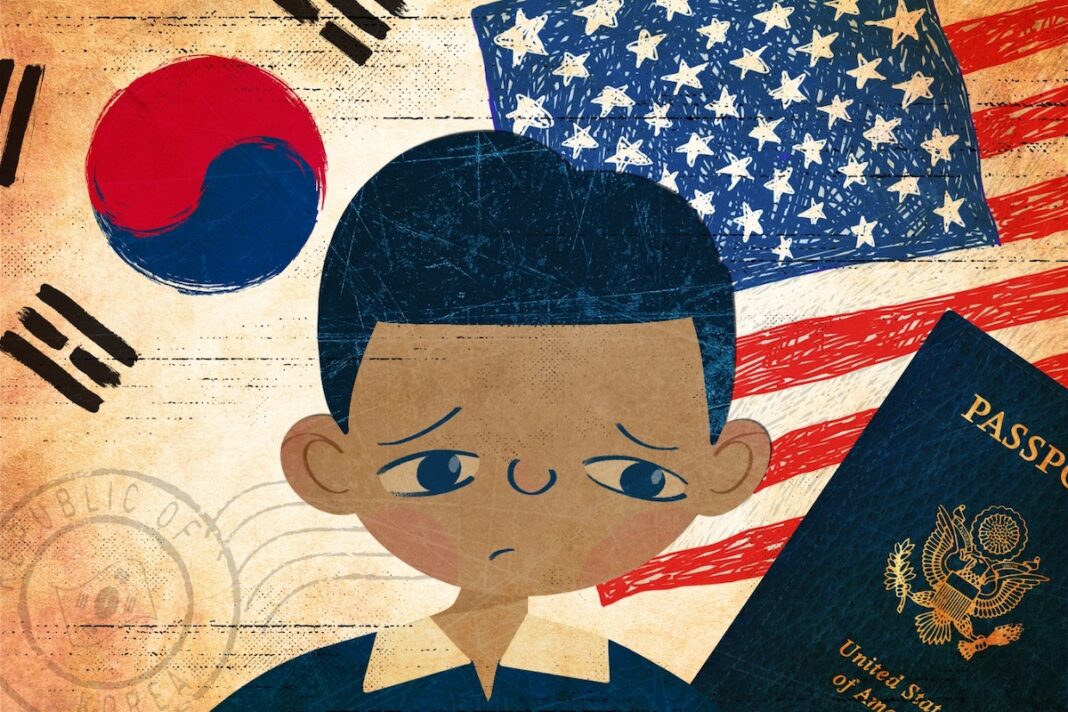
Emily was just three months old in 1964 when she was adopted by a Minnesota family. Emily (we are only using her first name) is undocumented and fears she may be deported to South Korea, a country she has not seen since birth.
She is among thousands of Korean adoptees in the US who never attained citizenship and are now vulnerable amid the Trump Administration’s mass deportation campaign.
According to Emily, who now lives in Los Angeles, her adoptive parents failed to complete her citizenship paperwork before she reached adulthood. The family eventually fell apart, after which Emily fell into legal limbo.
Now in her 60s, Emily says she faces restrictions in renewing her driver’s license and accessing health insurance.
Emily’s case is not unique. Her story is the outcome of a system that brought thousands of children to the United States and then failed to ensure they belonged to it.
Many, like Emily, face barriers in employment, licensing, and public benefits, while individuals with certain criminal convictions could be subject to deportation proceedings.
A lifetime lived as Americans
Following the end of the Korean War hundreds of thousands of Koreans were sent abroad as infants. A 2025 report by South Korea’s Truth and Reconciliation Commission cited widespread violations in the country’s international adoption program, ranging from falsified documents to child switching and lack of parental consent.
According to a report from the Overseas Koreans Agency, as of 2025, approximately 17,547 Korean adoptees in the United States still have no U.S. citizenship to show for a lifetime lived as Americans.
According to data compiled from South Korean government overseas adoption records, about 114,536 Korean children were adopted to the United States between 1953 and 2023. Korean authorities say 95,814 of those adoptees have been confirmed to have obtained U.S. citizenship through notifications provided by the U.S. Department of State or adoption agencies. The remaining roughly 17,500 cases reflect adoptees whose citizenship status was not reported to South Korean authorities.
Officials say the figure does not necessarily represent adoptees without U.S. citizenship because reporting between the two countries is not always complete, and some adoptees may have naturalized without the information being relayed to the Korean government. Based on available records, at least 84.5% of Korean adoptees in the United States have obtained U.S. citizenship.
Kim Park Nelson is a professor at Winona State University in Minnesota. “I know there are approximately 42,000 Korean adoptees who were likely not covered by the Child Citizenship Act of 2001. Most of these adoptees were naturalized and are U.S. citizens,” Park Nelson said via email.
A majority of Korean adoptees in the US live in Minnesota, according to the National Korean American Service & Education Consortium (NAKASEC), which puts the number in the state at approximately 15,000, nearly half of Minnesota’s entire Korean population.
Operation Metro Surge
As of a month ago, Minnesota was the site of one of the largest immigration enforcement operations in US history. More than 2,000 federal agents from Immigration and Customs Enforcement (ICE) and Customs and Border Patrol (CBP) flooded Minneapolis and surrounding areas.
For Korean adoptees in the state, the 2.5-month period during which agents roamed Minneapolis streets was fraught with fear and anxiety.
Park Nelson says concerns about racial profiling were particularly intense during Operation Metro Surge.
“There is a growing perception that simply having an Asian face draws scrutiny,” Park Nelson said, pointing to a Supreme Court ruling allowing officials to use race as a factor in immigration stops. “If enforcement actions rely on racialized assumptions about who ‘looks’ like an immigrant, then even U.S. citizens could become potential targets.”
In response, Korean adoptees — including naturalized and U.S.-born citizens — began carrying passports when leaving home and organizing emergency contact plans. Others have reportedly discussed safety protocols with their children in case of unexpected encounters with authorities.
In February the Trump Administration announced it was drawing down the operation in Minneapolis. The announcement came amid a growing nationwide outcry following the deaths of two US citizens at the hands of federal immigration agents.
‘Worse than Covid-19’
Still, community leaders say a significant federal presence remains, and concerns have not subsided.
According to Park Nelson, many Korean adoptees grew up in white households and may have limited connections to immigrant communities or access to immigration-related information.
“Some entered adulthood without fully understanding what documentation was required to confirm their legal status,” she said. “As a result, news of enforcement activity alone can trigger intense fear.”
Park Nelson pointed out that she personally checks reports of ICE activity before leaving home and carries her U.S. passport as a precaution.
The enforcement operations also affected local businesses and community life. Rev. Isaac Lee, who operates a homeless shelter in St. Paul, said during a recent online press conference that ICE agents entered the shelter’s parking lot on at least two occasions.
“Since then, residents have been on edge,” Lee said. “Some families keep emergency bags packed in case they need to leave quickly.”
Lee added that several Korean American business owners have reported sharp declines in revenue following the raids, and church attendance has dropped. “In some respects, it feels worse than during the COVID-19 pandemic,” he said.
Legislative efforts stall
Yonghoon Han, organizing director with NAKASEC, said his organization is expanding legal education seminars and working with adoptee advocacy groups. “We are also supporting broader Asian American community solidarity efforts,” he said.
More than two decades ago U.S. lawmakers passed the Child Citizenship Act of 2000, which granted automatic U.S. citizenship to internationally adopted children who met certain criteria. However, adoptees who were 18 or older at the time the law took effect were excluded, leaving some without automatic citizenship.
“Many who were adopted as infants do not even realize they lack citizenship,” said Han.
In September lawmakers introduced the Protect Adoptees and American Families Act. The bill was co-sponsored in the House by Rep. Adam Smith (D-Wash.) and Rep. Don Bacon (R-Neb.), and in the Senate by Sen. Mazie Hirono (D-Hawaii) and Sen. Susan Collins (R-Maine).
The legislation seeks to provide a pathway to citizenship for intercountry adoptees who were excluded under previous law, but it has yet to advance. As of late 2025, the bill has been referred to the House Judiciary Committee.
“Enforcement officers do not distinguish whether we speak Korean or Chinese. To them, we appear as immigrants,” Han said. “The Korean community can no longer assume it is insulated from these actions. We must stand in solidarity with other communities, including adoptees.”


As an adoption scholar who was heavily cited as a source in this article, I strongly object to the characterization of the number of Korean adoptees without US citizenship. While the cited number (17k+) accurately reflects past figures reported by the Korean government reports in terms of how many adoptees have relinquished Korean citizenship, there are many reasons why this number should not be used as a proxy for Korean adoptees without US citizenship. Based on my research and demographic data collection over the past 23 years as a scholar of Korean adoption, I know there are approximately 42,000 Korean adoptees who were likely not covered by the Child Citizenship Act of 2001. Most of these adoptees were naturalized and are US citizens. However, this group would also include most undocumented Korean adoptees, both because most adoptees who came after this time would have been conferred citizenship through the Act and also because adoptions from Korea after 2001 dropped off to under 10% of the total number of transnational adoptees to the US. Claims made in in this article would mean that almost 40% of Korean American adoptees in this group is undocumented. This is simply not borne out in our community experiences; were this the case citizenship would have been the most important issue in our community for decades. We have found that while undocumented adoptees certainly exist, and their challenges are considerable, they are few in number, nowhere near the numbers this article is claiming. While the number reported by the Korean government may well be accurate according to their records, this assumes there is consistent and accurate reporting between the US and South Korea updating citizenship, and there certainly is not. This is data that Homeland Security has not even been willing to report domestically (I know because I have FOIAed it), so I very much doubt that accurate counts are being sent back to adoption sending countries. I surmise that because almost all Korean adoptees are subjected to a name change upon adoption, and because different administrations over time may have different priorities when it comes to immigration reporting, far fewer adoptees are taken off the South Korean citizenship rolls than should be. I was very clear in the public statement I made in the press conference the author attended that the vast majority of Korean adoptees in Minnesota are US citizens and this remark was completely ignored. To suggest that there is a large population in Minnesota or anywhere else in the US subjects the US Korean adoptee community to heightened suspicion of undocumented status at a time when ICE is acting with impunity and is harmful to our community.