


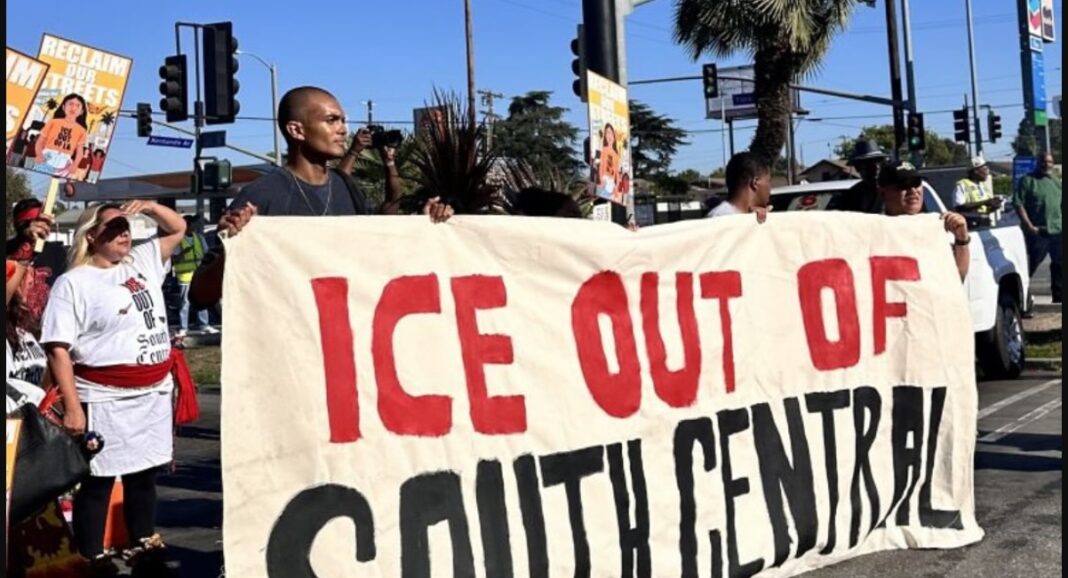
LOS ANGELES — “We are neighbors. And we will raise our voices to protect our neighbors who live among us.”
On July 29, from 4 PM to around 7 PM, the streets of South Los Angeles echoed with chants of solidarity and support as community members gathered for “Reclaim Our Streets – South LA,” a public action to defend their neighbors and resist aggressive immigration enforcement.
Residents who attended the event shared food, listened to one another’s stories, and strengthened bonds within the community. They then marched to the symbolic intersection of Florence and Normandie Avenues, demanding an end to immigration raids and pledging to stand with those being targeted and displaced.

The event was hosted by SCOPE (Strategic Concepts in Organizing and Policy Education), an organization that builds grassroots power to advance the rights of low-income, immigrant, women, queer, Black, and Brown communities. Several Black and Latinx organizations also participated in calling for an end to indiscriminate raids and deportations carried out by U.S. Immigration and Customs Enforcement (ICE).
Leslie Johnson of the Community Coalition spoke about the disturbing shift in daily life in South LA. “At some point, people just started disappearing from the streets. Street vendors are no longer around, and kids don’t feel safe playing in the park anymore,” she said, illustrating the fear that has taken hold in the community.
She stressed the need for collective action: “We must all speak up and fight together for our neighbors who can no longer enjoy the everyday freedoms they deserve because of invisible fear.”
Iretha Warmsley, a South Central resident and SCOPE member, added, “We may not speak the same language, but we are a community that takes care of each other.” She emphasized that this gathering was a true moment of “solidarity in action.”

Warmsley went on to say that ICE enforcement is not merely policy but part of a systemic pattern of violence that leads to mass deportation and incarceration, warning that such actions ultimately deepen poverty and fuel criminalization.
SCOPE is currently providing groceries, hygiene supplies, and emergency financial assistance to immigrant families whose livelihoods have been threatened by enforcement actions.
During the demonstration, participants marched through the streets for about an hour, chanting, “Stop the raids!” Some drivers honked their horns in support as they passed by. To ensure safety, organizers deployed approximately 40 volunteers along the roads to guide marchers and manage traffic.

A 54-year-old Black resident named Joseph shared his concern: “I’ve lived in this neighborhood for over 50 years, but I’ve never seen our community fall apart like this. Immigrants are our neighbors, just like us. These random raids must stop.”
Rachael Coracero, who was born and raised in South LA, reflected on her family’s story:
“My parents are immigrants who have worked harder than anyone to support our family. Deporting people who have lived here for decades just because of their status is not only an attack on immigrant families—it’s an attack on the whole community.”
She continued, “Immigrants are part of this community. If we want everyone to return to normal life, the raids must end, and the militarized presence in our neighborhoods must be withdrawn.”
This story was produced as part of “Aquí Estamos/Here We Stand,” a collaborative reporting project of American Community Media and ethnic/community news outlets statewide.