


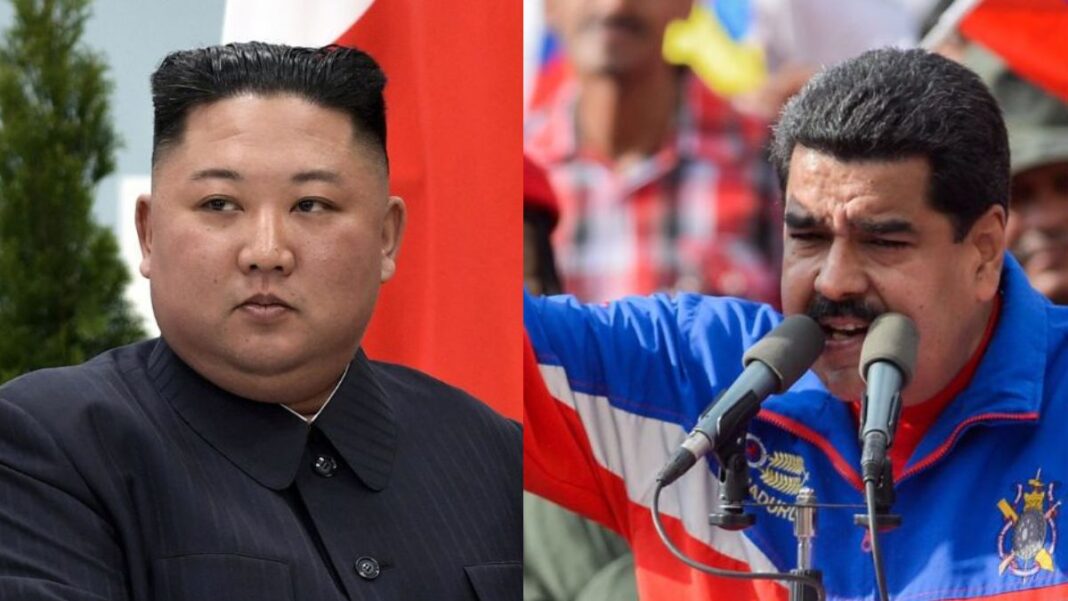
The United States’ Jan. 3 operation to capture Venezuelan President Nicolás Maduro has delivered a sharp political and psychological shock to North Korea, despite the absence of any direct military confrontation.
Pyongyang has chosen near-total silence in its domestic media coverage of the incident, a decision widely interpreted as a calculated move tied to regime stability rather than routine diplomatic caution.
North Korea has long relied on solidarity with anti-U.S. states as a pillar of its ideological legitimacy. Venezuela, which has maintained cooperative ties with Pyongyang through oil and arms exchanges, falls squarely within that category.
The spectacle of a close partner’s leader being forcibly detained by the United States is therefore not a distant foreign affair for the North Korean leadership, but a deeply unsettling precedent.
The Politics of Non-Coverage
According to reporting by the Dong-A Ilbo, North Korea issued a Foreign Ministry statement condemning Washington yet deliberately avoided covering Maduro’s capture in major domestic outlets such as Rodong Sinmun and Korean Central Television. Analysts view this omission as a strategic judgment: public dissemination of the event could undermine internal confidence in regime security.
Experts note that Pyongyang is acutely wary of allowing its population to absorb the message that the United States is willing—and able—to physically remove the leaders of anti-American authoritarian states if it deems it necessary. In North Korea, information control is inseparable from power maintenance, and the Maduro case may have been judged too destabilizing to expose to public scrutiny.
Military Signaling as Immediate Response
North Korea’s unease appeared to translate quickly into military posturing. On January 4, the day after news of Maduro’s capture broke, Kim Jong Un personally oversaw a test launch of the hypersonic missile Hwasong-11ma, underscoring the regime’s nuclear and missile capabilities. The Chosun Ilbo reported that Kim ordered the further enhancement of “nuclear war deterrence,” interpreting the launch as a political signal rather than a routine weapons test.
The move served dual purposes: reinforcing internal cohesion by highlighting leadership resolve and military strength, while externally reaffirming deterrence against any perceived U.S. inclination toward regime-change operations.
The Lesson of ‘Leader Without Deterrence’
Security analysts quoted by the Chosun Ilbo characterized Maduro’s fate as a stark illustration of what can happen to an authoritarian leader lacking sufficient military and nuclear deterrence. This framing reinforces Pyongyang’s long-standing narrative that nuclear weapons are indispensable to regime survival, not merely bargaining chips in negotiations.
South Korean public opinion reflects similar anxieties. Polling cited in local media indicates that while a majority supports Washington’s hardline foreign policy, many simultaneously fear heightened instability on the Korean Peninsula. North Korea is likely drawing comparable conclusions, interpreting U.S. actions through the lens of potential regime vulnerability.
Reinforcing the Survival Playbook
From Pyongyang’s perspective, the Maduro episode is likely to have reinforced a core belief: the fate of nuclear-armed states differs fundamentally from that of those without such capabilities.
The incident may also have been taken as a concrete warning about how the United States is prepared to act when it deems its interests at stake. As a result, analysts expect North Korea to further entrench its view of nuclear weapons as the ultimate guarantee of regime survival.
This is likely to translate into intensified efforts to advance nuclear and missile capabilities, tighter internal information controls, and more aggressive propaganda emphasizing external threats—measures aimed at strengthening regime defenses while continuing to exploit military tensions as a tool for internal consolidation.
Additional reporting by Jongwon Lee.
Kim Jong Un image via Wikimedia Commons. Maduro image via Flickr and published under CC license 2.0