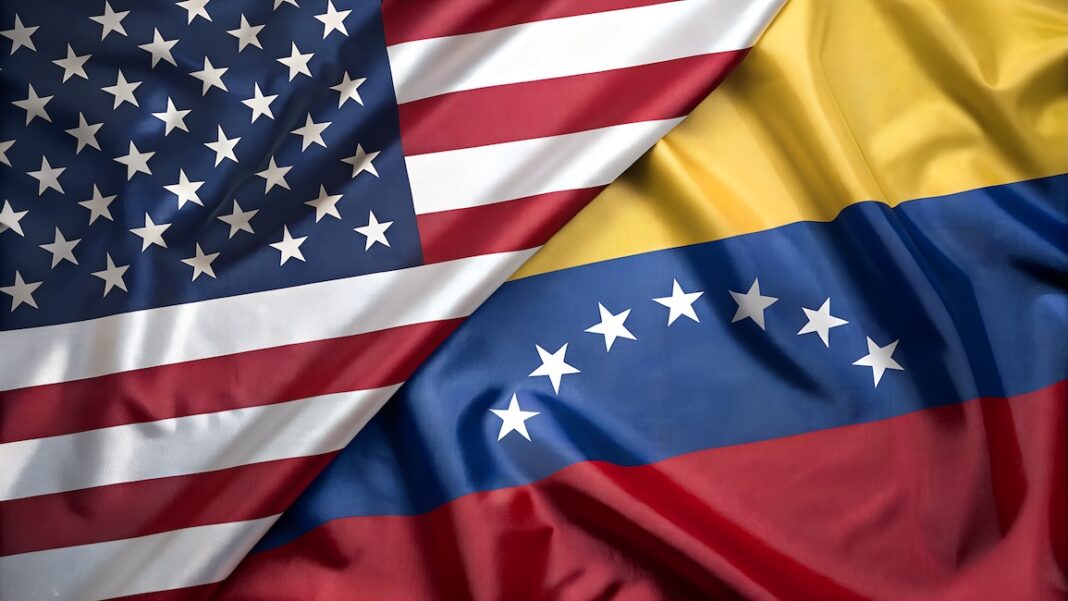
According to Andrew Latham, what transpired in Venezuela on Jan. 3 when U.S. forces entered the country, capturing its leader, Nicolas Maduro, along with his wife Cilia Flores, cannot be described as regime change but rather a “decapitation.”
Latham, a Senior Washington Fellow at the Institute for Peace and Diplomacy, says what follows may not look too dissimilar from what existed in the country under Maduro.
“Obviously, the very, very top layer of a multi-tiered regime has been removed, but the regime itself remains in place,” said Latham, pointing to the swearing in of Venezuelan Vice President Delcy Rodriguez as interim president on January 5.
Rodriguez, a lawyer and the daughter of a Marxist guerilla fighter involved in the high profile 1976 kidnapping of an American businessman, rose through the ranks under Maduro, including serving as finance and oil minister while helping to steer the Venezuelan economy through layers of U.S. sanctions.
Latham, who teaches international relations and political theory at Macalester College in Saint Paul, Minnesota, sees four possible scenarios playing out in Venezuela, the first being a “business as usual” outcome.
Under this scenario, the current regime survives intact, bound together by Chavista ideology—so named for the former Venezuelan leader Hugo Chavez—and existing power structures. Latham regards this as the least likely path.
The more plausible outcome, in his assessment, entails the same political actors and institutions remaining in control but quietly shedding much of the regime’s Chavista ideological baggage. In this version, power does not change hands, but priorities do: the government becomes more receptive to pressure from Washington, particularly on two fronts: opening the country’s vast oil reserves, as well as its critical minerals sector to U.S. interests, while scaling back strategic ties with China, Russia, and Iran.
Under a third scenario, Venezuelan opposition leader and Nobel laureate María Corina Machado assumes the presidency, marking a full rupture with the existing regime, replacing it with a government promising stronger democratic accountability. According to Latham, this is among the least likely outcomes, at least in the short term.
A fourth and final scenario would see a near total systemic collapse of governing institutions, with the potential for civil war and the prospect of “American boots on the ground,” a move Trump has said he is not afraid to make.
Reporting suggests events remain unstable in the South American nation following Operation Absolute Resolve, the name given to the nighttime raid on Venezuelan territory by U.S. forces, with thousands rallying in the streets of Caracas on Jan. 5 calling for Maduro’s release.
U.S. officials say the operation resulted in 75 deaths, including several civilians. Venezuelan and Cuban officials put the death toll at more than 80.
The White House, meanwhile, continues to describe the operation as part of a law enforcement effort targeting Maduro, who was indicted by the U.S. in 2020 on drug trafficking charges. Democrats and international leaders say the operation violated U.S. and international law.
According to Latham, signals from the interim leadership suggest a Venezuela that remains under familiar control but is already positioning itself as more cooperative and strategically aligned with the United States.
A recent message posted to Rodriguez’s Telegram account invited the U.S. to collaborate in “an agenda of cooperation.”
Pedro Urruchurtu is the International Affairs Coordinator at “Vente Venezuela,” Machado’s political party. In an interview with Venezuelan journalist Gladys Rodríguez, he said any post-Maduro transition would only be “possible and sustainable if it is led by leadership that people trust,” by which he means Machado.
Maduro declared himself the winner in presidential elections in 2024, despite Edmundo González—who ran as a sort of proxy for Macahdo after her candidacy was disqualified by the regime—claiming a lead of more than 40 percentage points based on total vote counts.
Urruchurtu insists the election demonstrates the desire among Venezuelans for a Machado government. He is also critical of those who attack U.S. intervention, noting powers including China, Russia and Cuba have long meddled in Venezuelan affairs.
Jorge Marquez is a Venezuelan petroleum engineer and public policy specialist now living in Texas. He says the post-Maduro transition should be led by González, though he acknowledges the country currently “does not have the conditions to undertake that transition.”
Both González and Machado are now outside Venezuela, having been clandestinely ferried out after remaining in hiding for months following the election, making an immediate handover unrealistic, says Marquez.
Even if that opposition were to return, he stresses, basic guarantees would still be required, given the power imbalance on the ground between opposition leaders and members of the Maduro government, which maintain control of the military, the police, and other paramilitary forces.
Rebuilding political structures would require international support to weaken the Maduro coalition, reduce its coercive capacity, and provide minimum security guarantees. Without protections for political leaders, meaningful political engagement is impossible, Marquez stressed.
As for more immediate political objectives, the first is to seek the release of the more than 700 political prisoners now behind bars in Venezuela.
“Two: ensure the return to the country of the main political leaders, including María Corina Machado and Edmundo González.” Finally, he said “Once this happens, regroup our entire team and rebuild our political strength to be able to manage the transition.”
Roxsy Lin is a California Local News Fellow with the UC Berkeley Graduate School of Journalism.