


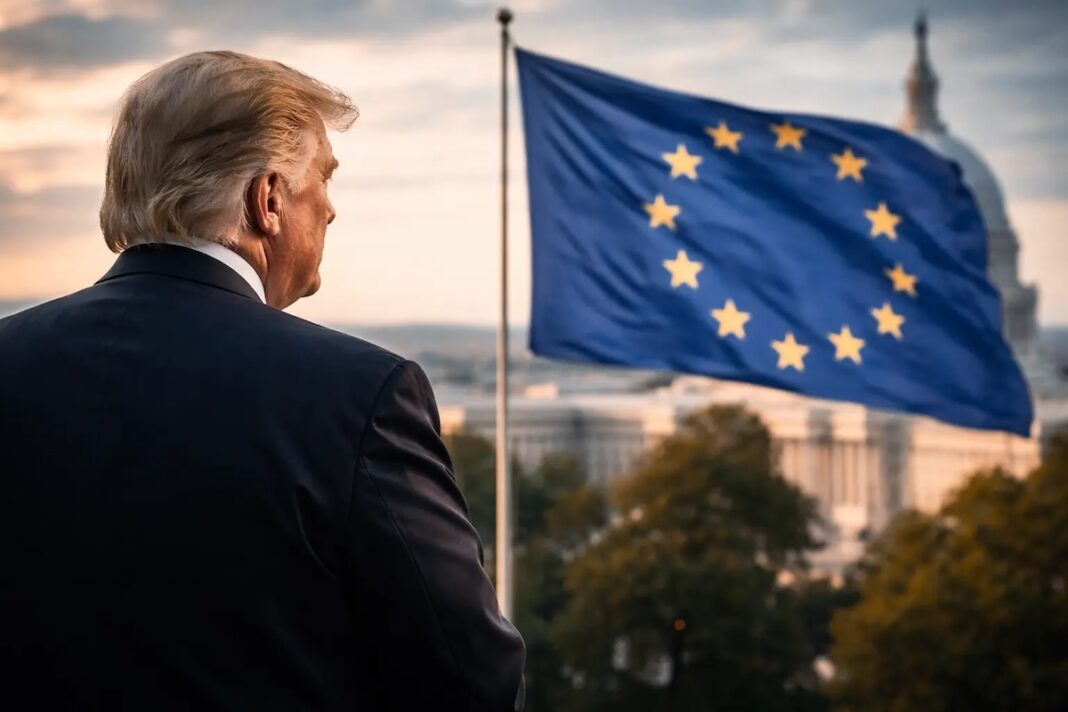
Among European countries, Italy remains one of the U.S.’s staunchest allies. With the U.S. invasion of Venezuela and Trump’s increasingly aggressive claims against Greenland—part of the U.S.’s new “Donroe” Doctrine national security strategy—Rome, under the leadership of far-right Italian Prime Minister Giorgia Meloni, has become a linchpin of European positions toward its bellicose ally. International observers are now looking to the country to discern the direction Europe will take at a moment when the very existence of the NATO alliance is in question.
Italian media’s reactions to the U.S.’s January 3 operation in Venezuela and the renewed push to “get” Greenland appear unequivocally convergent. Italian observers see the two as a defining feature of the Trump Administration’s broader vision of NATO and the future world order.
“Maduro’s arrest is the first real example of the new regional foreign-policy strategy promoted by Trump … now they call it the Donroe doctrine,” writes Fernanda Gonzalez in Wired Italia. “The recurring threats … lead several analysts to believe that this approach could soon be extended to other territories, from Latin America to the Caribbean and even Greenland.”
In this narrative, an American president that privileges speed, force, and threats over multilateral processes will push European allies to cow to U.S.’ demands and the dictates of like-minded autocrats. That in turn legitimizes de facto the rise of a new international of tyranny, validating the very premise of Trump’s own Donroe Doctrine.
“The ‘Donroe doctrine,’ articulated by Trump, corresponds perfectly to the principles of Putin’s Russkij Mir (Russian World)…” writes Stefano Caprio in Asianews.it, “both the U.S. and Russia view countries within their spheres of influence as ones to control, conquer, invade, and exploit.”
Venezuela and the oil question
Mainstream Italian media are interpreting the action in Caracas as both a unilateral military raid—destabilizing and legally ambiguous—and an intentional deterrent signal intended for capitals in the Americas, in Europe and across the Pacific.
“From Venezuela to Greenland… the ‘Donroe’ Doctrine marks a watershed for the international order and presents Europe with a dilemma: adapt to American hegemony or prepare to counter it,” writes Paolo Gnes in ISPIONline, for Italy’s Istituto per gli Studi di Politica Internazionale.
From here, the commentary splits along the usual Italian editorial lines. Centrist media like La Stampa and other institutional voices like RaiNews highlight the diplomatic fallout: the question of national sovereignty, the risk of tit-for-tat unilateralism, and the pressure placed on European governments to react without appearing either anti-American or complicit.
Meanwhile, Catholic and other ethics-driven media, such as the Vatican News and the periodical Famiglia Cristiana, lean hard on the “rules-based order” approach. The raid on Caracas is another step in a long-running erosion of U.N.-centered legitimacy, they maintain, an argument that resonates strongly in Italian foreign-policy culture where stability is often equated with respect for procedural traditions.
A third layer of interpretation—present mainly in the center-left press—centers on the question of “energy dominance” and coercive economic control as overt policy tools. The daily L’Unità underscores how oil shapes the U.S.’s broader strategy. Reporting on the seizure in international waters of the Russian-flagged tanker Marinera, it notes, “The embargo on Venezuelan oil… remains in force worldwide.”
‘Buy Greenland’ redux
Italian media remember Trump’s 2019 “buy Greenland” episode as a geopolitical curiosity. What’s changed in 2026? Credibility. Drawing on translated Reuters/AP reporting, Italian media stress that the Greenland issue was far more than Trumpian theatre, becoming a live stress test for NATO’s moral logic.
As Internazionale notes, “Meloni said it was ‘clear to everyone’ that any U.S. move on Greenland would have a significant impact on NATO…”— signaling that even Italy’s right-leaning government sees threats to a NATO ally’s territory as a potential rupture in allied cohesion.
Italian reporters such as Viviana Mazza of the Milan daily Corriere della Sera, meanwhile, treat the Greenland story as something more than a binary question of “invade/don’t invade,” outlining three possibilities: purchase, coercive control (via defense arrangements and political pressure), or outright annexation. Many also note how Trump’s language of “need” slides into the language of entitlement.
To the left is Rome’s Il Manifesto, which frames Greenland as part of Trump’s “imperial” outreach in which territory, resources, and alliances are treated as transactional assets.
“The Danish secret services had denounced, last August, the presence of American infiltrators in Greenlandic society to encourage the birth of a secessionist movement,” the paper wrote at the start of the New Year.
According to the newspaper’s editors, Pele Broberg, leader of Greenland’s opposition—who had urged the island’s prime minister to initiate “direct” contacts with the United States and to work for independence—would be the ringleader of this effort.
“[Broberg’s] party could be the Trojan horse of the United States by calling for a referendum for secession and thus opening up to the stars and stripes a protectorate in the Arctic,” concluded Il Manifesto.
A bridge to DC, NATO
Since the start of the year, there’s been much ink spilled in the Italian press over the balancing act Rome is seeking to strike as a “bridge” to Washington—supporting allied unity while avoiding a public rupture with Trump.
This position is especially visible in the coordinated European statement defending Greenland’s sovereignty. Italian media read this not as symbolism but as damage control: if Greenland becomes a prolonged confrontation, the cost is paid in NATO cohesion, Ukraine policy bandwidth, and Europe’s ability to present a single front.
Paolo Pontoniere is a San Francisco-based journalist and a former foreign correspondent for several Italian media outlets and wire agencies.
Feature image published under CC License 4.0