


SAN FRANCISCO — When it comes to food, there is perhaps no more iconic or indeed universal ingredient as tomatoes. They’re a staple, essential to everything from pizza to pico de gallo, from Middle Eastern wraps to your favorite Indian curries.
And they are getting expensive, in the Bay Area and nationally, putting a strain on restaurants and shoppers alike.
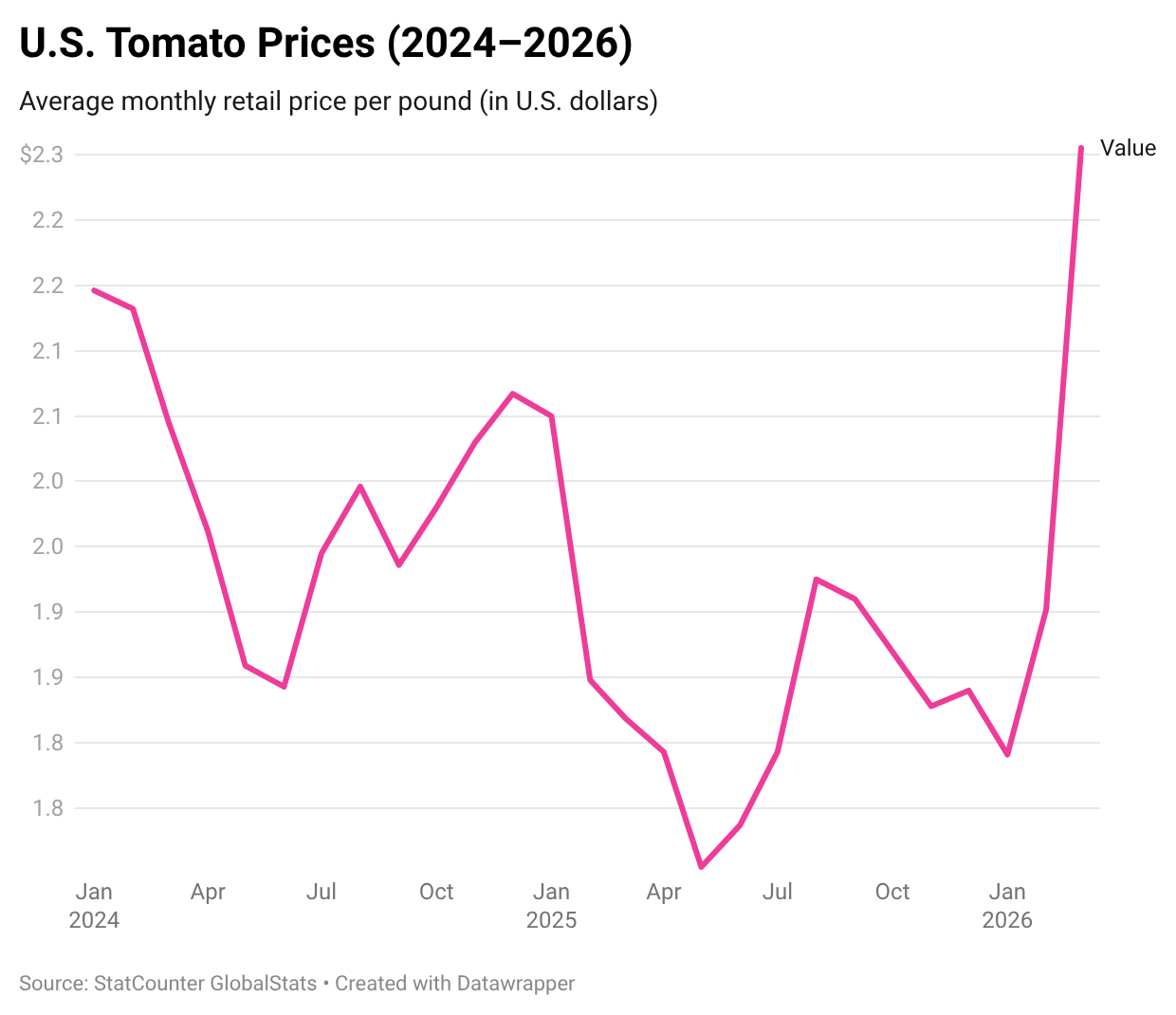
The cost of tomatoes surged by nearly 40% in April compared to last year, according to the Consumer Price Index — the largest increase of any vegetable category tracked. Costs reached an average of roughly $2.26 per pound, an eight-year high. Food prices overall, amongst other essentials, rose nearly 3.8% in April compared to last year.
Price uncertainty
At Mesopotamia Kitchen in San Francisco’s Noe Valley, tomatoes are featured prominently in sauce-heavy Turkish dishes like iskender kebab (lamb), moussaka (fried eggplant), and shakshuka (poached eggs). Salih Dogan, the manager, says that over the last month, the amount they have had to pay for tomatoes has fluctuated dramatically.
“Three or four times every week we get two cases of tomatoes, and lately every time there is a different price … sometimes going down, sometimes jumping. Usually the change is more than $10 or $20. Not week to week, sometimes daily.”
When prices first surged Dogan explored other vendors, but all were reflecting the same changes.
“We asked one time why the price was up, they all said, ‘We don’t know, we just sell it.’”
That instability in costs adds to mounting economic uncertainty that small businesses in costly cities like San Francisco and Los Angeles feel acutely.
Policy, poor weather impacts
In the case of tomatoes, a combination of tariffs, bad weather causing lower yields, high diesel costs for transportation, and high fertilizer costs are among the drivers behind the price surge. According to the USDA, roughly 70% of the U.S. domestic supply of tomatoes is imported. Of that number, 90% comes from Mexico, with the other 10% coming from Canada.
The US previously had an agreement with Mexico that allowed tomatoes to be imported for free. The Trump administration withdrew from that agreement last summer, and applied a 17% duty on tomatoes. The USDA adds that poor winter weather in key production regions in Mexico, particularly Sinaloa, may have led to a poor harvest and thus constrained supply.
The ongoing war in Iran and the subsequent closure of the Strait of Hormuz has also caused supply chain disruptions, resulting in soaring fuel prices, driving up costs of fresh produce across the board.
‘Meat is cheaper‘
Samer Elbandak owns two diners in San Francisco; Town’s End Brunch, along the Embarcadero, and New Spot on Polk Street. He says his pocket book has felt the impact of tomato prices.
“I joke about it. I tell the employees, put more meat on the burger and less tomato, because now meat is cheaper than the tomato.”
Elbandak says he buys two to four cases of tomatoes a week. Just a few months ago he was paying $15 per case. Now, he’s paying between $75 to $88.
“We’re talking about spending $500 more per week, a couple thousand more dollars a month, just on tomatoes. Just that would pay the water bill, the ecology bill, the insurance bill,” he says. “I’ve seen some cases where tomatoes go up to $40, $45 and that was really ridiculous. But to see it in the 70s and 80s, that’s unspoken of. I’ve never seen it that high before.”
Still, Elbandak is reluctant to increase menu prices or alter the recipes. For now, he is (no pun intended) eating the loss, but says if the affordability issue persists, he may have no choice.
“We’re in unpredictable, unprecedented times. You cannot really tell what’s going on or where the problem is coming from. There are so many factors and they’re all going the wrong way at the same time.”
‘Never seen anything like this‘
At Tia Margarita, a neighborhood institution in the Richmond district of San Francisco, die hard regulars have been packing the horseshoe bar and woodpaneled dining room for over 60 years. They’re famous for the eponymous cocktails, but the menu is also full of classic, tomato-heavy northern Mexican dishes like chili rellenos.
Fernando, the general manager, says he’s never seen anything like this before in his 35 years in the Bay Area restaurant business.
“Tomatoes are very important to us. It’s the number one ingredient we use,” he says. “We used to pay about $40 per case of tomatoes. And last month, we were paying $110, $115 per case.”
Buying cheaper varieties of tomatoes, like Romas, didn’t make a difference because the price of every kind of tomato shot up. The overall price spike for Mexican produce is also affecting limes, which Tia Margarita burns through for its popular margaritas.
And it isn’t just restaurants feeling the squeeze. Higher costs are forcing shoppers to buy less, or switch from fresh foods to cheaper canned or frozen goods. Data show sales of frozen foods nearly doubled during the first year of the Trump presidency as shoppers looked to fight inflation and stretch their food budgets.
All of that means higher priced produce sits on the shelves longer, where it ages and dries out. Now a cocktail calling for one juiced lime needs two or three to get the same volume, says Fernando. Tomatoes he managed to purchase, meanwhile, were not fresh or juicy enough to be used in his pico de gallo and guacamole.
Rising insecurity
“The thing is when you have an old restaurant and you have the quality of food for so many years with the same recipe, there is no way you can go any different. Literally you are forced to pay whatever it is you have to pay for that lower quality product.”
He says that prices have gone down somewhat in the past week — and concurrently, produce quality has improved. On May 8th, for a 5×5 25lb box of vine-ripe tomatoes, he was able to pay $65. But that’s still almost double what he’s used to paying.
Fernando says even as prices might start to stabilize, he feels the lingering tension of an unstable economy.
“All of a sudden you’re not as confident as before,” he says. “You get concerned when something like tomatoes or any vegetables go up more than double the price, then you start getting insecure about it. How can you put a price on a menu when something like this just doubles in price overnight?”
He continues, “It’s making it very difficult for GMs and any business owners to run businesses because, any prices you set, you don’t know if you’re going to have to change it tomorrow.”
Elbandak agrees that national fiscal policy, international turmoil, and bad weather are all landing on the humble vegetable that nearly every restaurant relies on.
“Hopefully they’ll end the war soon, but even that is not going to clear the problems immediately. To us as small business owners, middle class, hardworking Americans … [it] doesn’t look promising at all.”
Chris Alam is a California Local News Fellow with the UC Berkeley Graduate School of Journalism.