


By Charlene Muhammad | LA Sentinel
Jawane Hilton is an educator, pastor and dedicated Councilman of Carson, CA’s District 1. He spoke one-on-one with Sentinel Contributor Charlene Muhammad about the importance of park equity, creating green spaces and why accessibility and inclusivity for all residents is crucial, and the value it adds to children, in particular those facing disabilities.
What does park equity mean to you?
I believe park equity means access for everyone, no matter what side of the city that they live in. Each park in their area or their direct area, the immediate area and where they stay, is equitable. Carson has a robust Parks and Recreation Program, and I believe that it is equitable in every area. Some of our parks are being worked on, some of them are being overhauled, but we want to make sure that they’re equitable, that they have access, ADA (Americans with Disabilities Act), children who are on the spectrum. We want them to be able to play in the parks. So, we want it to be equitable, and we’ve done a great job, in the city of Carson, with doing those things towards equity in our community.
Would you identify one or two of those efforts?

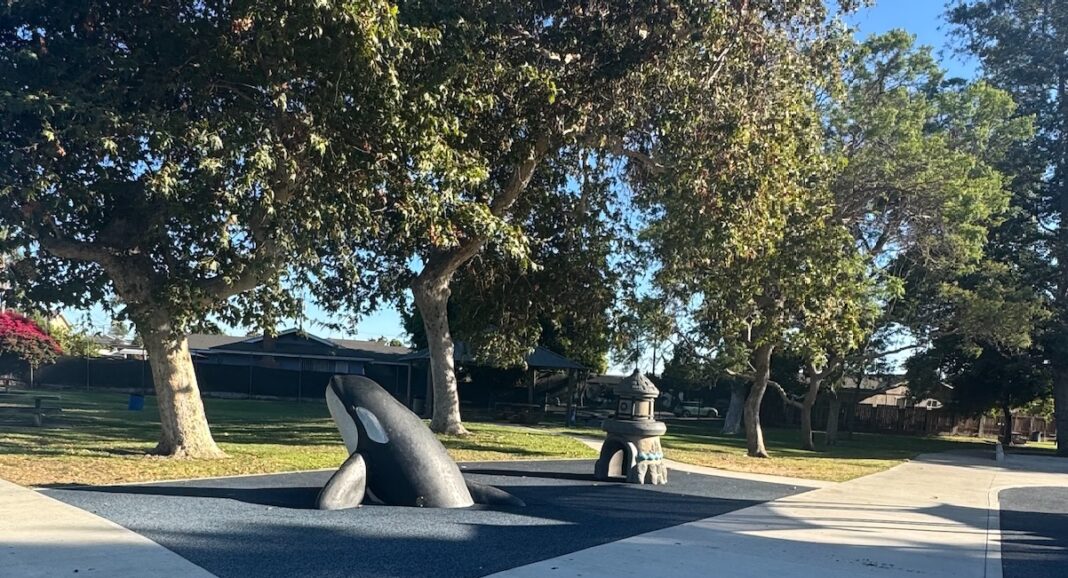
For instance, at Dolphin Park, it is a sensory park. It is a park designed for children with ADHD (Attention-deficit/hyperactivity disorder), who are on the spectrum or who may have autism. The playground is designed for them to play, to swing, to do all of those things. And it was designed with them in mind, whether it be the mats, whether it be the way they interact, the instruments that are there.
(Dolphin Park’s playground equipment was designed to provide activities and experiences for all children, in addition to those with special needs. City officials boasted, the playground goes above and beyond by providing stimulating activities not only for children with impaired motor skills (e.g. ambulatory disabilities), sensory needs, diverse body size, posture, mobility, and motor control. The playground features audio stimulation, ramps, convenient hand-holds, and adaptive swings.)
And in all of our parks, people have access to free Wi-Fi. What we found out during the (COVID-19) pandemic was in the parks, during the pandemic, some people did not have Wi-Fi. We cited that we would see children pulling up to local restaurants that have free Wi-Fi in order to work on their homework. And we didn’t want that to happen. We want people to be able to go to their community park and be able to do their homework.
When we look at ensuring park equity and Green spaces for all in Carson, what have been any challenges observed in your experience and observation, and how were those overcome?
One of the challenges of Parks and Recreation is that we have so many people who love our parks, and they may not necessarily be residents in the City of Carson. So, one of the challenges is that Carson serves a lot of people who may not be residents in our community, and which sometimes they take up the services that normally our community or our community members should get but because our park system is so robust, people from different neighborhoods, they come over and try and say they’re from Carson, but really are not.
What role do you see for partnerships with community organizations or non-profits and other agencies to achieve greater park equity in Carson?
Carson has so many outside events at our parks. I believe we have about 20 or 30 events a year, and they are in our parks. We often look for community-based organizations to come alongside and partner with us. So, those are incredible places to partner and to get the word out and to be active in portions of the community. So, I think there are always opportunities for partnership with community-based organizations. Our Parks and Recreation Program also has a Community Service Department, so if you have a company that highlights stuff to use, highlights stuff for seniors, that’s all incorporated.
Would you like to add anything in terms of the diversity of Carson and why the parks and having Green spaces in Carson is so important, from whether it’s families with babies to seniors?
Green space is just so important. They have this thing that says “Parks Make Life Better.” So, we think Green space is important. That’s why we put a good portion of our budget, as our mayor calls it “front-end loading.” But if we take care of our children on the front end, if we take care of our community on the front end and the parks and stuff like that, if we keep them in the park, we’ll keep them off the street. If we keep them in a program, oftentimes they won’t veer off in a different direction. Parks bring family. My children play in the park. My children are involved in sports in the park, and they have not only created friends, but they’ve created family from being in the park. So Green space and being in parks in community makes life better and people should take advantage of that.
This story was produced by American Community Media in collaboration with the Laboratory for Environmental Narrative Strategies (LENS) at UCLA as part of the Greening American Cities initiative supported by the Bezos Earth Fund. Read more stories like this by visiting the Greening Communities homepage.

