


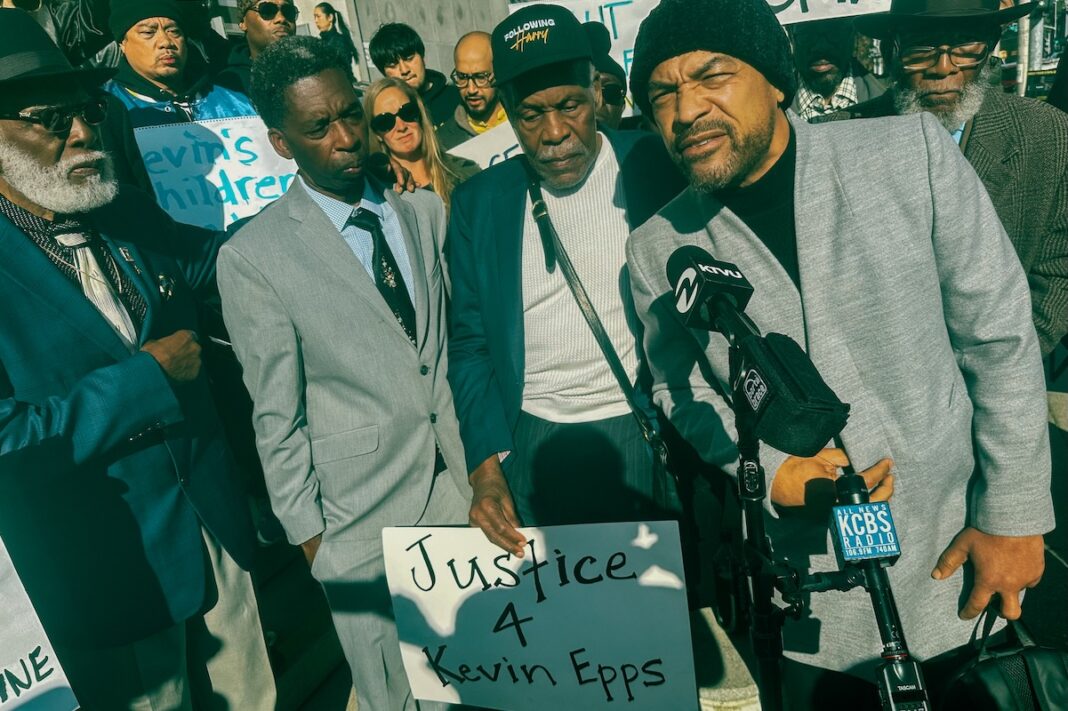
Kevin Epps, a 57-year-old documentary filmmaker and media executive on trial for the 2016 killing of 49 year-old Marcus Polk, could no longer hold back the tears. As African American faith leaders and community advocates offered prayers and testimonials on the steps of a San Francisco courthouse where Epps is facing murder charges, the unbearable pressure of his situation finally got to him. His face, which had remained stoic throughout courtroom proceedings, started to crumble.
“In this time, we pray (for) your special blessing over our brother Kevin,” said Devin Crawford, a pastor at San Francisco’s Third Baptist Church. “We know that you are the God that is able to meet us in the courtroom.”
“These charges should never have been brought… It’s a selective prosecution,” said attorney Julian Davis, who organized the rally. “This is about a system of injustice that we see every day. And we’re not going to stand for it.”
“Justice is not some abstract idea for us,” said Dr. Jonathan Butler, president of the San Francisco chapter of the NAACP. “The San Francisco NAACP stands here with one clear message: that every person deserves fair, transparent, and fact-driven trial processes.”
As the rally went on, Epps’ supporters held signs and placards as TV and radio stations filmed and recorded for later broadcast. Drivers passing by honked their horns.
Community activists have wondered aloud why Epps’ case was reopened in 2019 after initially being dropped, citing a lack of substantive new evidence. They’ve questioned the almost decades-long prosecution effort, likening it to a persecution fraught with double standards and racial implications.
When the case finally went to trial in 2025, Epps’ supporters attended pretrial hearings, issued press releases, held rallies, and showed up in court daily. No one offered greater support than Epps’ octogenarian mother Brenda, who has herself been wrestling with turbulent emotions as the trial enters its final stages. “It’s a lot,” she said, during a break in the proceedings.
The San Francisco D.A.’s office has doggedly pursued the case for almost a decade, insisting that Epps’ claim of self-defense was invalid, bringing the case to trial with mostly-circumstantial evidence, and a sole eyewitness – Polk’s estranged wife Starr Gul – whose credibility has been challenged by inconsistent statements. The trial has reopened a family’s traumatic wounds as they relive the circumstances leading up to Polk’s death on October 24, 2016 each day in court.
After three weeks of testimony – highlighted by the dramatic witness stand appearances by Gul and her two daughters – the trial has now reached the jury instructions phase.
“One of the most important aspects of today is the deliberation and argumentation about whether the Castle Doctrine and related sections of California law are going to apply and how they’re going to apply in terms of what the jury is instructed in this case,” said Davis.
Jury instruction hearings began on December 4 and continued the next day. The hearings also offered a preview of what to expect in closing arguments. Prosecutor Jonathan Schmidt pointed to Gul’s testimony as sufficient evidence of premeditation and deliberation – elements needed to prove first-degree murder. This prompted defense attorney Darlene Comstedt to say, “She didn’t see the shot. Ms. Gul testified to that.”
Schmidt argued that Polk telling Epps his common-law wife Maryam Jahn “doesn’t like you” constituted verbal provocation – a potential motive for the shooting. He expressed skepticism that Polk coming at Epps represented “imminent danger.”
The bottom line, Schmidt insisted, was that Epps was “a felon with a gun.”
“Even if he’s a felon with a gun, he had the right to defend himself,” Comstedt answered.
“At some point before Mr. Polk came at him, Mr. Epps would have had to have that gun” in his possession, Schmidt said. “Mr. Epps was the aggressor. He followed him into the house. He got the gun. He shot him.”
“This was the house where he was raising his children. He lived there. He had a driver’s license (address) there. He got mail there,” Comstedt responded
During this exchange, the gallery was so quiet, you could hear a pin drop. The gravity of the situation and possible consequence – life in prison for Epps – hung in the air like Damocles’ sword.
When the hearing resumed the following day, the courtroom was packed with Epps’ supporters who had attended the rally on the courthouse steps. Defense attorney Mark Vermeulen took the lead, arguing that Epps was a resident of the house, Polk was not, and that Polk’s conduct amounted to unlawful entry and forcible behavior.
“Melina Polk said sometimes (Marcus Polk would) come over and he would be let in, sometimes he would not be let in. He did not have blanket permission.”
On October 24, Polk “went in and he stayed in. That was an intrusion. That was contrary to what everyone in that home was saying to him. There is plenty of evidence his entry was unauthorized, unlawful, uninvited… He banged on the door. Then he got into a confrontation with maintenance workers on the street. He threatened them. He was yelling at them. Immediately after he went in (to the house)… We have sufficient evidence to make the argument.”
After considering Schmidt’s objection that mere trespassing wasn’t strong enough evidence of unlawful conduct, Judge Ferrall ruled that the jury could consider self-defense. Epps’ supporters breathed an audible sigh of relief.
The trial’s next stage, closing arguments, will present opposing theories, with the prosecution arguing Polk’s death was a deliberate act, and the defense making a case that Polk provoked Epps into using deadly force.
This story was produced in collaboration with California Black Media. It is part of ACoM’s ongoing coverage of the Kevin Epps trial.