


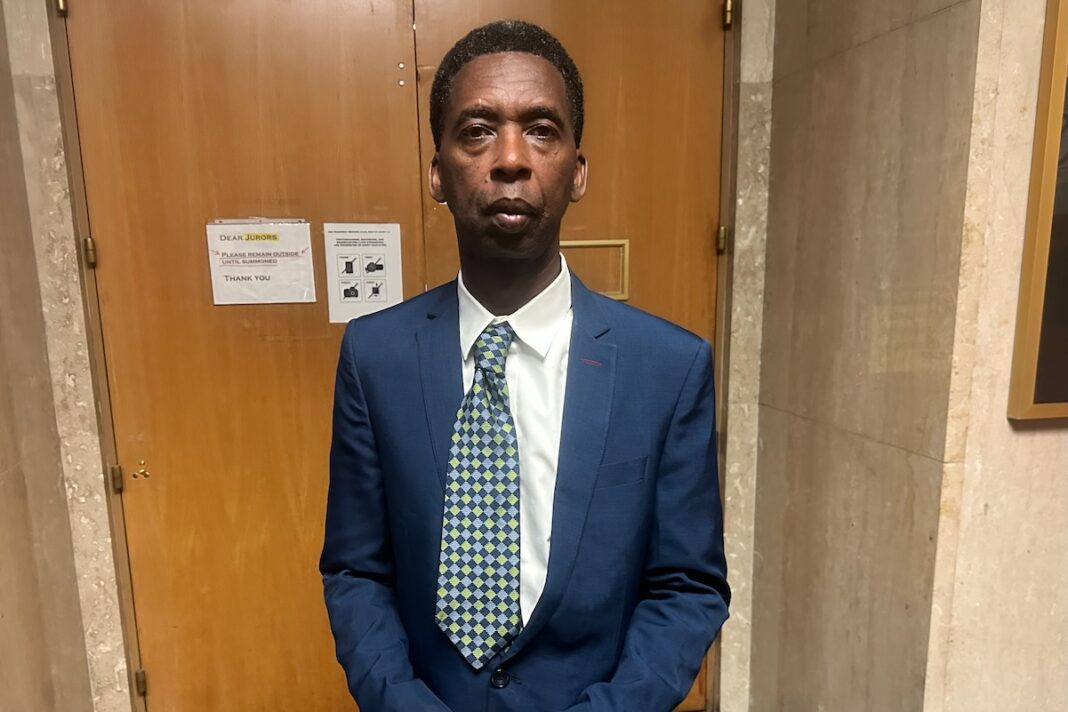
The murder trial of SF-based filmmaker Kevin Epps has been a highly-procedural affair to date, as the prosecution has relied heavily on law enforcement officers and expert witnesses whose testimony has offered hours of dense technical jargon for jurors to digest. But last week, the complicated extended family dynamics between defendant Epps and decedent Marcus Polk took center stage, as Polk’s wife and daughter were called to the stand.
The testimony of Starr Gul and Melina Polk raised new wrinkles in the trial of Epps, who is accused of murdering Marcus Polk on October 24, 2016. Gul is the older sister of Epps’ former common-law wife, Maryam Jahn, and the mother of Melina Polk, a teenager of 17 at the time of her father’s death.
The two were frequent visitors to 137 Addison, a townhouse in a low-income housing development within San Francisco’s affluent Glen Park neighborhood. Jahn, the leaseholder of the residence, lived there with Epps and their two young children. Gul and her daughter frequently spent holidays there and were regular overnight guests. Sisters Gul and Jahn had a close relationship and would alternate driving their young children who attended the same school. In addition to Melina Polk and a younger daughter, Gul had two children not fathered by Marcus Polk, who were also regular houseguests.
Marcus Polk, 49 at the time of his death, met Gul when she was 14 and married her at 21. The two separated in 1998. Court documents reveal that Marcus Polk had a vested interest in remaining in the lives of his estranged wife and children, which was complicated by his chronic drug use, homelessness, and frequent incarceration.
Epps, 48 at the time of the incident, saw himself as the man of the Glen Park house, even though his name was not on the lease. He frequently looked out for Gul’s children, buying them groceries when they were short on cash. But he also had a contentious relationship with Marcus Polk, who was sometimes invited to stay at the home by Jahn over Epps’ objections. This dynamic bubbled for years until it boiled over into an irrevocable act of deadly violence resulting in the death of Marcus Polk.
Those basic facts formed the background for Gul and Melina Polk’s testimony in the Epps trial. What’s in dispute are Epps’ and Marcus Polk’s actions leading up to the shooting, along with the central question of whether the shooting was self-defense or murder.
On the witness stand, Gul testified that the night before the shooting, Epps brandished a gun during an argument with Marcus Polk that began with her two young sons “teasing” Polk, who was outside the home, demanding to be let in. Epps allegedly retrieved a semi-automatic pistol from a kitchen cupboard and at one point, pointed it at the door where Polk stood outside. Gul described Epps demeanor as “angry, cold, evil” – characteristics she had never seen in him before. After Marcus Polk finally left, she said, Epps continued to walk around the house, waving the gun, for 20 minutes. This sensational testimony, if credible, laid a foundation for premeditation needed to prove the first-degree murder charge the prosecution sought.
Gul testified to being “terrified” and “scared” for her children at Epps’ actions that night. Yet the next day, she admitted to smoking marijuana with Epps approximately an hour and a half prior to the shooting.
On the day of Marcus Polk’s death, he came to the house, asked to be admitted and was denied. He stayed around the premises and attempted to put the residence’s trash into another neighbor’s bin. This action led to a confrontation with maintenance worker Anthony Walker, who had previously testified that Polk threatened him, prompting Walker to call the complex’s management company, who subsequently called leaseholder Jahn to inform her of the problem.
The situation began to escalate. Epps, Jahn, and Gul all went outside the house, reacting to the commotion. Gul testified that Marcus Polk was asked to leave by her and Epps but refused saying that he would only leave if Jahn asked him to. Marcus Polk then reentered the house.
What exactly happened next remains a mystery. The circumstances under which Epps shot and killed Marcus Polk are unclear. Neither Gul nor Melina Polk directly witnessed any confrontation. Gul stated she saw Marcus Polk standing in front of a television, holding a TV remote, just prior to the shooting. Melina Polk said she was in an adjacent room.
Two shots rang out. Gul claims she turned just in time to see Polk hit by the second shot which “spun him around 180 degrees on his tippy-toes.” Melina Polk said she hid in a closet upon hearing the first shot but witnessed her father “gasping for breath” as he lay dying.
“He came at me,” Melina Polk recalled Epps saying.
Taken at face value, Gul and Melina Polk’s testimony appeared to be very damaging for Epps. But on cross-examination, it was revealed that their recollections had shifted dramatically over time. The claim that Epps was waving a gun around for 20 minutes the night before the shooting was absent from Gul’s 2016 interview with SFPD investigators and her testimony from a 2019 preliminary hearing; it only came to light after a September 2025 interview with prosecutors. When confronted with the discrepancy by defense attorney Darlene Comstedt, Gul broke down in tears, claiming she was “traumatized” at the time of the earlier interview and hadn’t slept in 72 hours. Melina Polk’s account was also contradicted by her previous testimony.
Given the opportunity to ask the witnesses questions, jurors asked Gul whether it was possible to see outside from behind the door at the Glen Park house. She conceded that it was not.
That admission cast doubt upon her recollection of events.
As the Kevin Epps trial continues, the prosecution is nearing the end of its case, with just a few remaining witnesses and experts expected to be called. Among those is Jason Fries of 3-D Forensics Inc., whose digital animation formed the basis for the 2019 reopening of the case.
This story was produced in collaboration with California Black Media. It is part of ACoM’s ongoing coverage of the Kevin Epps trial.