


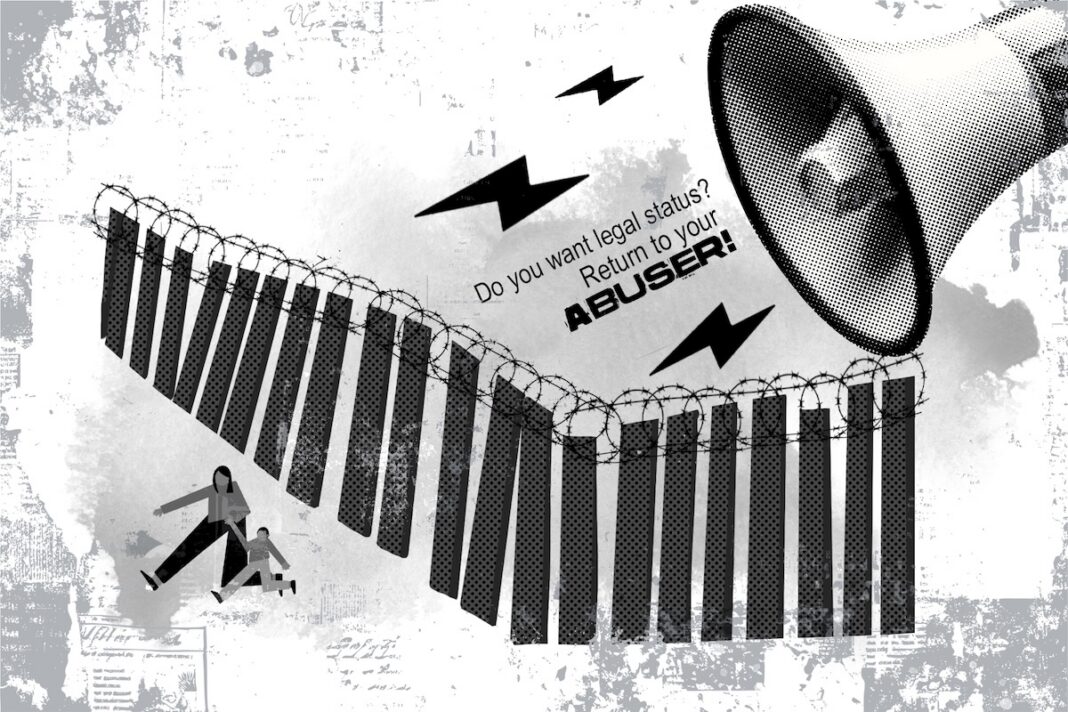
Editor’s Note: Immigrants experiencing domestic abuse now have fewer resources amid federal cuts to support programs. President Trump’s proposed budget for fiscal year 2027 threatens yet more cuts. These include $14 million for transitional housing and $15 million for legal assistance programs. Advocates report that survivors now fear calling 911 due to potential collaboration between local police and immigration authorities. Figures from the Alliance for Immigrant Survivors reveal 50% of victims have abandoned judicial processes for fear of being detained by ICE in the courts.
Julieth Gualtero was a veteran TV journalist in Colombia before immigrating to the US. Working for over a year in the South Bay for Child Protective Services, she made regular site visits to vulnerable families. On one such visit in August 2025, she met Lucia, a mother of four. Gualtero stayed in contact with Lucia after leaving her job to return to journalism. Below Gualtero shares Lucia’s story to highlight the trap of undocumented women experiencing domestic violence. Many, like Lucia, must choose between the risk of losing custody of their children if they report the abuse and living with the abuser. Sometimes, the only way out is to self deport.
Lucia was 26 when she crossed the border from Mexico into California in 2023 with her four children. She had hoped to escape from cartels that had killed her father and brother and were targeting her then 12-year-old son. Yet after arriving and over the next three years she encountered a different form of violence — from her husband.
Lucia (a pseudonym used for security reasons) shared her story over several phone interviews after self-deporting back to Mexico. I first met her in August 2025 when I was a case worker for child protective services. I stayed in touch with her after leaving my job out of concern for her situation.
Lucia’s story echoes that of a growing number of immigrant women without legal status who experience domestic violence. Many see self-deportation as the only path to avoid ultimately losing custody of their children.
After surrendering to border authorities and receiving an asylum appointment, Lucia travelled to the Bay Area. There she reunited with her husband, also a native of Mexico who was 20 years her senior. He had acquired U.S. citizenship in 2000, returning for brief periods to Mexico where the couple met and married in 2022. After she gave birth to their child, he had returned to the US to seek work. He promised her he would file a family petition to secure her status.
Her first inkling of trouble was when she found her husband living in a cramped apartment and without a job. After sending her three eldest children to live with their biological father in Arizona, she and her infant son settled into her husband’s one room apartment. It was in that room that the abuse began. It worsened after the landlord evicted them, fearful that the violence he witnessed would attract police. The couple spent the next 10 months living in a truck with their baby.
Lucia recalls her husband forbade her from working and denied her money for food and diapers. The couple lived off donations and government aid. “What’s the use of eating if you have to go to the bathroom and there’s no bathroom,” her husband told her when she asked for money to buy food. “Two or three weeks would pass and I couldn’t clean myself.”
At one point her husband attempted to strangle her, and she finally turned to the police. She filed a report showing the injuries he had left on her neck. Her husband was arrested and she was taken to a local women’s shelter which offered emergency housing for eight days. Other local shelters were over capacity. Meanwhile, her husband’s brother threatened to report the couple to Family Protective Services for living in the truck unless she dropped the charges. When he arranged for the husband’s bail, she felt forced to return with her child.
Eventually Lucia’s husband found work as a heavy-load driver. To survive she would secretly keep a few dollars of change every Friday when he sent her to buy alcohol. With no further word about the family petition, she contacted a lawyer to reopen her asylum process. She paid his $3000 fee with help from her mother and grandmother who had taken out loans in Mexico. The lawyer managed to obtain a work permit and a social security number for her as part of the asylum process.
The couple finally managed to move out of the truck and into a small studio. Lucia and her husband filed the family petition. By then her three older children had reunited with her after their biological father said he could no longer care for them. Desperate for a way out, she begged the lawyer to apply for a U-Visa on her behalf. U-Visas provide temporary legal status for victims of domestic violence. But the lawyer advised her that the U-Visa would take 10 years. He instead urged her to wait for the family petition process which meant staying with her husband.

When the immigration court in San Francisco notified her to appear at a hearing on her asylum petition the lawyer advised her, given her lack of English fluency, to answer “yes” to the judge’s questions. It was only after the hearing that she learned from a translator that she had unknowingly agreed to withdraw her asylum application. The judge refused to reopen the case, let alone to recognize that her youngest son was the child of a U.S. citizen. Instead, she left the court with an ankle monitor and a pending deportation order. She had a one-month deadline to leave the country.
Exactly one day before that deadline, immigration agents showed up at the couple’s studio apartment with an ultimatum. She would have to leave the next day, or they would carry out a forced deportation. Her husband immediately bought plane tickets for her and the children. He understood that with her out of the country, the charges against him she had refused to drop would disappear. The next morning he drove Lucia to the airport. With a handful of diapers and her kids, she boarded a plane back to Mexico.
Since then, Lucia has been rebuilding her life from scratch in the Mexican countryside. She prepares meals with firewood due to the lack of gas, and scrambles to find grains and raise enough chickens to feed her family. And while still legally married to her husband, she says she has regained her peace of mind after the terror of losing her family.
“Living in the United States without papers is like being a prisoner … especially for a mother. You are in constant fear they will take your children away. If we are going to live for a short time, it’s better to live in freedom,” she tells me on our last call.
Julieth Gualtero is a freelance reporter based in the South Bay.


This a heart breaking story in a country I no longer call my own. It sheds light on a topic I knew nothing about. San Francisco and the Bay Area has had 18 of its 20 immigration judges dismissed by No. 47, a punishment beyond that for other states because we are resisting his regime, and now I imagine it will take 10 years for a U visa to reach a hearing. That her lawyer advised her to say “yes” to everything seems like malpractice to me. Where is the court interpreter? I wonder if you might list a few honorable groups that address these kinds of problems for domestic abuse victims? I support Las Casa de las Madres in SF and I know they and other legal and shelter support systems need help. I’m a retired senior but I do my best to turn this tide back to the far better country we used to live in, imperect as it was. Yes it is better to live in freedom than fear, no matter what.