



SAN FRANCISCO, Calif — As children merrily played at the Willy Woo Wong playground in Chinatown here July 1 morning, the local Asian American community held a rally to celebrate the recent Supreme Court ruling affirming birthright citizenship.
The celebrations paid homage to Wong Kim Ark, who was born in San Francisco’s Chinatown in 1873. After traveling to China at age 21 to visit his parents, Ark was denied entry back into the US on the grounds he was not a citizen. Ark took his case all the way to the Supreme Court, which ruled in his favor in 1898. Ark’s case, along with the 14th Amendment, have codified birthright citizenship in the US.
Speaking to American Community Media on the sidelines of the rally, Sandra Wong said that, growing up, she knew little about her great grandfather’s legacy. “I was never taught about him. So when I came to learn of him later in life, I always felt more people should know.”
I am on board with educating children in schools so that they know this important part of history,” said Wong.
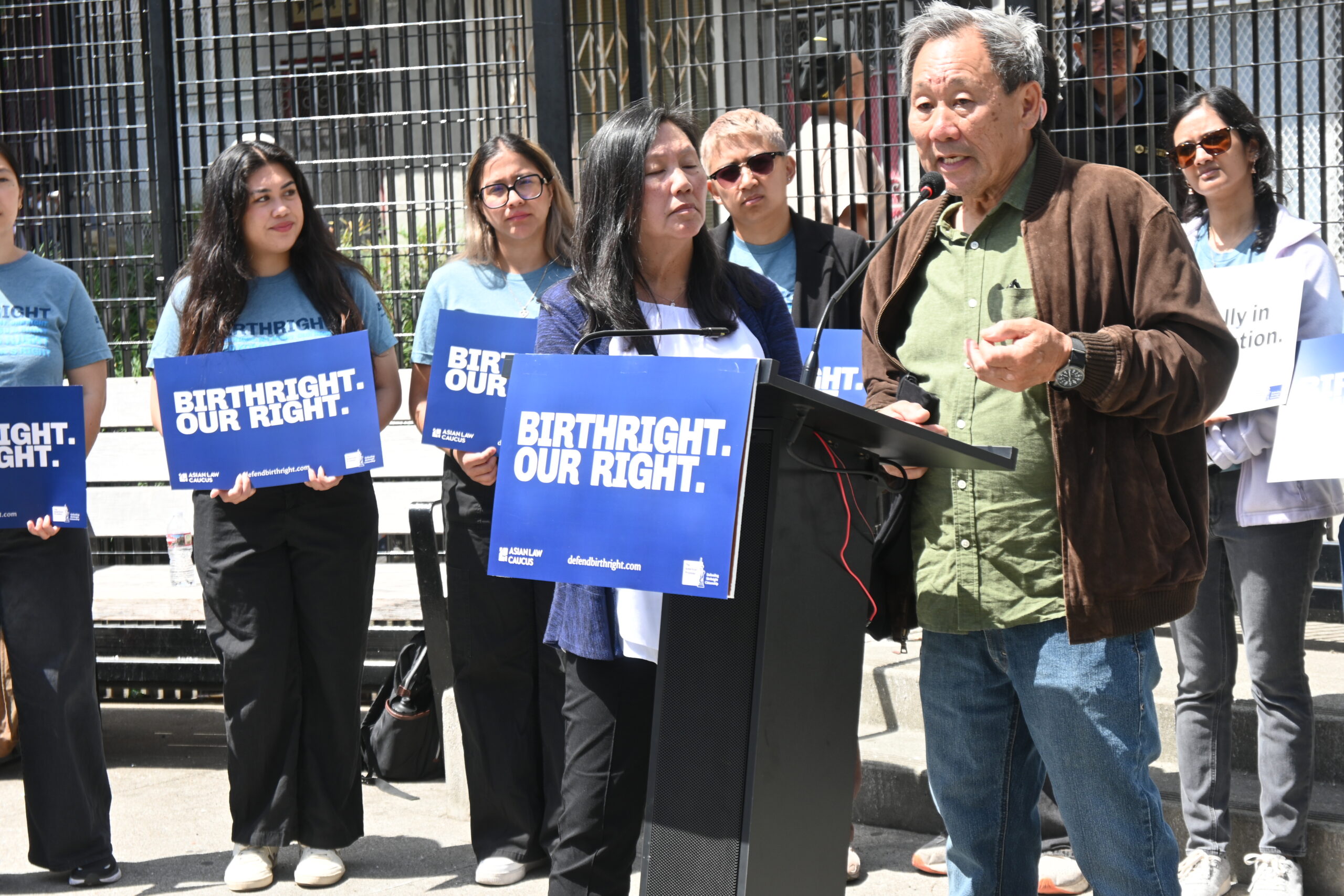
Citizenship is a right
“My great grandfather would be relieved, as we are, about yesterday’s ruling,” she said, adding: “I don’t think he even realized how impactful his case was.”
Norman Wong said at the rally that he was inspired by the courage of his great grandfather. “He is a symbol of the common man, who stood up to write our history.”
”The idea that some people can keep their rights while others lose theirs is fallacious,” said Wong. “Citizenship is not a privilege: it is a right.”
New mural honors Wong Kim Ark
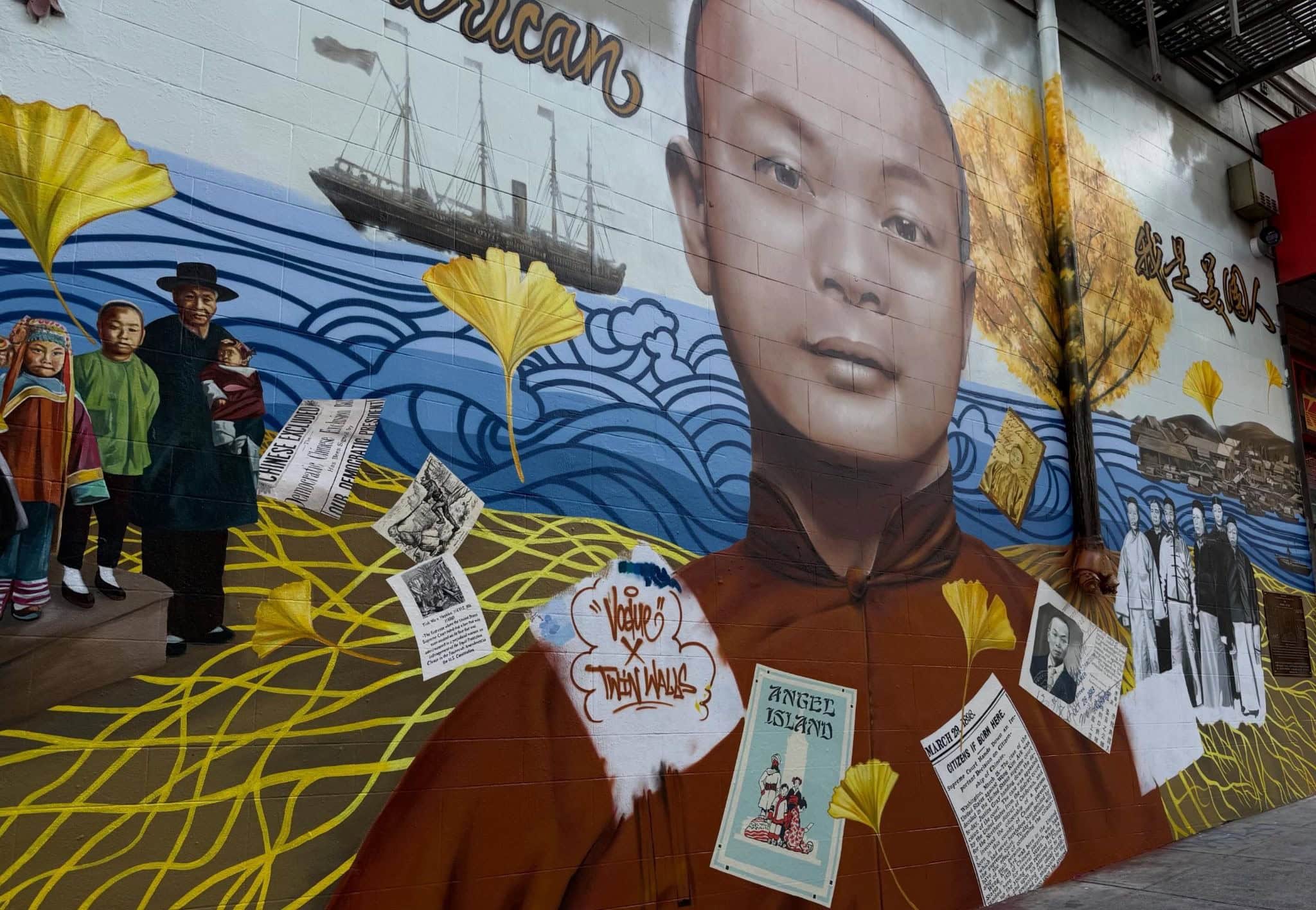
A mural honoring Ark was unveiled June 26, on Grant Ave., in Chinatown, near where Ark was born. The mural is titled: “I Am an American.”
“Wong Kim Ark is a name that most Americans never heard of until this Supreme Court case. For those of us who are lawyers though, he stands for what courage means: being able to stand up for a community and stand up for our basic constitutional rights,” San Francisco City Attorney David Chiu told ACoM at the rally. Like Wong, Chiu said the story of Ark’s historic fight for citizenship should be included in all school textbooks. He also shared that San Francisco is looking for other ways to memorialize Ark.
Last year, Chiu joined California Attorney General Rob Bonta and a coalition of local and state governments to file a lawsuit challenging Trump’s executive order.
“As goes San Francisco, so goes California, so goes the nation,” Chiu said responding to Attorney Bonta’s remark on California’s influence on the nation.
‘Victory for all immigrants’
Bonta, who spoke at the rally, said the 6-3 Supreme Court ruling affirming birthright citizenship was a victory for all immigrants. “They are our secret sauce, our superpower that has made California what we are today.”
He noted that California has the fourth largest economy in the world. “This state has led in so many places and spaces. It has led to the phrase in politics: ‘As California goes, so goes the nation,’driven by our immigrant communities.”
“With this decision, the highest court of the land has reaffirmed a basic but powerful principle. That the Constitution, not the whims of any president, is the law of this country,” said Bonta. He noted that every lower court decision on the case has found against Trump.
U.S. District Judge John Coughenour, a nominee of the late President Ronald Reagan, called the executive order attempting to end birthright citizenship “blatantly unconstitutional.”
Constitutional integrity
Bonta said he sat in the same row as Trump, during oral arguments at the Supreme Court. “I saw him bear witness to an embarrassing defeat for his administration, but more importantly, a victory for the rule of law and for the US Constitution.”
“There is no question the president is not a king. He cannot just violate the law or rewrite the Constitution based on his own personal preferences,” said the state attorney general.
“Families who shouldn’t have to fear that their children’s citizenship can be questioned or stripped away through executive overreach. This is about protecting the integrity of the US Constitution itself,” said Bonta.
The legacy of slavery
Aarti Kohli, executive director of the Asian Law Caucus, paid homage to Dred Scott, a former slave who fought to be recognized as a citizen. The Supreme Court ruled against Scott in 1857. That decision was the catalyst for the 14th Amendment.
“There is 150 years of precedent affirming birthright citizenship. Yet, conservative justices would have taken this right away if they had the chance,” she said.
Kohli said it was fitting that the ruling came down 5 days before the nation celebrates its 250th birthday. “We are at an inflection point. We can be a country that chooses hope, housing, healthcare, food on the table. A country that allows all to build a life without fear.”
”This is not about immigration. It is about who belongs,” said Kohli.
Supreme Court ruling
On the 1st day of his second term in office, President Donald Trump issued 26 executive orders, including a ban on birthright citizenship. The executive order impacted the children of undocumented residents as well as those holding temporary visas, including employment-based visas.
In a 6-3 ruling June 30, the justices — led by Chief Justice John Roberts, who wrote the 62-page decision for the majority — ruled that all children born on US soil are automatically US citizens, regardless of their parents’ immigration status.
Justice Clarence Thomas, joined by Neil Gorsuch, issued a dissenting opinion, arguing that the 14th Amendment protected only Black people who were formerly enslaved and had no other homeland. “The same could not be said for the children of foreign temporary visitors. Foreign temporary visitors were attached to their home country, lacked similar bonds to this country, and would not be called upon in time of war,” wrote Thomas.
Justice Samuel Alito also wrote a dissenting opinion, focusing on so-called birth tourism, the practice of a foreign-born woman coming to the US while pregnant to procure citizenship for her baby. He urged Congress to develop restrictions around birth tourism.
Birth Tourism
Trump has also urged Congress to develop policy on birth tourism. But Vincent Pan, co executive director of Chinese for Affirmative Action, told ACoM that the president was flatly wrong.
“The only way to change this ruling now is through amending the Constitution. This is a much more difficult path, and there’s absolutely zero support to do that,” he said.
“And so the question of birthright citizenship for now — in all practical ways — is resolved. But the fight for equality has to continue, and that has to be won not just in the courtrooms, but in the ballot box, in organizing and lots of individual acts of courage,” said Pan.
“As goes Chinatown, so goes San Francisco, and by the transitive property, so goes California and so goes the nation,” he said to highlight how Chinatown, for the first time has the major breakthrough in civil rights and immigrant rights, and it all derives from Wong Kim Ark and puts the Chinese at the forefront of the war on immigrants.