


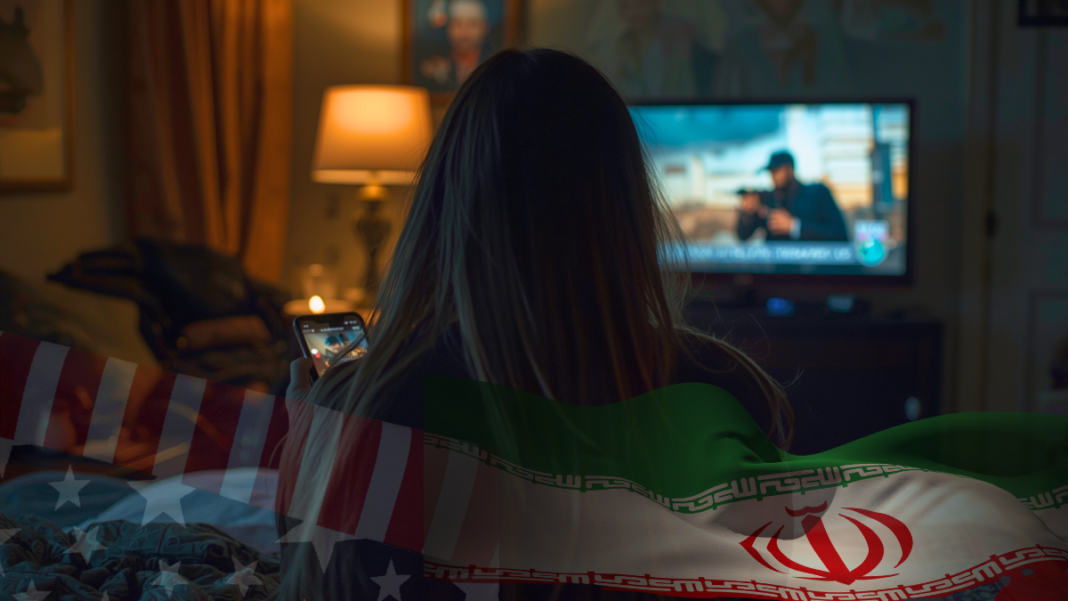
More than two months into the U.S. conflict with Iran and the two sides appear to have made little progress in talks over a possible end to the fighting. On May 12, President Trump warned Tehran that the country would be “decimated” if the two sides fail to reach an agreement. For young Iranian Americans, the conflict is both distant and immediate, a tragedy playing out on TV screens and in their own homes.
“Our house, our neighborhood, is basically destroyed,” said Ava Tarapore’s aunt, speaking from the northern Iranian city of Ramsar during a long-awaited phone call.
For Iranian Americans, the current U.S. conflict with Iran has been a tense period. For Tarapore, a high school sophomore from Oakland, the hardest part has been the cloud of sadness that has settled over her family’s house since fighting began in February.
“I compartmentalize things a lot,” said Tarapore. “I decided I just won’t read the news at school because I did that once, and then I was almost crying going into one of my classes.”
Tarapore adds that her maternal grandmother, who is currently staying with her family, is “very stressed about everything,” adding to an already tense atmosphere at home. “Everyone is so sad,” said Tarapore.
U.S. and Israeli forces began bombing sites in Iran in February, in what President Donald Trump at the time said would be a limited action. Critics say the president has yet to clarify the conflict’s objectives, whether regime change or a dismantling of Iran’s suspected nuclear program.
Tehran quickly closed the Strait of Hormuz, through which much of the world’s oil and other natural resources pass, after fighting began. The strait has since become the center point of negotiations over how and when to end the fighting. Its closure has led to what experts are saying is the worst energy crisis in decades.
The start of the war coincided with Persian New Year, or Nowruz, a time for food and family gatherings. This year’s celebrations were more muted.
“Celebrations centered around just keeping a safe space for people to talk,” said Tarapore, describing the mood during her family’s annual gathering this year. She added that her family’s sorrow “bleeds into the rest of the house … Even my little sister can feel it. I don’t think she really understands what’s going on, but it’s still there.”
As for a planned trip to Iran this summer, Tarapore — who has made two previous trips to Iran — says that, too, is on hold. “I can’t imagine going back there … it’s going to be very hard for the people to come back from this.”
For Meda (who asked that we only use her first name), a high school junior living in San Francisco, the conflict has brought home the sense of distance she’s felt toward a country she has never visited but is a permanent presence in the day-to-day life of her family.
“I can’t really know what it was like for my dad to live there, or much about what the country is like, because I’ve never been,” she said. Meda’s father left Iran at six years old, among more than 2 million Iranians who fled in the wake of the 1979 Islamic Revolution.
He has yet to return. And while Meda has extended family in the country, she says they, too, feel distant. Her grandfather, who lives in California, routinely speaks with his brother in Iran, a man she has met only once.
“The war is a tragedy … because of its impact on the Iranian people,” said Meda, adding it’s also “really sad for us to watch the divide grow between the US and Iran.”
But on a more personal level, for Meda the conflict has deepened a feeling she has long had toward Iran, which — now more than ever — she can only “watch movies and read books and see photos of … it feels very distant.”
Not so for Alex, a 16-year-old living in Oakland who says he worries every day about family in Iran. Tehran imposed a near total internet blackout after the bombing began. Almost 80% of Iranians in the US have families in Iran, yet many struggle to contact them.
Alex (who also requested that we only use his first name), whose maternal family is Iranian, also says news of the war and of the Iranian government have made it difficult for him to embrace his culture openly. “A lot of people don’t really separate people from countries,” he noted, pointing to attitudes among some of his peers. “I’m trying my best to express pride in my culture,” he said, which “can sometimes be hard.”
Iranian Americans remain conflicted, torn by a desire to see a change in leadership in Tehran and fears of expanding violence. In an Easter morning social media post President Trump warned, “A whole civilization will die tonight,” comments widely condemned at home and abroad. On May 4 the president said Iran would be “blown off the face of the earth,” if it did not meet his demands for reopening of the strait.
President Trump also rejected the latest proposal from Tehran this past weekend, raising fears that fighting could begin again.
“In the Bay Area people definitely overall believe the war is bad,” said Meda, pointing to recent May Day protests where criticism of the war was a prominent theme.
Meda says the Bay Area’s political climate takes some of the sting out of watching this crisis continue to boil.
Still, says Tarapore, the mood at home is “sometimes … just too much.”
Sophie Martin attends The College Preparatory School in Oakland, California. (Class of 2028). A section editor of her school newspaper, she loves writing and aspires to become a journalist.


It is so valuable to have the youth perspective — thank you Sophie Martin.