


Danielle Parenteau-Decker | Richmond Pulse
Deliberately inaccurate information comes in many forms, much of it about the COVID-19 pandemic. It can create doubt, anger, unrest and fear.
It takes a tidbit of truth or a reasonable concern, twisting the truth or magnifying and manipulating any fear.
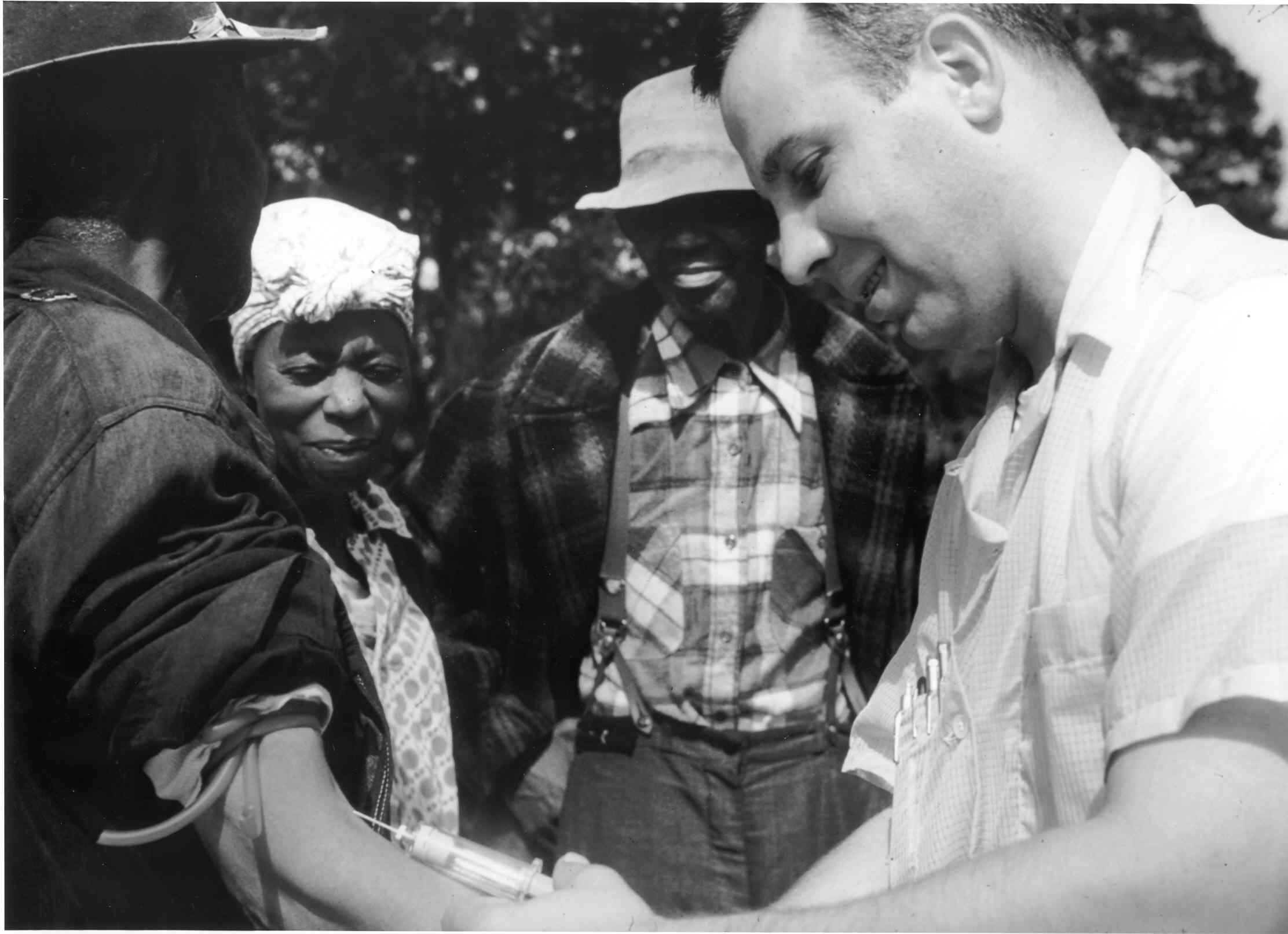
That is what happened with a 2021 video that twisted the real history and trauma of the U.S. Public Health Service Syphilis Study at Tuskegee to advance an anti-vaccination agenda. Two of the men behind the 2021 debunked video were Robert F. Kennedy Jr. and David Centner. Kennedy is a noted anti-vaccination activist. Centner co-founded a Florida private school that discouraged teachers and students from getting vaccinated against COVID-19.
The legacy of Tuskegee
People who spoke to Richmond Pulse last year about COVID-19 vaccine hesitancy among the Black community repeatedly pointed to the Tuskegee study. They said that while disinformation was a factor in why some Black people were reluctant to get the vaccine, for many, the distrust created by decades of mistreatment by the government and healthcare system was a far bigger reason.
The 2021 video brought those things together. NBCNews.com reported that it “promotes false claims that COVID-19 vaccination efforts are part of a larger, sinister experiment on Black communities.”
“Real facts on the ground can be powerful ways to amplify or get people to believe mis- and disinformation,” said misinformation expert Cameron Hickey in a Feb. 8 Ethnic Media Services press briefing. “The African American community was experimented on by the United States government, so that leaves us in a position where that community rightly has some skepticism of [the idea that] now you should trust the government.”
“The Black community has been historically attacked, marginalized and sabotaged,” Nicole S. Grove, editor in chief of the Harvard Kennedy School’s Misinformation Review, told the Pulse via email. “As a consequence of things like centuries of undisclosed medical experiments, the subversion of black industry through redlining, and clear histories of law enforcement collaborating with racist vigilante groups like the KKK, they have more cause than most to distrust institutions…”
Brandi Collins-Dexter of the Harvard Kennedy School’s Shorenstein Center on Media, Politics and Public Policy told NBC News the video “sought to take advantage of the pain felt by Black communities.”
Collins-Dexter, who is Black, added that the film’s most obvious manipulation tactic was “to liken vaccines to the Tuskegee Study.”
“When you say ‘Tuskegee experiment’ to Black people, that’s automatically going to mean something that feels truthful, and that opens the door to a sort of manipulation…” she said. “But they don’t contextualize what it means.”
Mis-information ‘thrives’ where trust is low
Taking something out of context is a common strategy behind a lot of disinformation and misinformation.
Hickey said that false information and misleading claims are sometimes shared with legitimate news sources to make them seem more believable. Information is also shared that is technically true but “lacking critical background details” or perhaps was once true but no longer accurate or relevant.
He said recognizing the no longer accurate or relevant notion is “particularly important in the ever-changing world of public health information.”
The RFK Jr.-backed film also used another dubious anti-vaccination strategy: co-opting civil rights language.
“Anti-vaccination activists have targeted marginalized groups for years,” NBC News reported.
“Misinformation thrives in low trust environments,” Grove said, “particularly among people for whom institutional failures in the past have produced scenarios where it makes more sense to believe that the worst is true.”
It is important to understand why these claims resonate with people, Hickey said. Just throwing facts and data at people and expecting them to immediately admit they were wrong and change their mind won’t work — with anyone.
“I’m not sure the solution to this should simply be getting more and better information out there,” Grove added.
Addressing the information deficit
One step in countering disinformation, Hickey said, is considering the “information deficit.”
“If a piece of misinformation is spreading and if it’s being amplified,” he said, “the first thing we want to do is think about, what is the gap, what is the information people don’t have that creates the space for this message to gain traction?”
Additionally, getting people to move away from bad sources “requires dialogue” and “engaging with someone in a responsible and empathetic way,” he said.
He suggested asking questions such as “Why does this make sense to you?” and “What are the fears or concerns that lead you to believe this?” Then, offer to explain your own perspective, what you have learned about the issue and how you came to your conclusions.
Also important is who is starting these conversations and where they happen.
That’s the reason behind the state of California undertaking efforts to overcome COVID-19 vaccine hesitancy by having “trusted messengers” talk to people in the “places they tend to be,” says Ashley Clark, press secretary for the state Office of Community Partnerships and Strategic Communications.
Clark, who is Black, said the state has done vaccine outreach and hosted vaccine clinics in places such as churches, beauty salons, barbershops and farmers markets to make it easier for people to get “resources and information that’s accurate and reliable.” Then, if they want, they can get the shot.
Black doctors are among those delivering the information “so that folks can see themselves in the people that are providing them with this key information that they need to be able to get the vaccine and feel comfortable doing that,” she said.
The state has also worked with gospel artists and pastors through its Shot of Faith program. Clark said churches have “been very important” in reaching the Black community.
Lower life expectancy
She also said “the vaccine is all the more important” for Black people, partly because they are more likely to have preexisting conditions “that COVID takes advantage of, and it has led to many deaths in the community,” as well as long COVID. She pointed to a study that showed that life expectancy had dropped across the state since the start of the pandemic, “but for Black communities, it was by … a little bit more than the average.”
“Seeing that lets you know right there that we need to do what we can to combat misinformation that is preventing folks from getting the vaccine so important to them and their health,” she continued.
Over time, efforts to overcome disinformation, distrust and access issues have showed positive results.
“I still have a segment of patients that just don’t feel comfortable with getting the vaccine, but thankfully those are fewer and fewer in number,” Dr. Jennifer Miller said in February. Miller, a Black East Bay physician, spoke to the Pulse last year about vaccine hesitancy.
Many people got vaccinated. Then, the booster shots came out, and they didn’t go back for them.
“Several [patients] have gotten the primary series, but the uptake of the bivalent booster has been much lower,” Miller said.
She said some “are not convinced that the bivalent booster is making any worthwhile impact” because people still get sick.
But Clark said people “need the vaccine to prevent the more severe outcomes of COVID.”
“It has been a bit of an uphill climb for the booster,” she said. “Folks are tired of getting shots.”
“It’s important to make sure that we’re up to date with that booster dose to make sure we’re as protected as possible,” Clark added.
This story was produced as part of Ethnic Media Services’ COVID Myth Busters series with funding from the California Department of Public Health.