


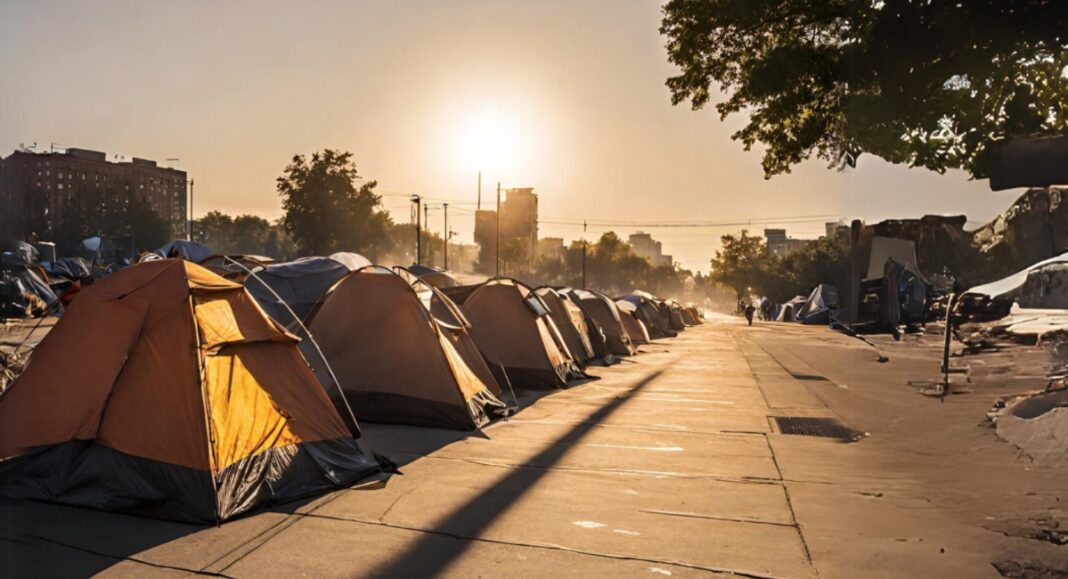
Above image generated using AI software.
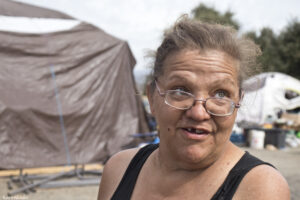
Donna Shepard spent some of Chico’s hottest days this past summer hunting down water.
Shepard lives at the encampment known in Chico, about 90 miles north of Sacramento, as the “alternate site” -– the homeless campground the City established to comply with a lawsuit settlement -– and though a spigot was installed, the water it released in the middle of a hot day was itself often too hot to touch.
After collecting water elsewhere, she’d douse herself and her three small dogs. “It gets so hot out here I almost lost Dixie,” she said of her 15-year-old Chihuahua mix. Her two other dogs are service animals; she describes herself as “four times legally blind.”
“My service dogs are my heart,” said Shepard, a licensed caregiver who at 46 found herself unhoused after losing a job.
As the climate crisis produces more homelessness in the western United States, homelessness becomes more difficult to survive because of extreme and unpredictable weather. And because most of the large, unauthorized encampments in Chico have been broken up with eviction sweeps, unsheltered people increasingly rely on their own resourcefulness — and local nonprofits — for survival and support.
The Chico Police Department has sent out more than 13 “Death in Public” press releases so far this year involving the discovery of deceased persons found in public spaces.
Meanwhile, nonprofits that assist the unhoused are on a continual hunt for grants and scramble for donations as demand for their help grows.
Shepard’s sheltering troubles started after the 2018 Camp Fire when her Chico landlord sold her rented home to a fire survivor. Her father passed away from Covid two years later. She became homeless in June after losing her job, called the 2-1-1 referral number to ask about sheltering options, and says she was told, apparently mistakenly, that she could stay temporarily at the alternate site campground. She’s now in danger of eviction there because the City says she doesn’t have the authorizing referral needed.
Shepard is among many longtime Chico-area residents who face housing troubles directly or indirectly related to the Camp Fire. A consulting firm’s study prepared for North Valley Community Foundation showed vacancy rates in the area plunging from up to 2.3% before the 2018 fire to less than 0.5% within the 60 days after.
There are likely more than the 925 people who were identified as unhoused in Chico in January. The Butte County Continuum of Care (CoC) that conducts the census says it probably produces undercounts. Some unhoused are middle-aged adults who have lost jobs or family and can’t rent on a social security or General Assistance income, some live with medical conditions or addiction, some are wildfire refugees.
Patrizia Hironimus, executive director of Butte Environmental Council, said fire survivors are clearly “climate refugees” as droughts produce more wildfires that are more aggressive.
“We need longer term planning for the hundreds of thousands of people who will become climate refugees in the coming years,” Hironimus recently told journalists at a statewide news briefing.
Comfort in company
At a recent mutual aid event in City Plaza, people lean against planters, chatting quietly and sharing a dinner provided weekly by Chico Red Meals. Most are homeless, but some are low-income Chico residents struggling to cover rent and food costs. Community organizations have dropped off donated clothes and water bottles.
Nathan Beakley’s bike basket has less than a half loaf of white bread and a partially consumed soda; he says he fell into homelessness after moving into the Depot Park homeless encampment that was cleared by the City last month. He hoped to make a documentary, he says, but without any income quickly exhausted his resources and “became one of them.”
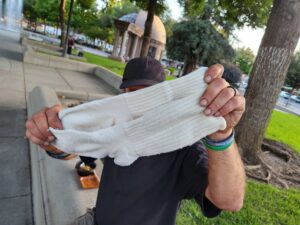
He says he struggled with alcoholism earlier in his life and underwent rehab. At one point in the interview, Beakley reaches into his pocket and pulls out a damp, folded two-page resume stained with something black, perhaps bike grease.
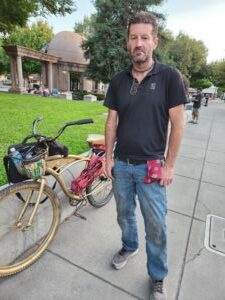
Beakley’s resume impresses: It indicates he has a Bachelor’s degree in video production and computer graphics from Chico State, and shows experience in video editing and as a computer technician.
“It’s tough to live like that,” he says of the unauthorized Depot Park encampment that so frustrated nearby business owners. “I was there almost three months, but it feels like two years. I saw it all.”
There were both terrible and surprisingly nice things that happened, he says. Lack of lighting “brings in the dealers at night” and fentanyl circulated among some. But a dining table was set up during that three months, and many other campers found support in the camaraderie and discussion that took place. “That table was special,” he says.
On one triple-digit hot summer day, Beakley says he passed out downtown. A Starbucks’ employee called an ambulance and a dehydrated Beakley was taken to the ER.
At the mutual aid dinner, Jason M. is chatting with a slim, blonde woman, Stacey, and neither want to be fully identified. “We’re walking targets,” Stacey says, referring to the harassment homeless people face. (Residents at the alternate site campground say they’re fired at with pellet guns, and in fact someone fired BBs at the camp while ChicoSol journalists were visiting Sept. 29.)
Jason, 49, has a gentle manner and, he says, experience in construction. As someone who has been in and out of homelessness for a decade, he’s what the Butte County Continuum of Care (CoC) calls “chronically homeless.” The CoC says most of the chronically homeless struggle with a disabling condition, and the number reported this year -– 379 -– “reflects an ongoing decrease” from 2017 even though there was a slight increase over 2022.
Jason wants off the streets for good, and he’s developed tricks to survive in the meantime. He places a wet rag on the back of his neck on hot days and rolls up in a piece of plastic in the rain. But the biggest problem, he says, isn’t the weather -– it’s the isolation he now endures.
Jason was evicted from the sprawling Comanche Creek encampment last year. Now, the mutual aid dinners bring a few minutes of welcome relief by providing him with a meal and companionship.
“The hardest thing is being alone,” he says. “This [dinner] brings everyone together. It’s definitely a good idea.”
Chico’s dangerously hot days have increased in number dramatically, says Climate Central, a nonprofit staffed by scientists and communication specialists. Climate Central says that number has gone from 37 in 1970 to 70 in 2022 and 74 the previous year.
Hot weather is likely to stretch into fall and spring in the future, said Braden Kay in the California governor’s Office of Planning and Research, and the state has launched a “Heat Ready” program to provide information and help fund heat preparedness outreach by community-based organizations.
“One of the challenges with climate change is that it’s not just change, its chaos,” Kay said at a Ethnic Media Services news briefing. “It’s not a linear path that every summer is going to be hotter; the weather is going to be more unpredictable.”
Andy Frerks, Bear Fire survivor
When the winter sheltering program run by nonprofit Safe Space ended on March 4, Executive Director Hilary Crosby became particularly worried about client Andy Frerks. Frerks, 70, was undergoing cancer treatment and had become homeless during the 2020 Bear Fire.
During that wildfire, Crosby said a tree fell and destroyed his Berry Creek mobile home.
“He had been a truck driver and was such an interesting person,” Crosby said. He was too medically fragile to be housed in the congregate shelters and “wasn’t somebody qualified to stay in the hospital.”
Crosby and her team looked for him in vain, and his body was found in the Oroville area on April 10. “He had been afraid to die alone,” she said. “He didn’t get treatment for his cancer and didn’t get to die in a loving, compassionate way.”

Crosby said the City’s eviction sweeps make it difficult for outreach workers to stay in contact with people on the street because the unhoused that are evicted become “dispersed all over.”
Chico PD’s ‘body found’ press releases often include “no foul play suspected,” making it seem likely the deaths were related to homelessness. For example: On Sept. 19, a body was “floating face down” in Big Chico Creek; on Sept. 7, a body was found “down in the bushes” off Business Lane; nine days earlier a body was found off Humboldt Road.
Mary Kay Benson, active with Butte County Shelter for All, has set up a Google document showing that 10 of the people have been identified despite the challenges. It doesn’t help that the gender of the person who’s found is often not mentioned, she said.
Meanwhile, Safe Space, which provides extreme weather sheltering for limited hours at local churches is gearing up for a 10- to 12-week winter program. Overnight sheltering will begin in December.
The City provides up to $5,000 monthly, but the winter shelter program costs $70,000, Crosby said. The biggest cost during sheltering season is the four-person staff. A $100,000 grant helped fund the summer cooling center and runs out at the end of the year, forcing Safe Space to look for more grant funding.
“It’s incredibly hard not to rely on sustainable funding,” she said. “Sustainable funding is the gold standard. Small donations support our program, but our community can’t afford $70,000.”
In addition, a couple of churches have ended their participation. Participating churches have to be willing to foot the electricity bill, and many churches have an aging population and a decreasing number of parishioners. “Some of our providers are feeling tapped out,” Crosby said.
Crosby said an “analysis of weather patterns” suggests that February and March of next year will be the wettest months. In that case, Safe Space, she said, will need to extend the sheltering season.
Leslie Layton is the editor of ChicoSol, a digital publication covering issues impacting vulnerable communities in the Northern Sacramento Valley, where this story first appeared. This is the first in a two-part series on homelessness in Chico in 2023.
This story was produced as part of a collaboration with the Office of Community Partnerships and Strategic Communication for their Heat Ready CA public awareness and outreach campaign. Visit Heat Ready CA to learn more.