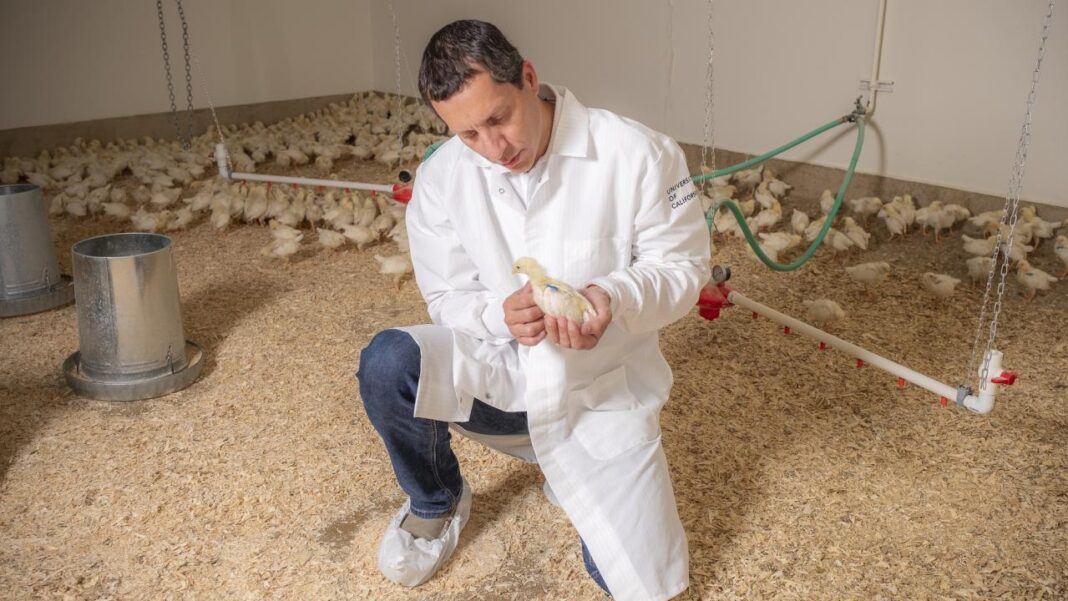
The next major pandemic of Covid-like proportions will likely be avian flu, a respiratory disease already killing millions of poultry and waterfowl, and infecting thousands of cattle.
Currently, there is a version of H5N1 — the avian flu virus — on six continents, an unprecedented event, said Dr. Maurice Pitesky, associate professor at the UC Davis School of Veterinary Medicine, who focuses on highly pathogenic avian influenza disease modeling.
The virus spreads via an infected waterfowl’s fecal material, said Pitesky, noting that many dairy and poultry farms have lagoons and other large bodies of water nearby. Feral cats that roam around dairies are also conduits for spreading the virus, as are infected farm and factory equipment.
Immigrant Workers at High Risk
Workers in poultry and dairy industries are at a unique risk for catching an infection: humans who have close contact with sick birds can catch the virus when it gets into a person’s eyes, nose or mouth, or is inhaled. Wearing Tyvek suits, gloves, masks and other personal protective equipment can be extremely challenging in the immense heat, said Pitesky.
Vaccinating chickens is a Herculean task: the US currently breeds about 8 billion chickens per year. Containing spread to particular regions is also difficult: animals are only tested when they cross state lines.
“Avian flu is a risk to all of us at some level; there’s so much virus floating around. There’s a lot of new research that’s focusing on virus in wastewater from human wastewater treatment facilities,” he said.
Extremely Deadly
Bird flu is extremely deadly in humans, said Dr. Peter Chin-Hong, professor of Medicine and director of the immuno-compromised host infectious diseases program at the University of California, San Francisco.
It appears like a very bad flu, but the fatality rate is much higher, he said.
Both researchers were speaking at a May 24 Ethnic Media Services news briefing.
“The reason why it’s so deadly initially in humans is because we’re not used to seeing this kind of infection. It’s almost like the early days of COVID. So we don’t have the necessary immune system to target it,” said Chin-Hong.
“It is possible that we can have a pandemic at some point in the medium term,” he stated.
Spanish Flu
The 1918 “Spanish flu,” which killed more than 50 million people worldwide, was caused by an H1N1 virus with genes of avian origin, noted Hong. He added however, that better detection and therapeutics today could decrease the number of human fatalities.
Only three cases of humans infected in the US have been reported thus far. In each of those cases, the infection presented with conjunctivitis — pink eye — and symptoms were relatively mild.
But Chin-Hong and Pitesky believe there is a vast under-reporting of avian flu infections in humans. Immigrants make up 56% of workers in the meatpacking industry and 28% of workers in the poultry industry, according to data from the Economic Policy Institute.
Federal Interventions
Employees work in tight quarters, with little or no protective equipment to ward off exposure to the virus. Immigration status, as well as losing out on pay during a sick day, might discourage workers from reporting, said Chin-Hong.
“Those three cases we know about are just the tip of the iceberg. We don’t even know how many people have asymptomatic infections,” he said.
“There’s a fear of deportation. So if there was some regulation around immigration amnesty, I think it will help all of us.”
Income assurance for those who get sick and for farms who must shut down during an outbreak could also potentially lead to better reporting, he said. The federal government does provide $50,000 per day to temporarily-shuttered farms.
Raw Milk
Humans could potentially get the virus from drinking unpasteurized milk or eating unpasteurized cheese, said Chin-Hong. He referred to a recent study in which mice were given milk from infected cows with H5N1. “It left the gut and actually went to the lungs and caused them to be very sick.”
Pitesky said he was also concerned about avian flu from a food security perspective. “Poultry is the number one consumed animal protein on the planet. It’s relatively inexpensive and healthy. What we’re dealing with right now is an existential crisis to the poultry industry globally.”
“If we’re going to feed 2 billion more people in the next few decades, poultry is probably part of that solution. And if we can’t get a good handle on this, I’m afraid that that’s gonna be a real challenge for us. Food security is really important for global stability,” he said.