


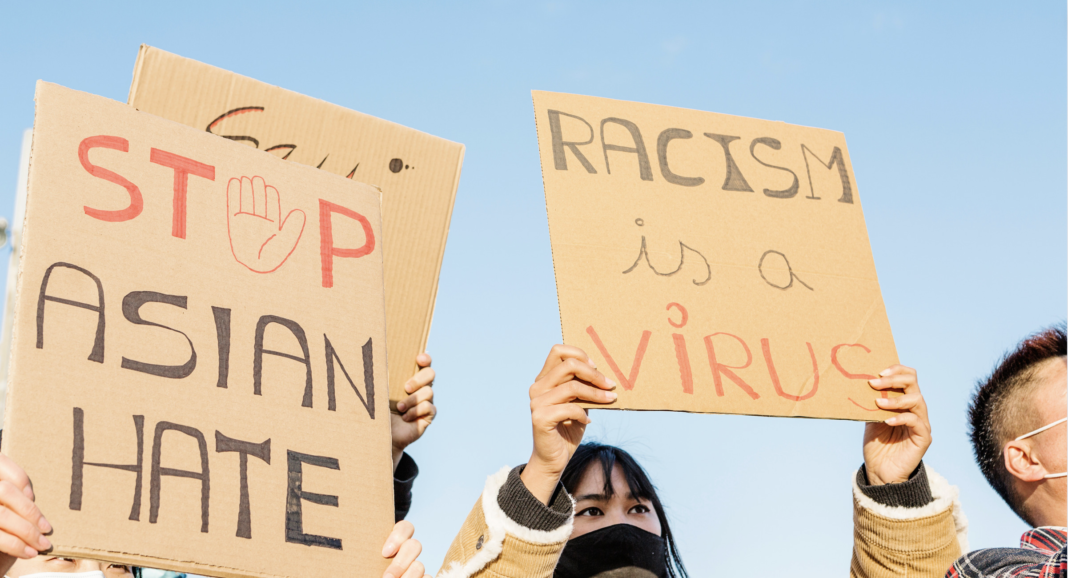
Against historic surges in anti-Asian hate since the pandemic, a new pilot program is helping AAPI communities heal from hate crimes.
The Healing Our People Through Engagement (HOPE) program uses a “Radical Healing Framework” to help the five largest Asian communities in Los Angeles County — Cambodian, Chinese, Filipino, Japanese and Korean — respond to past and ongoing racism.
The project is funded by the California Department of Social Services and led by the AAPI Equity Alliance, an LA-based coalition of over 40 community-based AAPI organizations.
Racism and the Radical Healing Framework
During the pandemic, Asian Americans — comprising over 15% of California’s population, or six million people — experienced “brutality on a scale not seen for generations in this country,” said Michelle Sewrathan Wong, managing director of programs for AAPI Equity Alliance. “They were scapegoated by politicians for transmission of COVID, targeted for violent physical attacks, made to feel unwelcome in their own communities and bullied by neighbors and strangers alike.”
Since 2020 alone, over 11,000 cases of AAPI hate have been reported to Stop AAPI Hate, an organization co-founded by AAPI Equity.
“Exploring the devastating toll this was taking on our community, and its root causes … led us to a Radical Healing Framework that moves beyond individual-level approaches to coping with racial trauma.” she continued. “Our community was suffering an epidemic of isolation, anxiety, and depression … Racism doesn’t just occur on an individual level, and healing, hoping for a different future, requires collective action.”
“Decades of research shows that racism can harm both physical and mental health, leading to symptoms of depression, anxiety and PTSD, as well as headaches, trouble sleeping, hypervigilance and withdrawal from other people,” Dr. Anne Saw, associate psychology professor at DePaul University and one of the designers of the HOPE program.
“This program is the very first community-based program developed from Radical Healing psychology, to address the mental health impacts of racism for Asian Americans,” she continued.
The Framework, developed by a multiracial team of psychologists in 2020, builds upon decades of Black liberation psychology research, Saw explained. “It emphasizes healing rather than simply coping with the traumatic impacts of racism by helping communities see how their experiences are connected to histories of injustice and brainstorming actions we can take to protect our own well-being.”
“After this pilot phase of the program where we learn what works best, we hope to offer it to any Asian American who wants it,” she added. “To fight against racism as a whole requires solidarity across races, so we’d also like to work across different communities of color.”
Radical Healing in action
“Initially, there were doubts about whether this program was needed in the Japanese American community,” said Xueyou Wang, HOPE facilitator and social services program assistant at Little Tokyo Service Center. “We soon realized how much we needed it.”
In weekly community action groups, participants ranging from new Japanese immigrants to fifth-generation Japanese Americans “talked a lot about micro-stressors building up during the pandemic; for example, that being Asian American and wearing a mask in public made them feel like targets for attack, or when they saw another Asian American person in a crowd, they would feel the need to protect them,” Wang explained, “given all the violence on the news.”
“A big concern for new Japanese immigrants was the loss of culture, while Japanese Americans who had been here longer feared the loss of history; for instance, of grandparents surviving the internment camps,” she continued. “We had a call to action about an issue they saw in Little Tokyo today, which was gentrification, which we realized also encompasses this loss of culture and history … it was empowering to express these fears as something we could tackle rather than feelings to push aside.”
“Our weekly group had four Chinese American participants including a man who had lived and worked in the U.S. for many years, two international students who recently entered the workforce and a women in her 40’s who grew up in a predominantly white community in California,” said Yu Wang, HOPE program facilitator, and associate marriage and family therapist at Asian Pacific Counseling and Treatment Center.
“Although the woman initially expressed distrust and hopelessness about our community, saying she didn’t feel Asian or Chinese, after seeing others share their stories of traumatic experiences she said it was the first time she felt truly accepted in wanting to explore her own identity,” she said.
“The students said that before the group, they didn’t see this community as a resource, whereas after they did see it as a way to improve their well-being,” Wang explained. “The older man initially often dismissed other participants’ parallel stories of racism, but after a few sessions, reflected that racism can occur on a structural level.”
“Our group had five Korean participants between their 20s and 30s,” said Joann Won, HOPE facilitator, at Koreatown Youth + Community Center,. “As someone who is Gen Z growing up in Koreatown, I always understood racism on a theoretical level but had the privilege of not personally facing it in any explicit or aggressive way. Sharing stories, we quickly learned that this changed for all of us during the pandemic.”
“I shared how my parents were worried to the point where they were afraid of stepping out of their homes, just going to the grocery store, because we kept hearing about all these crimes nationwide,” she said.
“One first-generation immigrant participant revealed such pain and catharsis expressing her experiences for the first time, including how being outcast within her neighborhood and being looked down on for cultural differences and her accent affected her mental health,” she added.
“We were strangers when we started HOPE, but by six weeks we were going out to lunch together,” Won said, “having built a community on the shared understanding that we’re no longer isolated in our pains.”
“It all made me think about how wonderful this program would have been for older generations, like my own parents, if they could have had the space of connection to heal from trauma relating to racism,” she added. “What really set us up for success was understanding that just because we’re all Korean, or Asian American, doesn’t mean we have the same experiences — but we can hold space for our differences.”

This resource is supported in whole or in part by funding provided by the State of California, administered by the California State Library in partnership with the California Department of Social Services and the California Commission on Asian and Pacific Islander American Affairs as part of the Stop the Hate program. To report a hate incident or hate crime and get support, go to CA vs Hate.

