


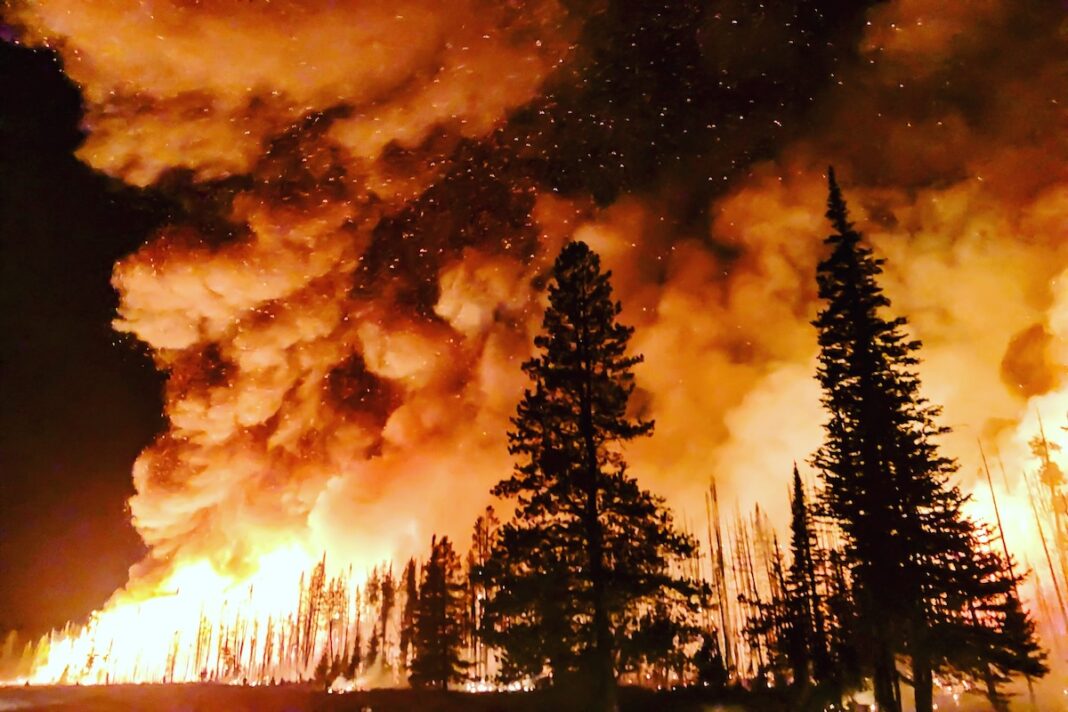
By 11:30 p.m. on July 24 – the day that some Chicoans heard that a fire had started near Upper Park’s Alligator Hole, an area that hasn’t burned in a very long time – the blaze had devoured 6,465 acres.
The next morning, Cal Fire reported that by 6:46 a.m. the scorching-hot fire, driven by south winds, covered 45,550 acres. The fire had moved at a speed so stunning that while most Chico-area residents slept, it had covered on average almost 6,000 acres an hour.
The Park Fire is one of the fastest-moving — perhaps the fastest — of the so-called catastrophic fires that have occurred in Northern California in recent years. But speed isn’t the only characteristic it shares with megafires. Like other explosive wildfires in recent years, it doesn’t sleep.
“It used to be that fires went to sleep at night, and that’s often when [firefighters] made the most gains on them,” said Mark Stemen, a Chico State University environmental studies professor. “The Park Fire’s greatest gains were between 1 a.m. and 3 a.m. on the first morning. It ran big that night.”
As this summer closed in on the hottest July ever, night-time humidity has been low most nights, accompanied by winds that have been “stronger and steady,” said Sergio Arellano, who is working with Cal Fire’s public information office and has 18 years of experience in fire service.
“This is the trend – lower relative humidity at night with stronger gusts of wind,” Arellano said. “That’s why you’re seeing more activity at night.”
The Park Fire is a stunningly fast night stalker. “This is a rate of spread we’ve not seen before – 5,000 acres an hour,” Arellano said. “This is the fastest fire I’ve seen.”
The speed of the Park Fire has made it – in a mere six days – one of the seven largest wildfires in the state’s history.
Stemen says the conditions described by Arellano – the low humidity and the windy, hot nights – are because of climate change. For decades, Chico had an average of four days a year with temperatures over 104 F. This summer, there have so far been 29.
Cal Fire said today the Park Fire is more than 370,000 acres in size and only 12 percent contained. Five structures have been damaged and 109 destroyed in what is a mostly rural area north of Chico. Officials are describing the fire as unstable and unpredictable.
“We’ve been seeing activity day and night,” said Jahaira Zaragoza, a Cal Fire public information officer. “You wake up in the morning and it’s doubled overnight. Our fires have evolved. A few years ago, we would consider a large destructive fire to be less than 13,000 acres.”
Zaragoza, speaking early today with ChicoSol, noted that Cal Fire is concerned that the Park Fire on July 28 jumped Highway 32, and conditions for firefighting were likely to worsen after a day or two of cooler temperatures. “Smoke is clearing out and that is going to allow the wind to fuel the fire,” Zaragoza said. “They are preparing and anticipating for some battles today.
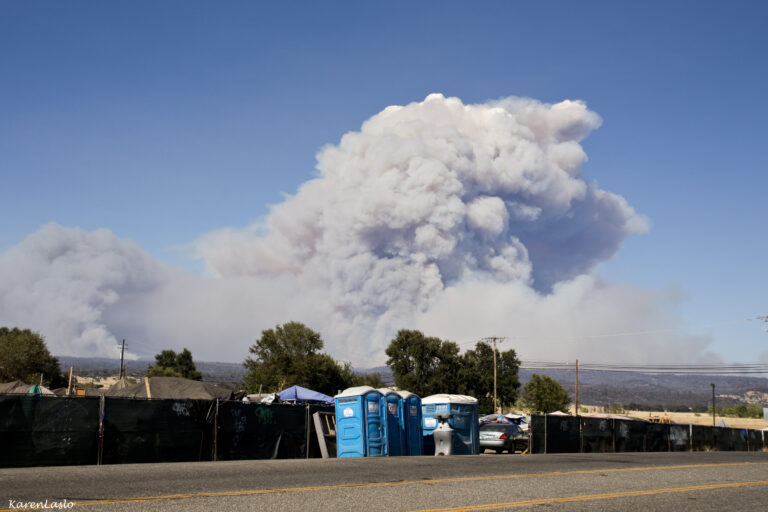
“There’s a lot of lava rock in the northern section of the fire,” Zaragoza said. “It’s very difficult terrain. We had winter storms just a few seasons ago, so those dead and dying logs that were knocked over by the wind, they’re now on the ground. There were extensive rains just a few years ago; that created a lot of fuel. There are annual grasses to full-on timber on the ground.”
Officials say Cal Fire has been successful in halting the fire on the lower and west sides.
But climate change has produced a whipsaw of weather extremes in California, Stemen says, that can make fire control difficult in some areas. “We have wet winters that produce all this vegetation, and then the dry summers.”
A study funded by the National Integrated Drought Information System showed that most of the increase in huge wildfires during the past 50 years “is due to human-caused climate change.” And the science journal Nature shows in a recent article that “night-time fire intensity has increased, which is linked to hotter and drier nights.”
Stemen said fires are burning faster, hotter and at night because of what’s called, in scientific terms, “vapor barrier deficit.”
“As the air gets thirstier, it sucks the moisture right out of the ground,” he said. “The air is so thirsty that it literally starts pulling moisture from the soil.”
Stemen said the man who has been accused of pushing a car into the creek ravine created a problem that exploded because of climate change. “While some yahoo drove his mom’s car into a ravine, climate change drove the fire all the way to Tehama County,” he said. (Ronnie Dean Stout II was charged with arson today in Butte County Superior Court and hasn’t entered a plea in connection with the incident.)
Retired Chico State political science professor Beau Grosscup lost his Cohasset home Friday – probably in the middle of the night, he says – and blames firstly the man accused of pushing the burning car. But he knows climate change played a part in the fire’s voracious nature.
“We’ve been affected not just by [climate change],” Grosscup said today, referring to him and his partner, “but also by the ideological challenge to science.”
There hasn’t been the “political will” by those in power to undertake the “fundamental change” needed to confront human-induced climate disaster, he said.
Cal Fire’s Zaragoza didn’t want to discuss climate change, but said one important tool for firefighting is prescribed or controlled burns – fires set deliberately to eliminate ground cover in an area that can then act as a firebreak. A fire that is kept low and slow can also help regenerate vegetation, such as ponderosa pines.
A prescribed burn can prevent a wildfire from “going up into the canopy of the trees,” she said.
But while the Park Fire inadvertently produced some “clean burn” areas, it is largely what fire officials call a “dirty burn.”
“This is a catastrophic fire,” Zaragoza said. “Catastrophic in the sense that it’s a massive wildfire that outpaced us, that outgrew us, and of course we have a lot of damage to the wildlife, forested areas, and homes as well.”
This story was originally published by ChicoSol and is republished here with permission.