



CHICO, Calif. — Picture this: It’s a hot day in the North State in early July, and after a 3 p.m. meeting with an attorney, a Glenn County personal trainer stops at a gas station to fill his tank. Suddenly, several vehicles including a Ford Explorer pull up around him. Eight men surround him and tell him he’s under arrest.
That’s roughly how the terrible odyssey back to Mexico began for a Chico-area man who opted for deportation after an interview at Redding’s Immigration, Customs & Enforcement (ICE) sub-field office. ICE gave him a couple of options, neither of which sounded good: Spend what might be years in an overcrowded detention cell or deport.
In a telephone interview from Mexico, the former personal trainer asked for anonymity to protect his safety in a western Mexican state that has become infiltrated with cartel activity. It has been 32 years since he emigrated with his parents and siblings to the United States; Mexico is a different country than the one he left at age 13.
Now, at 45, far from parents, siblings and children, all of whom are U.S. citizens, he’s starting over. “I miss my life,” said “Jorge,” whose name was changed in this story. “I miss everybody; I don’t know anybody here. You really feel like, ‘What the hell am I doing here?’”
Jorge obtained a valid Social Security number as a dependent minor – his father had been working and paying taxes in this country for years — but he never obtained citizenship or permanent residency. That makes his family, like many Latino families, mixed status, and like many, torn apart by “targeted enforcements.”
Targeted enforcements have produced agonizing separations and hardship when ICE has arrived in search of an individual who will be detained. Many of the non-citizens who have been detained have been subject to expedited removal – deportation without an immigration court hearing – or pressed, as Jorge was, to agree to quick deportation.
On a property in the rural Northern Sacramento Valley, Jorge occupied a small house adjacent to two other family houses. His parents founded two successful businesses, making their immigration story one of success built on family bonds. Family members gave interviews to this reporter with the understanding that only their first names would be used.

A traumatic journey to Mexico
Jorge loves to sing, and loves horses. His older sister Ana fondly describes him as a “very buff guy,” and showed this reporter a video of him in a cowboy hat performing with a mariachi band. He trains horses to dance in parades and shows in the Mexican tradition.
Like most immigrants who have been swept up in the ICE dragnet this year, he has no record of violent criminal activity. The Cato Institute reported in June that since October 2024, more than 93 percent of immigrants who had been booked into detention had no violent crime convictions.
His family says he had an outstanding traffic warrant because of an unpaid speeding ticket, and an unresolved legal problem related to child support. On the afternoon that he was detained, Ana took him to see an attorney to begin the process of resolving those issues. Maybe then he could apply for legal residency based on family ties, she thought.
“I told him, ‘They’re going to be picking people up,’” Ana said. “You need to get a lawyer and re-open the case. That’s why we went.
“He was with me around 3 in the afternoon,” she said. “At close to 5 he calls my dad and tells him he had been pulled over. When we arrived nobody was there, just his vehicle. People started calling us, telling us they had taken pictures when my brother was arrested and taken into custody.”
Two hours later, the family received another call, this time from ICE’s Redding office, where Jorge was debating whether to agree to deportation. Jorge recalled the interview with agents, and though he says they were cordial, they pressed the argument that deportation was his best option.
“They scare you,” Jorge said. “They tell you you’re going to go to jail for 10 years. They were going to send me to Colorado or Miami, and I was going to be there for months or years in jail” until he could see a judge.
Later that night he called his family and said he had agreed to “sign the document” – he would accept deportation.
“They were telling him, ‘The worst thing you could do is wait,’” Ana said. “He would be put in a cell with 20 people. They told him, ‘We don’t know if you’ll go to Colorado or the new (detention center) in Florida.’”
That same night, with his feet, hands and waist shackled, Jorge was placed in what he now calls a “dog van.”
His ride to Tijuana was punctuated by stops in Sacramento, Fresno, Bakersfield and San Diego. He was placed in a cell while officers rounded up more migrants. He became increasingly alarmed at how the detainees were treated.
“It’s unhuman what they’re doing,” Jorge said. “They act like they’re not dealing with humans. They look at you like you’re diseased, with hate.”
As they headed into the southern San Joaquin Valley, there were eight men on each side in the back of the van – “you can barely move” — which he said had become intolerably hot. “You feel like you’re going to die suffocating in there.
“They’d stop the van and it was like 120 degrees, and I’d say ‘Por favor, por favor, open the door.’” They were up there laughing and talking about their normal lives.”
Some of the detainees were defenseless because they spoke so little English, Jorge said. “They [ICE] need to have somebody in there who speaks Spanish. There are guys who don’t go to the restroom because they can’t ask.
“There were people who were really traumatized; they have chains on their feet and hands, they’re crying, they’re not allowed to call nobody. Trump is making you feel worse than a criminal.”
When the van stopped in or near Bakersfield, his family says the men were placed in a cell, but neither they nor Jorge could identify the detention center. (There are several Kern County detention centers; Mesa Verde and Golden State Annex have been accused of mistreatment.)
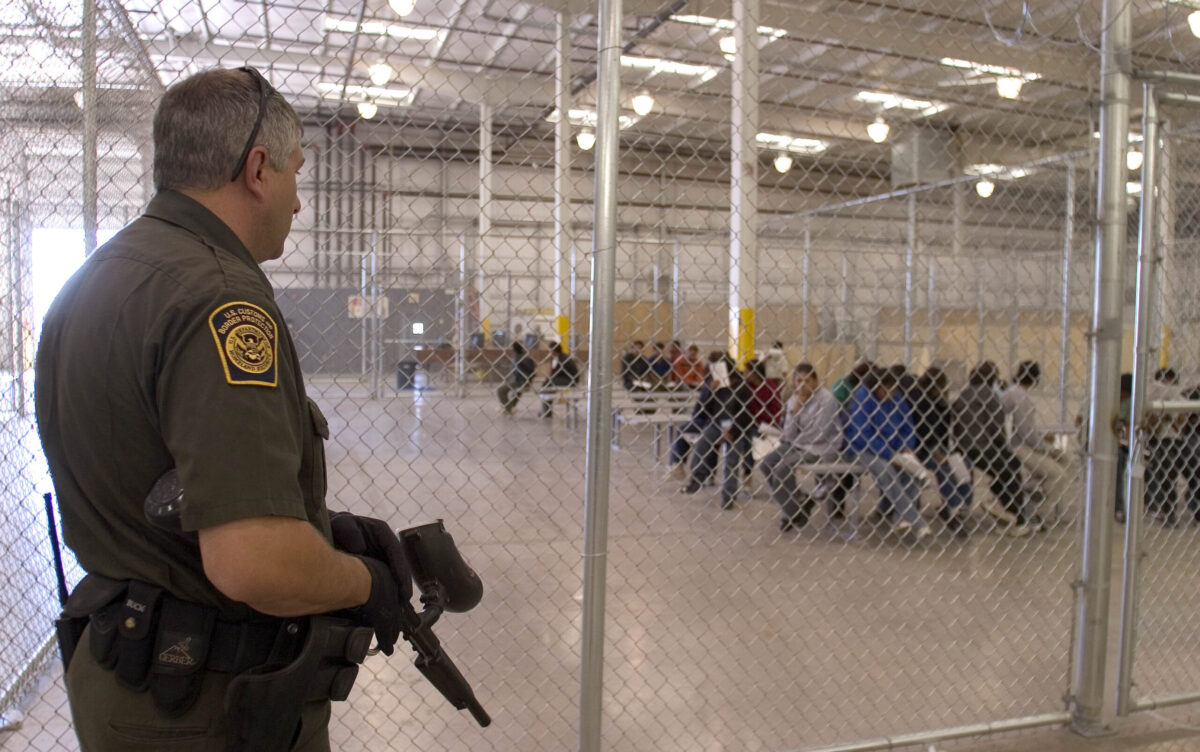
Jorge said the cell was initially packed with some 40 men, some of whom were sleeping on the floor. They asked for more space, and at that point the detainees were divided into two cells.
There was a single toilet in the corner. The men were each given a carton of juice, a “really bad-tasting burrito” and some kind of “rice candy,” along with a bottle of water. (The detainees were unshackled in their cells.)
Ana said Jorge complained that the relatively young people staffing the detention center sometimes used offensive language – calling the detainees “beaners” – and mocked or even spit on them.
He told Ana that during his stay in a cell, the detainees noticed that a couple of older men in other cells might have fainted or died and alerted guards.
The staffers pulled a body out from a cell, then a second body from another cell. “I stared at them,” Jorge told Ana, “and we all stood quiet, looking at them to see if they were going to move, but there was no movement.”
(Cal Matters reports that the death of a Mexican citizen in ICE custody in the Adelanto ICE Processing Center in San Bernardino County this week is the 14th confirmed death in ICE custody nationwide this year and the first this year in California.)
Thirty days later, according to Ana, her brother was still having nightmares. “Imagine if I would have stayed [multiple days, weeks or months] waiting to see a judge,” he told her. “I’m a tough man but that broke me to pieces.”
When this reporter spoke with Jorge several weeks later, he was unsure he had made the right decision in agreeing to deportation. Then again, a couple years jailed in those conditions would be tough. His advice to other detained immigrants: Speak up for your needs.
“If you’re hungry, if you need toilet paper, you got the right to tell them,” he said.
Looking for her brother
Jorge’s family was assisted by the Mexican consulate in Sacramento, which was able to locate him in the detention system. He was deported quickly.
“He was lucky to be taken out within a day,” Ana said. “Maybe it was because I was really pushing the Mexican consulate. It makes me feel proud that the Mexican consulate is actually doing something for their own people.”
The consulate told her that when Jorge arrived in Tijuana, the Mexican National Guard would take him to the city’s Flamingos shelter for deportees.
(This video, shot by Jorge, shows detainees who were dropped off in Tijuana, with orange bags to carry belongings.)
At that shelter, deportees are given food, water and access to doctors and medications. They’re given vouchers for bus tickets to destinations in Mexico. This is how the American Dream – the journey to “el otro lado,” as they say in Mexico — collapses for many.
Jorge is unsure what agency the men who detained him represented and never saw identification, although they were wearing vests that may have been part of a uniform. Were they ICE or FBI officers or federal marshals, he wonders. Ana calls them “bounty hunters” who she says had been following her brother for several days; she suspects the arrest was finally triggered by his appointment with the attorney.
When his mother, Maria, talks about what has happened, her eyes well with tears. She says many Americans don’t understand the lives of hard-working Mexican immigrants.
“We never got benefits from the government,” said Maria of her family. “I paid for everything for my family – everything,” she said, noting that “everything” included thousands of dollars in taxes. “What we eat we have earned with our sweat, with very hard work.”
(ChicoSol asked Maria to comment in Spanish on what she would like Americans to know about Mexican immigrants. “Just for one day, try to work like a Mexican so that you understand,” she said, in the recording below.)
Mass deportation snares working immigrants
ICE continues to advertise its deportation program as one that targets the “worst of the worst,” with a large black banner on its “Wow” Web page.
NorCal Resist Chico says that up to a dozen people have been detained during the past year from the counties of Butte, Tehama and Glenn, and predicts that ICE will become more active when the new budget takes effect in October. The One Big Beautiful Act provides billions of dollars to ICE that will fund the expansion of what the Brennan Institute for Justice calls a “Deportation-Industrial Complex.”
The sudden disappearances of community members in this area have lacked the drama of big-city ICE raids, but they have left families shaken and scared.
ICE agents arrested a half-dozen people at Butte County Superior Court in late July, and around the same time, a similar operation took place at Glenn County Superior Court in Willows.
A Paradise woman has set up a GoFundMe to help pay legal fees and translation for her fiancé, Ozan. Her GoFundMe indicates that he’s from Turkey and was detained by ICE at the courthouse. Virginia Hauer says he was “showing up for a routine court date over a minor driving matter.”
The Hispanic Resource Council of Northern California, which has been distributing grocery gift cards to affected families, has been taking calls from people requesting assistance. Some of the calls have come from women who are raising children without the income usually provided by husbands. Several “didn’t want to tell me where the men were, just that ‘he’s not here,’ or ‘he’s in Mexico,’” said Council President Reyna Nolta.
They fear that stepping forward – sometimes even for badly-needed groceries – will prompt unwanted attention or retaliation from authorities. Nolta said she’s talked to people who are afraid to go to work, and others who “bless themselves every day and keep going” because they have to.
Grieving a son’s removal
Jorge says his payments to help support five young children are on pause entirely — until and unless he can begin earning money again. “Every night, I ask God for his help,” he said.
In Northern California, Jorge’s house is visible from a window in his parents’ house, and his father took pleasure in those mornings when he could open the curtains and see that his son was nearby.
On the morning after Jorge was detained, his father opened the curtains and began to cry, said Maria. “I asked him why he was crying, and he said, ‘No more. Not any more.’”
Yet, said Maria, they are among the fortunate, because as citizens they can visit Jorge in Mexico and come back. Other families lack the documentation. “They separated them, forever,” she said.
Leslie Layton is editor of ChicoSol, where this story was first published. It was produced with support from the Aqui Estamos/Here We Stand immigration reporting project at American Community Media.