


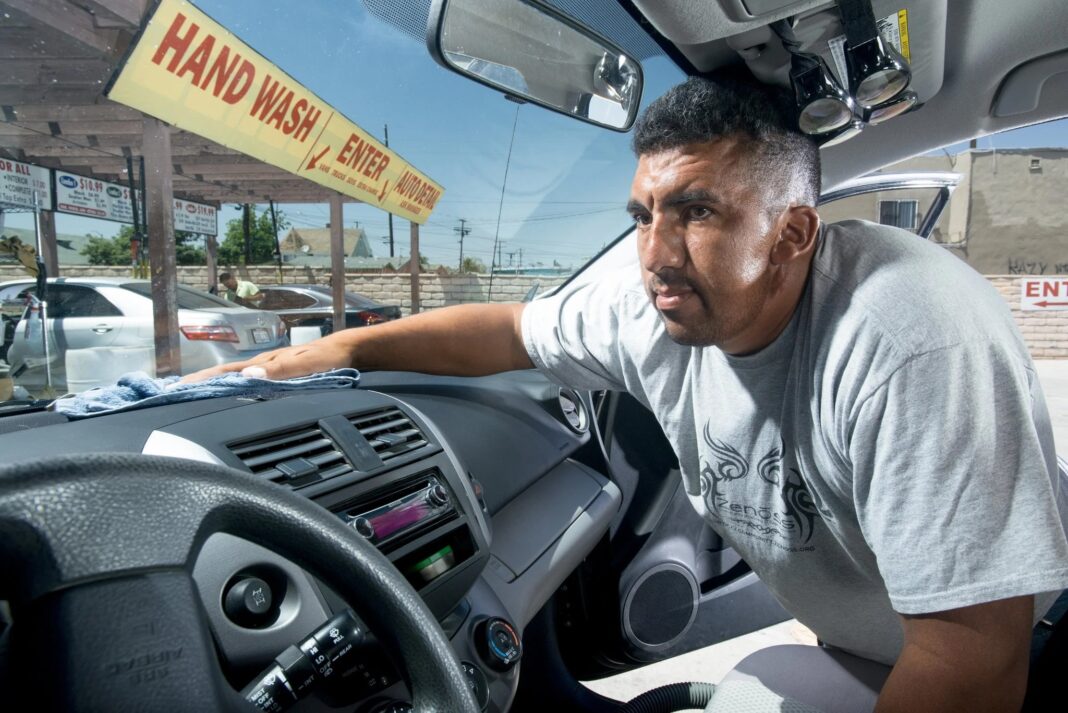
LOS ANGELES — Tears still well up in Jesús’ eyes as he recalls how he escaped a raid by Immigration and Customs Enforcement (ICE) at the carwash where he has worked in San Pedro, California.
“It was terrible, very sad and something I’ve never experienced before,” said Jesús, 57, who is originally from Mexico and has worked washing cars for the last 25 years in the Los Angeles area.
Advocates for carwash workers estimate that since June, more than 80 such businesses in Los Angeles have been targeted by aggressive immigration raids carried out by masked agents who typically arrive in new vehicles without identification.
In San Pedro, about 20 miles south of downtown Los Angeles, at least two raids have occurred at two separate carwash locations, Madrona and Lucky Seven, one in late September and the other in early October.
Jesús, who asked that we only use his first name, recounts the experience.
“I was on top of a car, cleaning it, when I spotted immigration. Since we work in groups of two, I told my partner, ‘Get ready. I don’t know what you’re going to do, but each of you come up with your strategy.’”
In seconds, Jesús climbed off the car he was cleaning to find immigration agents were blocking the entrances to the business.
“I saw my coworker take off running, with the agents chasing behind him. I took advantage of that distraction to escape, walking around the van I’d just cleaned until I found a safe place and locked myself inside.”
Panicked, Jesús said at that moment he could not stop thinking about his 13-year-old daughter and his wife.
“What will I do with them, they depend on me?” he remembers thinking, crying anxiously in his hiding place, turning the same question over and over in his mind.
An hour and a half later, those coworkers who managed to evade detention returned and helped him out of his hiding place. Weeks after, Jesús says the trauma of that afternoon remains with him.
“I see new cars and think, they are the masked ones,” he said, referring to ICE agents, adding that since the raid he has not been able to eat well. “The food tastes bitter. I have headaches, and pains from my stomach down to my feet.”
As for washing cars, Jesús has not returned to work, nor is he considering it. “I’m going to look for work in a safer area, where I am less exposed. It’s too easy to snatch people at carwashes. In the blink of an eye, the officers are all over you and there’s nowhere to run.”
After the raid at his workplace, Jesús says for him, the American Dream has died. Constantly nervous, he feels he has lost his sense of security.
“I go out on the street in fear; wherever I go I walk with fear. My colleague who was arrested is the father of two small children. I don’t even want to think about how I would feel in his place, locked up.”
According to Jesús, the raid that targeted his carwash was planned.
“A week before the raid, two blond men and two women arrived with three new rental cars; they only washed one of them on the outside. One of the women had a radio and started checking out the back of the business. The others stayed at the entrance, watching everything. That day they went to plan their attack on us the following Saturday.”
After his shift, Jesús says he returned home scared and certain that something was going to happen, and that he would need to be careful. “I told my coworkers that I was uneasy, that I need to keep an eye out for when they come; and they came just days later.”
Hundreds detained
Andrea González is an organizer with the CLEAN Carwash Worker Center, which advocates on behalf of the more than 10,000 carwash workers in Los Angeles, the overwhelming majority of them immigrants.
She says more than 300 workers, including 15 women, have been detained by immigration agents in Los Angeles and Orange counties and the Inland Empire.
“Most have been deported, while some 40 are fighting their cases and four were released on bail,” noted González, adding that in the midst of this crisis it is critical that workers and carwash owners know their rights.
“Although carwashes are considered private businesses, the workers are outdoors; therefore, the owners must have a plan or protocol in place in the face of federal agents who enter with such force that they put the car washers in a state of panic.”
She adds that if they do not have a search warrant, immigration agents should not be allowed to enter or ask if the workers have a permit to work.
“We have seen how when the community and business owners know what to do, and ask the agents, ‘What are you doing here,’ there’s been a positive outcome.”
González says her organization has held training sessions not only for workers but also for carwash managers. “We also have training for the community so they can learn more about the industry, and for the rapid response teams.”
González also urges residents to report if they see something suspicious. “We’ve created a system of support in the community, so that after a raid, we meet to share what happened and learn about how to better protect ourselves.”
González also says she’s launched several GoFundMe campaigns to raise funds for detained workers and their families. “We are creating alliances with food banks, with organizations that help with rent, and we’ve invited the Labor Commission to help ensure our workers know their rights.”
González says that while her organization has limited capacity to provide legal assistance, they have secured lawyers who provide pro bono or low cost counsel.
“The number of pro bono or low-cost lawyers is very limited, but they do exist. We have also offered legal clinics so that car washers can talk and consult with a lawyer, develop a family action plan, and learn what steps to take if they are arrested.”
The reality, she says, is that regardless of whether a worker is undocumented, they all now work with fear, constantly looking over their shoulders to see if immigration agents have turned up.
“The raids are out of our control, but we want workers to be prepared, to know their rights, so that if they are detained, they are confident in how to respond.”
Arrested one day, deported the next
José was arrested at Madrona Carwash in the city of Torrance on August 29. The next day he was deported to Mexico. “Honestly, before the raid I was calm. I never thought they would come after me.”
Nine car washers were arrested that day alongside José, who also asked that we only use his first name.
“I was waiting to dry a car when about six or seven immigration agents arrived in about 11 vehicles plus their reinforcements. I said, ‘This is it.’ I didn’t resist. I followed the advice not to run. The officer told me, ‘Turn around or I’ll turn you around (to put the handcuffs on me).’ I turned around.”
José says he showed the agents a pocket-sized Know Your Rights red card. He also refused to speak. But when they tried to take his picture and mistook his name for another, he had no choice but to tell them who he was.
After being arrested, he says they presented him with his options. “I only had two: fight to stay and wait in jail for at least three months to see the judge; or sign my voluntary release, hoping to return in the future with a work permit.”
But he was clear about one thing: he didn’t want to be locked up for months. “I had thought, if they catch me, I’m not going to fight.”
Interviewed via Zoom from Zapopan, Mexico, José says that sometimes he feels nostalgic, but also grateful to the Clean Car Wash organization and its entire team.
“When the raids started in June, there were days when we didn’t work, and they closed the carwash. Clean Car Wash helped us with groceries and a little money to pay rent.”
José, 55, arrived in California in 1991 and worked at the Madrona carwash ever since.
“I’m going to wait two years to see if I can return to the United States when my daughter applies for my residency, and if they say no, maybe I won’t come back.”
For questions about car wash workers’ rights or to find out when training will be held, write to: info@cleancarwash.org; or search on Instagram and Facebook.
Araceli Martínez is a reporter with La Opinión in Los Angeles. This story is part of “Aquí Estamos/Here We Stand,” a collaborative reporting project of American Community Media and community news outlets statewide.

