


LOS ANGELES — “Father, let’s go for a walk. Walking helps your legs stay strong.”
It has already been five years since Yunjung Lee’s father-in-law, who has dementia, came to live with her family. It all started the year COVID-19 hit. Time has truly flown.
At first, Yunjung brushed off the signs, even though she had worked as a nurse for 15 years and as a nurse practitioner for 13 years. “When it’s your own family,” she later reflected, “your heart leads before your logic.”
Yunjung’s father-in-law, Paul Lee had lived an accomplished life. A graduate of the prestigious Yonsei University in Korea, he taught English at Buniel High School in Busan, a school founded by his brother. In 1964, he came to the United States on a government scholarship, earning two master’s degrees, one in theology and another in education, before completing a doctorate in counseling from Drew University in New Jersey.
“He was intelligent, warmhearted, and eloquent,” Yunjung said. “He could even preach in English.”
There’s an old saying in Korea that scholars don’t get dementia. But now, the once-eloquent professor no longer recognizes his own wife or his only son.
The debilitating effects of dementia have meant that Lee, a one-time pastor, can no longer feed himself. Yunjung prepares porridge and spoons it into his mouth with care. She also tends to his basic hygiene. His condition has advanced far beyond what any of them expected.
Still, she feels deep gratitude for her mother-in-law, who provides round-the clock care with unwavering devotion. “It’s only because of her that we’ve been able to care for him at home,” she said quietly. “I pray every day that she stays healthy.”
Yunjung’s walks with her father-in-law have become slower now. His words, fewer. Sometimes she walks a few steps ahead, pausing to check her phone, just to match his pace when he catches up.
He once talked endlessly. “How’s your mother?” he would ask again, each time forgetting her reply. These days, he only murmurs when the wind brushes by: “Mmm… it’s cold.”
In those moments, she recalls a verse from Ecclesiastes: “There is a time for everything… a time to be born and a time to die, a time to plant and a time to uproot.”
“Life has seasons too,” she reflected. “A time to crawl, to walk, and to run. My father-in-law can no longer run, so I’m thankful he can still walk.”
She knows the day will come when even walking will no longer be possible. Until then, she walks beside him, grateful for each step they can still take together.
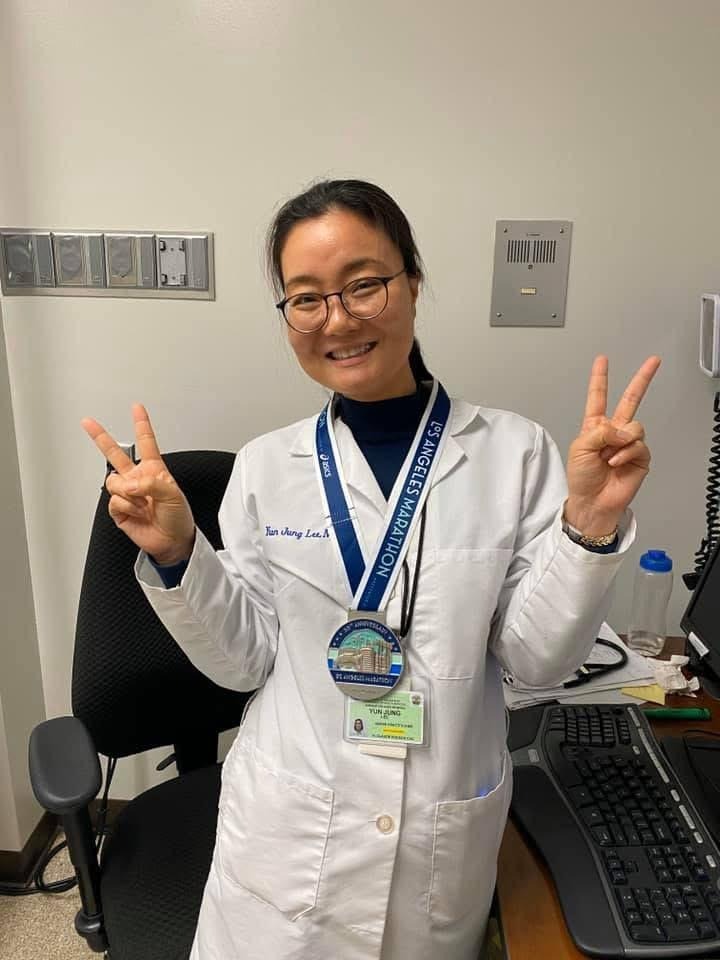
Yunjung also runs. Every Saturday before dawn, she drives to the Rose Bowl in Pasadena to run ten miles with her team. She joined the running club in 2017, hoping to check “complete marathon” off her bucket list. After finishing the Los Angeles Marathon in 2019 and again in 2021, she thought she was done. But she kept running.
“Running keeps me grounded,” she said. “It clears my mind, lifts the stress.” For her, running is more than exercise, it’s gratitude in motion. It’s her way of holding onto health, of cherishing what time and the body can still do.
One evening after their walk, she helped her father-in-law eat his dinner, brushed his teeth and tucked him into bed. He looked at her and said softly, “Thank you for your help.”
That simple sentence — increasingly rare — brought her to tears.
“Just walking together,” she said, “can awaken something in the brain. That moment felt like a small miracle.”
For her, it was an unforgettable gift.
This story was produced by American Community Media in collaboration with the Laboratory for Environmental Narrative Strategies (LENS) at UCLA as part of the Greening American Cities initiative supported by the Bezos Earth Fund. Read more stories like this by visiting the Greening Communities homepage.