


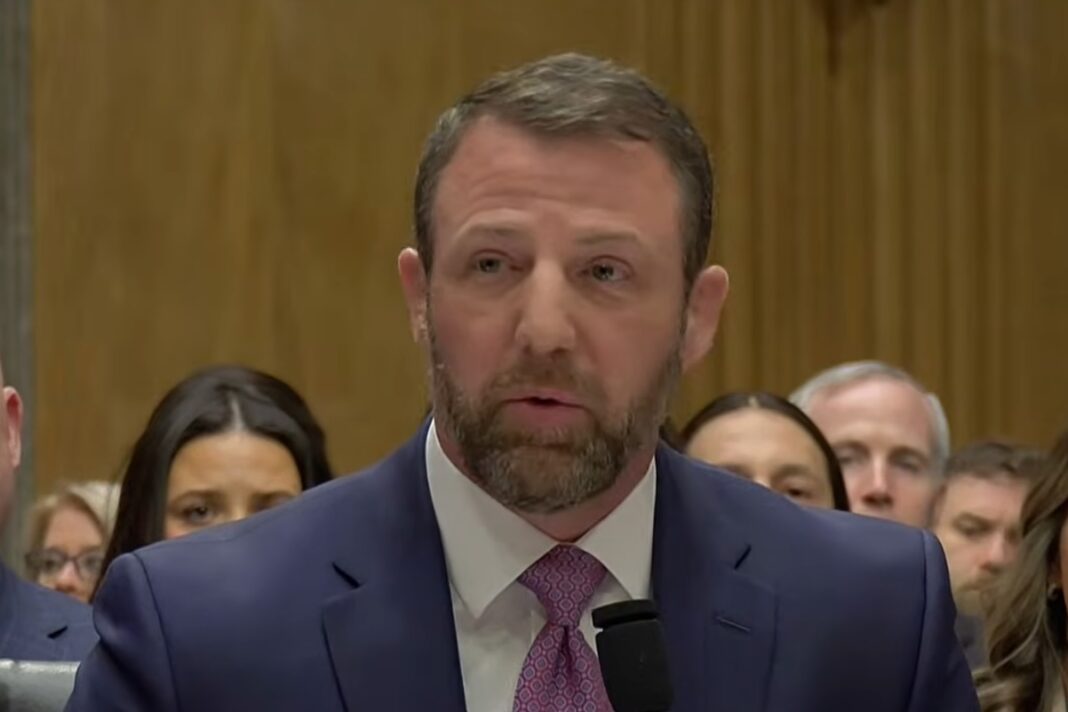
A Senate committee on Thursday advanced the nomination of Oklahoma Senator Markwayne Mullin as head of the Department of Homeland Security (DHS) to the full senate. Mullin was tapped by President Trump to replace ousted Secretary Kristi Noem.
At a hearing the day prior, Mullin — a former MMA fighter known for his pugnacious, confrontational style of politics — appeared to offer a more measured tone.
“My goal in 6 months is that we’re not in the lead story every single day,” said Mullin at the Wednesday hearing. “My goal is for people to understand we’re out there, we’re protecting them and working with them.”
Still, senators expressed concerns about the violent conduct of federal immigration agents, DHS expenditures and defunded priorities under Noem’s leadership. Questions from the 15-member committee largely fell along party lines.
The hearing was held against the backdrop of growing public criticism over the administration’s immigration enforcement tactics.
Senator Gary Peters (D-MI) called out the Trump administration’s dramatic shift in funding priorities, including “deep cuts” to counterterrorism resources and cybersecurity to fund a mass deportation agenda. Peters also noted steep cuts to FEMA, including the ending of flood mitigation programs that had bipartisan support for over three decades.
Immigration enforcement actions were a key concern of several Democratic senators.
“The stakes for the success of the Department of Homeland Security could not be higher,” said Maggie Hassan (D-NH). “People have been rightfully outraged about the lawlessness from the department’s leadership which has not only resulted in the deaths of two American citizens but has also led to the hollowing out of agencies like FEMA.”
When Hassan asked how Mullin would govern DHS differently from Noem, whose tenure was marked by controversy, Mullin replied, “I want to protect the homeland. I want to bring peace of mind, and I want to bring competence back to the agency.”
Sen. Richard Blumenthal (D-CT) queried Mullin on the deaths of U.S. citizens Renee Good and Alex Pretti in Minneapolis at the hands of immigration agents, asking the Oklahoma senator whether their killings were justified. Mullin replied that in the case of Good’s killing, the agents “had to make a split-second decision,” and that Good’s car had moved toward and struck the officer. That claim is not backed up by video footage.
Blumenthal challenged the nominee’s statement that an investigation into Good’s shooting is being conducted. “DHS and the Trump administration have blocked state and local investigations. I hope you will permit that investigation to go forward.”
DHS has been in partial shutdown since February 14 as Democrats demand changes to immigration enforcement policy. Among their demands are that agents be prohibited from targeting sensitive locations, including schools and churches, and from entering homes and businesses without a judicial warrant.
Blumenthal pressed that latter issue during the Senate committee hearing.
“ICE has been breaking into our homes without any judicial warrant. The sanctity of our homes is absolutely critical, and it is the law that a judicial warrant is required to forcibly enter people’s homes.”
A leaked May 2025 memo revealed that DHS would rely on its own administrative warrants when arresting individuals in their homes. In his remarks, Mullin appeared to cede the question, saying that a judicial warrant would be required unless agents were chasing an individual who subsequently entered a private building.
Several GOP senators on the committee used their time to call out the partial government shutdown impacting DHS. Hassan countered the Republicans’ position, indicating that Democrats’ proposals to fund other DHS agencies have been rebuffed.
Sen. Bernie Moreno (R-OH) highlighted the need to keep US Customs and Immigration Services open — noting the agency is where he was naturalized. An explainer by the American Immigration Lawyers Association indicates that many DHS functions including that of USCIS are not affected by the shutdown.
The bolstering of ICE’s budget with a $75 billion supplement from the “One Big Beautiful Bill” Republican spending package also means operations are funded beyond even the second Trump administration.
In his remarks introducing Mullin as the fellow U.S. senator from Oklahoma, Republican Sen. James Lankford lauded the administration’s actions as a deterrent against the unauthorized entry of immigrants. “We’ve seen incredible progress at the southern border,” he said, citing DHS statistics that crossings had fallen by 96% since former President Biden was in office.
Sen. Andy Kim (D-NJ) who served on the U.S. National Security Council during the Obama administration, kept his focus on community concerns, including the massive expansion of immigrant detention centers.
He questioned the proposed ICE facility in Roxbury NJ that has stirred local controversy, describing it as “the size of 8 football fields to house over 1500 detainees.”
One local outlet reported that $129 million in federal funds had been spent to acquire the warehouse, and that the project was moving forward with no communication from ICE to the mayor or local officials.
Under Noem and Corey Lewandowski, a former Trump adviser and campaign manager, a $38 billion makeover plan that included transforming 11 warehouses into detention centers had been moving quickly.
Mullin promised that he would conduct a site visit personally to assess the infrastructure, and viability of this project, which he suggested was more meaningful than producing the assessments that Kim had requested from ICE.
Kim, the first Korean American to serve in the U.S. Senate, later recounted how he had to instruct his father-in-law on what to do in case federal authorities questioned him upon reentering the country.
“I’m hearing from American citizens that are now feeling like they need to carry their passports around for fear of being stopped,” he said Kim, noting the “chilling effect” across immigrant communities.
Sen. Rick Scott (R-FL) came out forcefully against sanctuary city policies, calling out Los Angeles and Chicago, both of which have been targeted by ICE enforcement surges. “Working with municipalities will be vitally important,” said Scott, who pushed for federal withholding of funds to sanctuary jurisdictions that expressly limit local law enforcement from cooperating with ICE.
In his response, Mullin said that the ability to ban funding to sanctuary cities could be used “as a last resort,” citing U.S. taxpayer dollars from states like Florida, Oklahoma, Kansas, and Arkansas. However, 2023 U.S. government data shows that other than Florida, 3 of those states actually receive more federal dollars than they contribute in taxes.
The vast majority of sanctuary states are also identified as net contributors paying more in taxes than they receive from federal funding.
Sen. Elissa Slotkin (D-MI) pressed Mullin on the prospect of ICE agents deployed to polling locations during the 2026 midterms. Mullin responded that they would be tapped for “specific threats, not for intimidation.” He added, “We will work with local law enforcement.”
To which Slotkin responded, “Americans trust their local law enforcement now way more than they trust ICE. If we ever get to the point where we put armed ICE officers at polling locations, we have lost the plot as a country.”