


During a period marked by soaring food prices, more than 3 million people have lost access to the federal Supplemental Nutrition Assistance Program — SNAP — over the past 10 months.
An additional 1 million more are expected to lose the critical food safety net over the next 6 months as new work requirements roll out for more states, according to new data released by the Congressional District Health Dashboard. Black, Latino, and Native American households face greater food uncertainty than the population at large, according to CDHD data.
“This is not just a nutrition program. SNAP is one of the most amazing public health policies and programs that we have in our country,” said said Dr. Giridhar Mallya, senior policy officer at the Robert Wood Johnson Foundation. Speaking at an American Community Media news briefing May 22, Mallya noted that the new SNAP cuts were the deepest ever since the program rolled out in 1964.
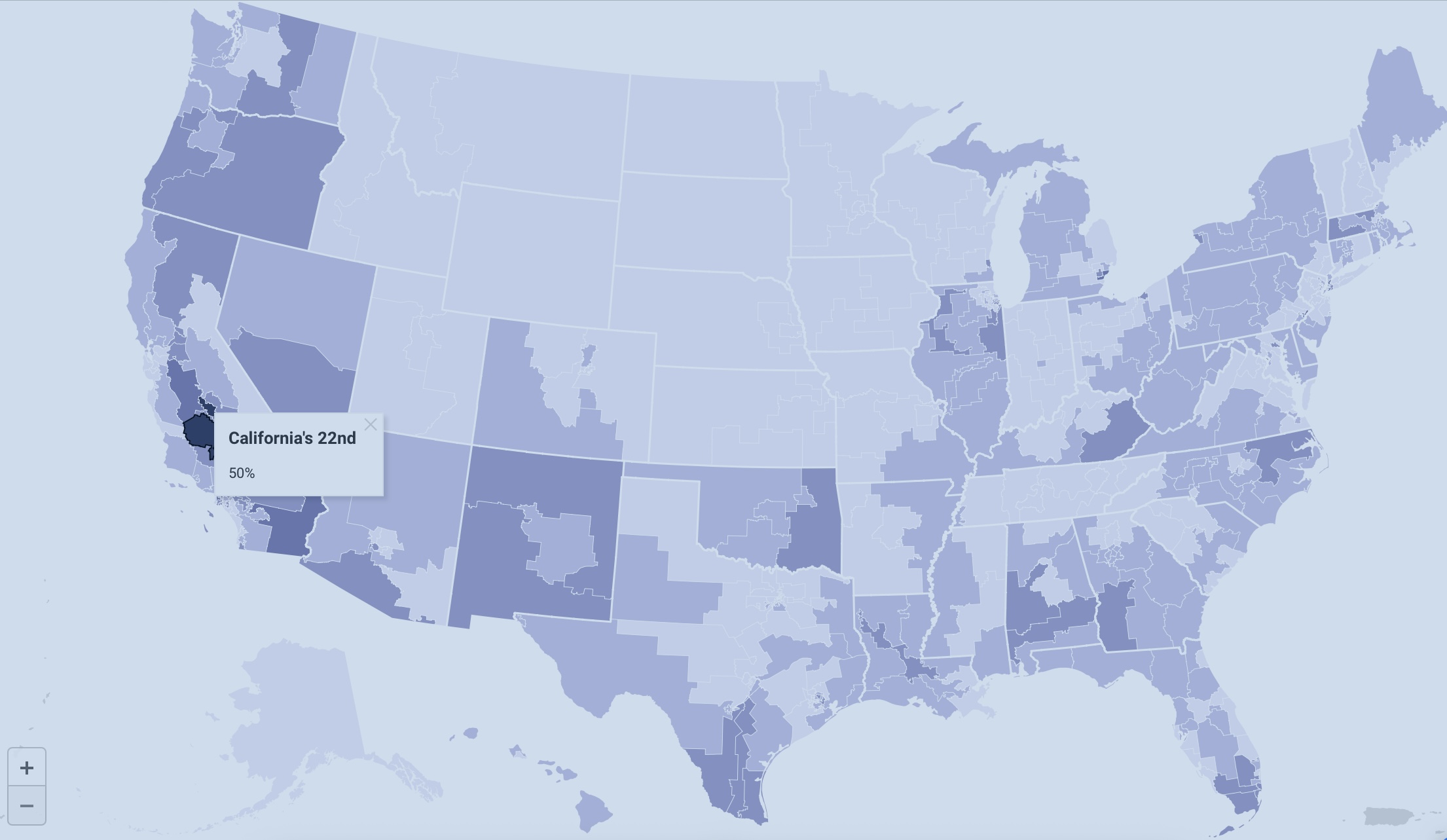
California is one of the states with the highest levels of SNAP participation, said Dr. Lorna Thorpe, chair of the Department of Population Health at NYU Grossman School of Medicine and co-principal investigator of the dashboard project. In California’s 21st Congressional District, centered around Fresno, and the 22nd District near Bakersfield, more than half of households participate in SNAP, according to the dashboard’s third-quarter 2025 data.
New work requirements
Last summer, Congress passed HR1 — also known as the One Big Beautiful Bill. The legislation cut almost $1 trillion from critical health and food safety nets. It also imposed new eligibility requirements, including working at least 80 hours per month. The budget of the Supplemental Nutrition Assistance Program — SNAP — was slashed by $187 billion through 2034.
Alaska, Colorado, Georgia, Hawaii, Nebraska, South Carolina, Texas, and West Virginia began strictly enforcing the work guidelines shortly after HR1 was passed. Illinois and Ohio also began counting work hours for SNAP eligibility later that summer.
California’s work requirements for SNAP eligibility begin June 1.
SNAP supports seniors and children
The Center for Budget and Policy Priorities estimates that 700,000 low-income children have lost food aid since HR1 took effect last July. CBPP surveyed 12 states for which data was available.
38 million people, including families, children, the disabled and the elderly people currently use SNAP to buy food. The program supports individuals living at or below 130% of the federal poverty level, about $42,900 for a family of 4.
SNAP supports 1 out of 4 children living in the US, notes the CBPP. About 8 million elderly people also rely on the program, according to the National Council on Aging. For 2026, an eligible SNAP recipient receives about $204 per month, working out to $2.20 per meal.
Rising food prices, less food security
The Bureau of Labor Statistics Consumer Price Index notes that in the past 13 months, food prices rose by 2.9%. American families now spend about $345 per week on groceries, about $1,380 per month.
Beginning this year, states must assume a larger share of SNAP administrative costs, rising from 50% to 75%. Starting in 2027, states also will be required to cover between 5% and 15% of SNAP food benefit costs.
The changes could force difficult budget decisions nationwide. Many states that are unable to pay their share may drop out of SNAP entirely.
Reductions could worsen hunger
“Black households, Latino households, and certain Asian American and Pacific Islander communities are overrepresented in the SNAP program. This is because of longstanding economic inequality,” Mallya said at the briefing. “So when SNAP participation declines, those communities are disproportionately affected,” he said.
Mallya warned the reductions could worsen hunger, increase malnutrition and intensify chronic health conditions among vulnerable populations.
Research consistently links SNAP access to improved infant health, better educational performance, and reduced hospitalizations among low-income seniors, Mallya said.
“There’s good evidence that seniors who receive SNAP are better able to afford medications and manage chronic illnesses,” he said.
Onerous work requirements
Mallya also criticized the new work requirements for SNAP eligibility. Expanded work requirements now apply to adults ages 55 to 64 and parents of children as young as 14. He noted that the documentation requirements create bureaucratic burdens that are difficult to navigate by particularly vulnerable individuals.
“The majority of SNAP recipients who can work already do work,” he said. “They do very little to increase employment, but they lead to huge drops in participation. And that’s because the paperwork is very confusing and time consuming.”
Immigration enforcement
Immigration enforcement actions are creating additional fear among mixed-status families, experts said, discouraging eligible citizen children from enrolling in SNAP or Medicaid.
“We are seeing citizen children lose benefits because parents are afraid to engage with government programs,” Mallya said. “That fear is understandable.”
Undocumented immigrants have never been eligible for SNAP benefits. But advocates say anti-immigrant rhetoric and data-sharing policies have created a chilling effect across immigrant communities.
California’s Central Valley
The new SNAP data establish an important baseline for tracking the effects of the policy changes, said Thorpe at the May 8 briefing.
“Our data show that more than one in six households in the United States participate in SNAP. But geographically, there is tremendous variation between congressional districts,” she noted.
The dashboard found SNAP participation ranging from as low as 3% of households in some districts to nearly 60% in others.
Already vulnerable communities hit hardest
Thorpe noted that many of the districts with elevated SNAP participation also experience high unemployment, lower incomes and other indicators tied to poorer health outcomes.
“What the dashboard allows people to see is how federal nutrition policy intersects with housing, poverty, employment and health,” she said.
The dashboard also includes demographic breakdowns by race, ethnicity, age and sex for many health measures, helping reporters and policymakers identify disparities within districts.
In California’s 12th Congressional District, which includes Oakland and Berkeley, Thorpe demonstrated how life expectancy and breast cancer mortality differ sharply among racial groups. Black residents in the district experienced lower life expectancy and higher breast cancer mortality rates than white, Hispanic and Asian residents.
The demographic breakdowns help illustrate longstanding racial and economic inequities affecting health outcomes, said the researcher.