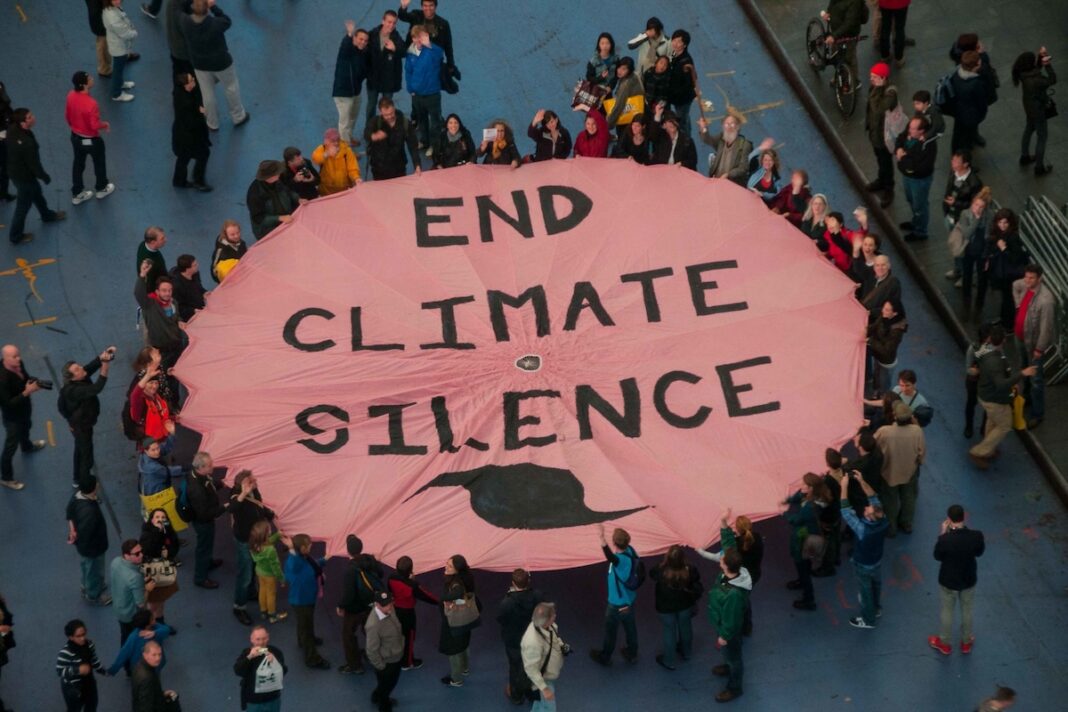
Even as the country faces record heat, wildfire smoke and a potentially historic El Niño, climate change has receded from political conversation. Federal rollbacks of climate forecasting and response programs, meanwhile, are making it harder to predict and prevent increasingly frequent extreme weather conditions.
The Trump administration has proposed cutting the National Oceanic and Atmospheric Administration’s (NOAA) budget by roughly 27%. It has also eliminated its research arm entirely after having already cut the agency’s climate research spending by about 25%. NOAA has also stopped updating its decades-old database tracking the cost of billion-dollar weather and climate disasters.
Staffing losses tied to Department of Government Efficiency (DOGE) layoffs have forced the National Weather Service to halt or reduce twice-daily weather balloon launches, a key forecasting input, at more than a dozen offices as extreme heatwaves worsen nationwide.
‘Not a one-size-fits-all answer’
“At this point, essentially every heat extreme is getting hotter because of climate change,” said Karen McKinnon, associate professor of statistics and the environment at UCLA.
She spoke during a July 17 ACoM virtual news briefing.
“The weather patterns that cause heat are happening on top of a warmer baseline state, so we’re in a pretty consistent cadence of getting these record-breaking heat events. This feels, I think, surprising for many of us on the ground. But scientifically, it’s not surprising.”
Climate science has advanced enough in recent years to quantifiably attribute the likelihood and intensity of individual extreme events, not just long-term global averages, to human-caused climate change — a shift McKinnon believes could reshape how people talk about the crisis.
“I don’t think that the average person, if you say the world is going to warm by two degrees Celsius — what does that mean? That doesn’t resonate with people,” she said.
Describing telling her daughter she couldn’t camp in her grandparents’ backyard during a recent trip to Colorado, McKinnon said: “All of the smoke was blowing in from the wildfires that were then in Colorado and Utah. I had to say, ‘No, it’s not safe, you can’t camp out in the backyard.’ You can’t actually be outside in these conditions. I think that will really resonate much more — that what we want back is the case where we’re not having smoke ruining our summers.”
“We know exactly the cause of climate change. We therefore, in theory, know how to reverse it, but in practice, to reverse it, we need to make large structural changes to our economy in order to reduce carbon emissions,” she continued. “We’re seeing that people are more likely to get air conditioning in cities. Reducing the urban heat island effect with tree cover in those places makes sense. There’s not a one-size-fits-all answer to adaptation.”
Building ground-up resilience in Oakland
Shina Robinson, resilience project director at the Asian Pacific Environmental Network (APEN), said that the need for adaptation is already reshaping how her organization’s members — largely Asian American immigrant Bay Area residents living along industrial corridors — plan for the future.
APEN has been investing in “resilience hubs, trusted community facilities that people go to for year-round access to services, programs, to connect to information, to their neighbors, and build capacity that happens before, and then during, and then after a disaster,” she explained.
APEN’s flagship example is the Lincoln Recreation Center in Chinatown in Oakland, California, currently serving about 1,000 people a day: “Seniors in the morning who are there for tai chi, table tennis and dance classes, and then after-school programs, and then teen programs at night with basketball courts,” Robinson said. “It’s very intergenerational, open from early in the morning to late at night, seven days a week.”
The center also connects working-class families to CalFresh aid, voter registration and free community college classes, with services offered in Cantonese, Mandarin, Vietnamese, Tagalog and Korean. It’s set to break ground at the end of July on a renovation adding solar power, battery backup, upgraded air filtration and a community kitchen, becoming one of the first municipal resilience hubs in the country.
“It’s known as the pearl of Chinatown,” Robinson said. During the pandemic, the center became a lifeline when isolated seniors couldn’t get public health information in their own languages. “In Chinatown there was some anti-Asian violence related to the pandemic, and it became a place where people could gather, where volunteers set up stations to do walking patrols, so that our seniors wouldn’t have to do their errands alone.”
The renovation is being handled differently than past projects in the neighborhood. “We call it conducting open-heart surgery,” she continued. “All the previous big capital improvement projects have either shrunk the footprint of Chinatown or displaced people, but this time it’s being done with a deep level of community involvement.”
Current programs at Lincoln will relocate to other neighborhood sites during construction rather than shut down, she added, “so people don’t lose that connection to each other or to the things that they love and keep them healthy. Even though we’re seeing dire threats at the state and national level, this is an example of being able to continue some of the momentum of wins of past years on the ground.”
Addressing a global polycrisis
Mark Valentine, senior advisor to the Omega Resilience Awards, said that tension of local progress against state resistance is playing out on a global scale as well.
He described a “polycrisis” of converging economic, environmental and political pressures: “It’s like domino lines all coming together, and then the dominoes all toppling … When we thought about these different issues, and climate really stood out — most of the narratives of the future are filled with despair about the onset of various kinds of disasters, whether it’s coastal flooding, wildfire, drought, you name it. We were trying to identify different themes that could be more inspiring and more hopeful.”
Over three years since 2022, partner organizations in Buenos Aires, Delhi and the Niger Delta identified more than 1,500 candidates for Omega Resilience fellowships; 63 received funding and training, including indigenous land defenders in Chile and Colombia and rural communities in Africa honing traditional adaptation strategies.
“We have fellows in Latin America fighting against green extractivism, efforts to identify rare earth minerals that could power all the devices that might make our lives more bearable in the global north, but would possibly significantly degrade theirs,” he said, pointing also to pushback against large-scale, top-down hydropower projects in the Himalayas and wind development in coastal India and Southeast Asia.
Valentine said many of the leaders he works with resist being praised for their resilience.
“Resilience implies the necessity to survive a crisis, often not of one’s making,” he said. “They would rather not have had to have gone through the torturous journey to achieve some semblance of resilience.”
“If communities themselves get to be part of this and their expertise is recognized, there will not be sacrifice zones because they won’t be inviting pollution,” added Robinson. “How we make decisions is just as important as what we implement in the change from a fossil fuel economy to a well-being one.”
Feature image: Adam Welz via Flickr