


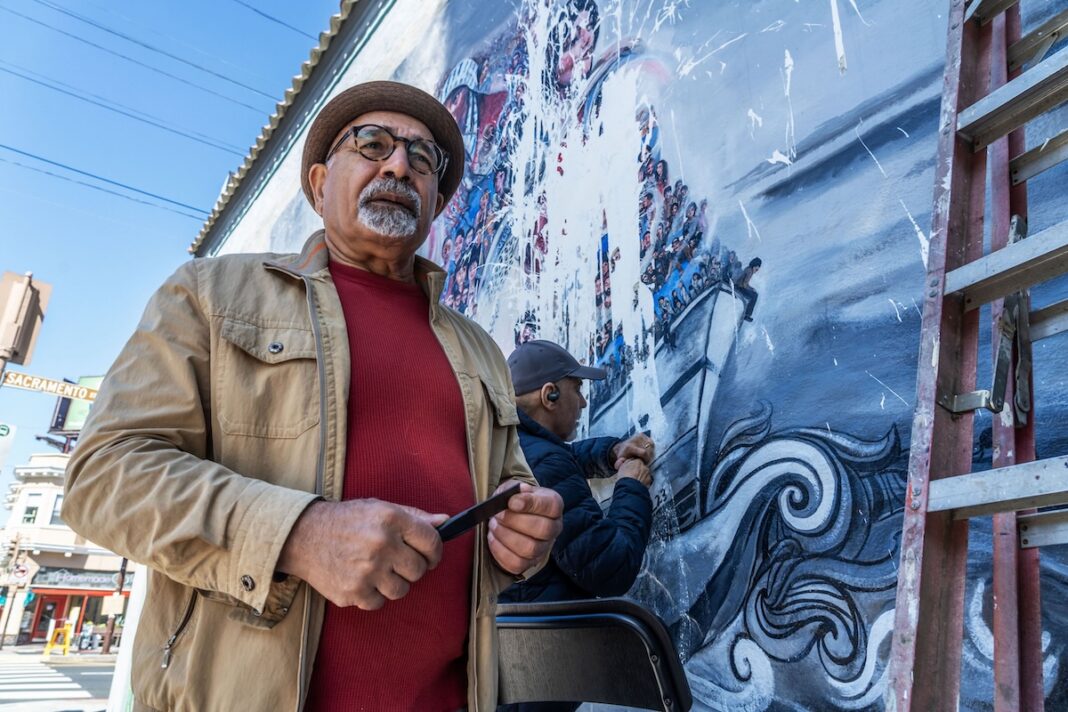

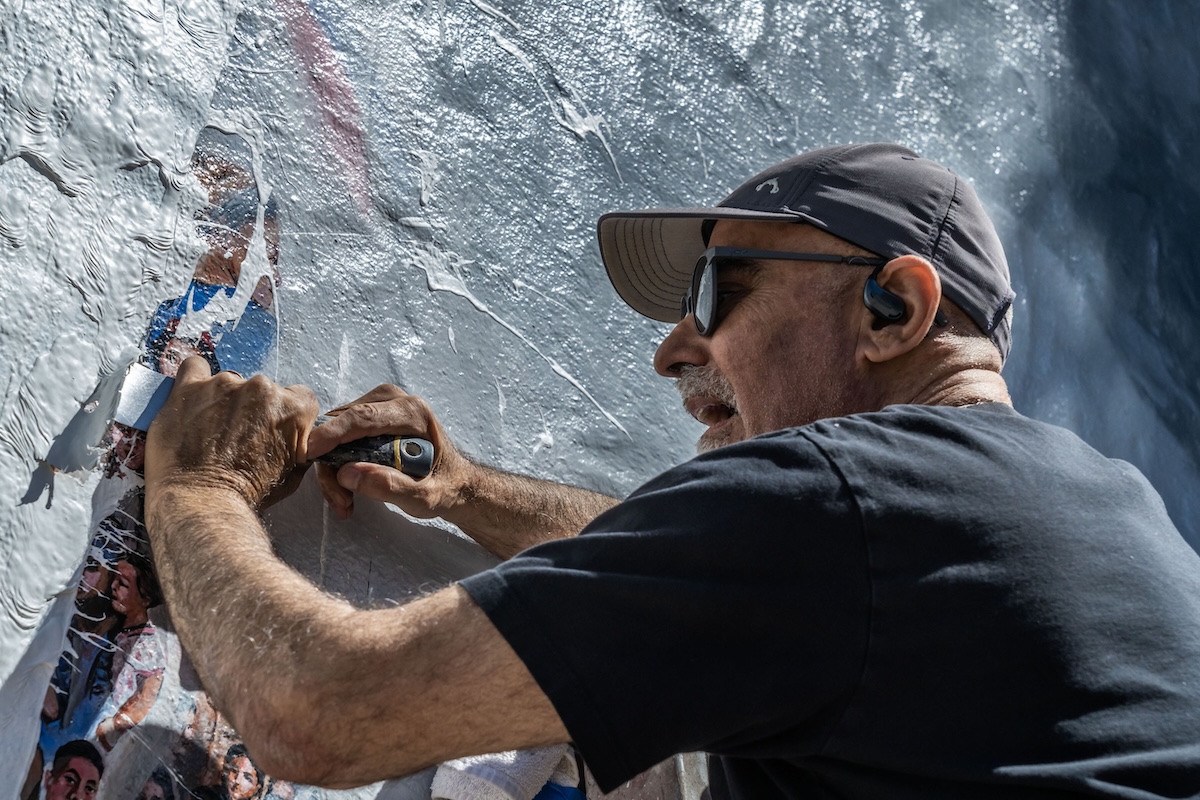
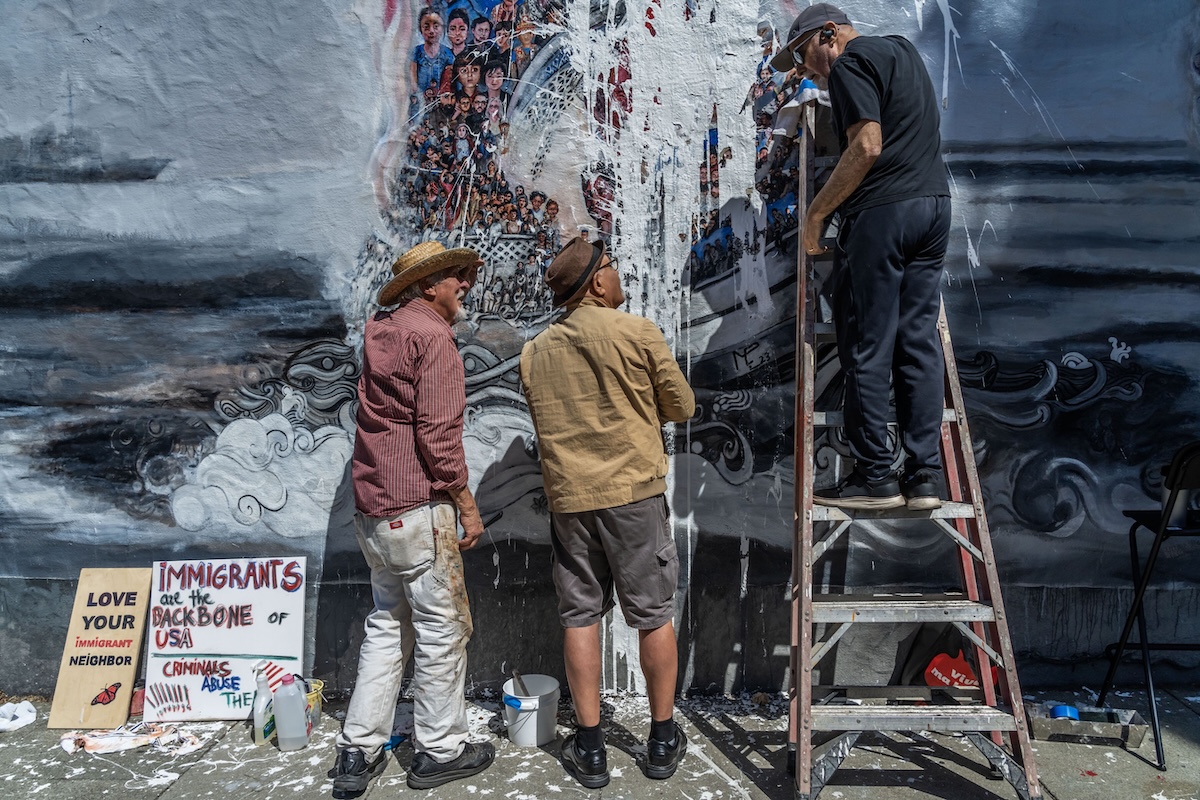
A mural in Berkeley, California depicting immigrants and refugees braving the open sea was vandalized earlier this month. Mokhtar Paki, who painted the mural, describes it as his “love letter to Berkeley.” An immigrant himself, Paki left Iran as a political refugee in 1983, later settling in Berkeley and gaining U.S. citizenship. According to the artist, the mural’s desecration — with white paint splattered across the image — is an attack on all immigrants. But Paki is using the incident to bring attention to the plight of immigrant communities across the country. Working alongside two other muralists — Massoud Salamat and O’Brien Thiele — to restore the painting, Paki discussed its origin and meaning with photojournalist David Bacon. (This conversation has been edited for length and clarity.)
Tell me about the name of the mural.
Sinbad’s Voyage refers to a fairy tale from the classic One Thousand and One Nights. It’s about a group of sailors trying to reach, metaphorically, a happier place to live. They tried seven times, and each time they had to go back. I found it very relevant to the story of many immigrants who try to reach another land and are deported, or have to go back, and then they try again. So it’s about resilience — about trying, about adventure, and finally getting somewhere you want, or, unfortunately, perishing along the way, very much like in the story of Sinbad’s Voyage, where many people died.
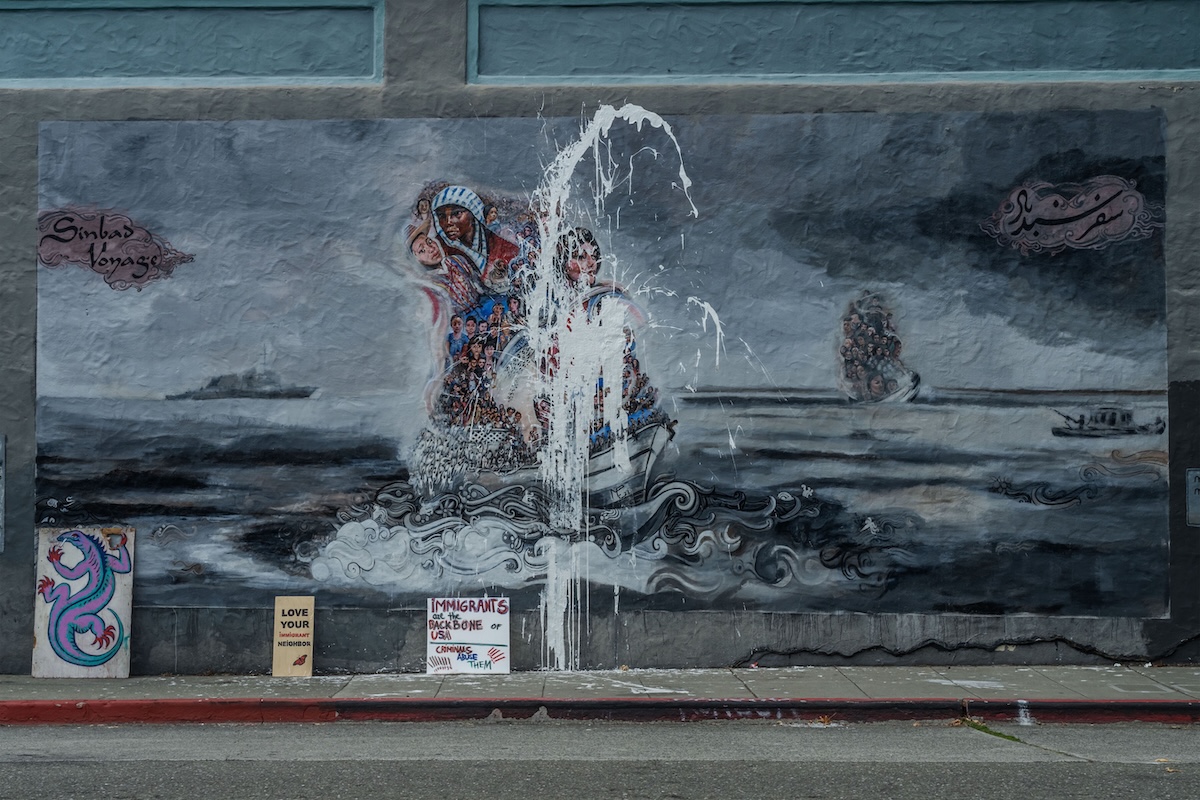
How did the mural come to be?
In 2014, we were witnessing this whole movement of immigrants trying to reach the Mediterranean Sea from Africa and the Middle East. Many of them used really small boats, crammed with people, and unfortunately many of them died, drowned in the Mediterranean near the Greek and Italian coasts.
I was really devastated every time I saw so many people crowded into one small boat. So in 2016, I did a simple black-and-white ink drawing and posted it on social media. Then in 2019, I made a painting of it. But I still wasn’t satisfied — it was just a painting in my studio. So what? So I took a picture of it and sent it to the City of Berkeley, to the Civic Arts Commission, and to other places. It took about two years to hear back — that was 2022 — and then about five or six more months for the paperwork. I finally started on January 23rd, 2023, and finished in May. Those were the best four months of my life as an artist, because everybody here was really coming out and supporting it.
And the image itself. What does it depict?
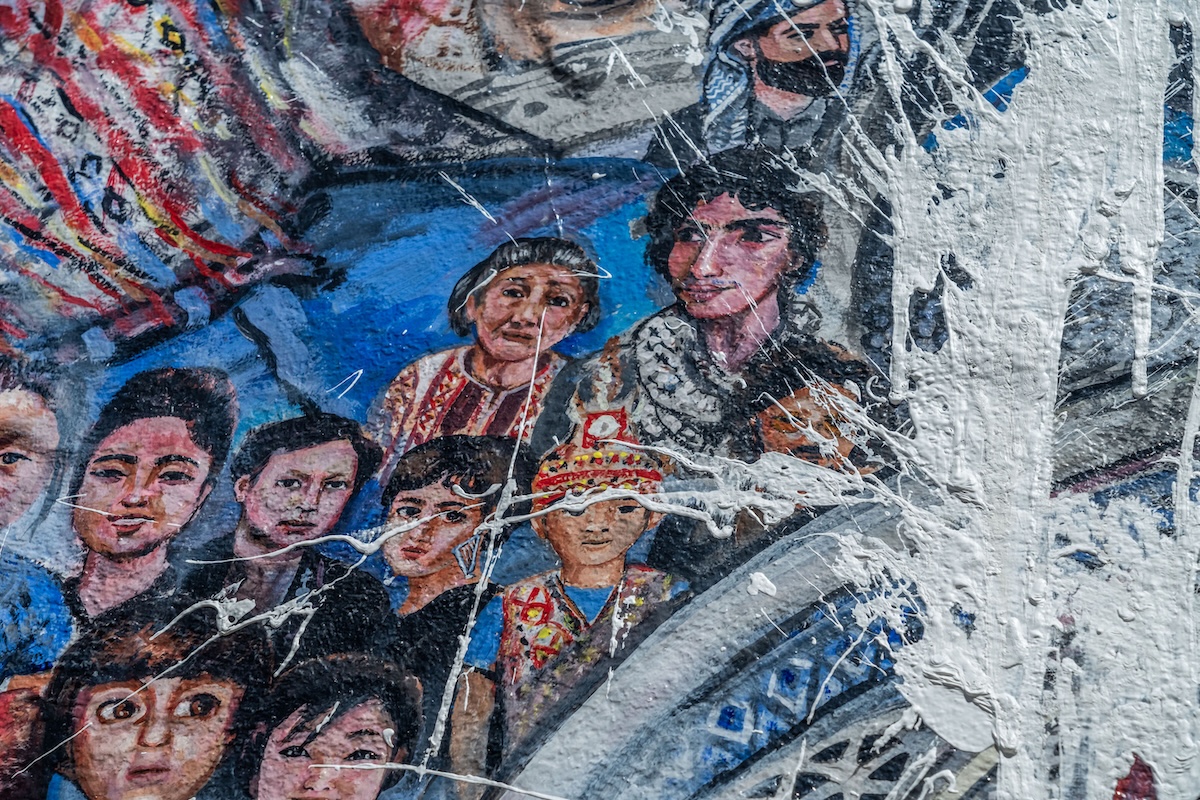
The image is a vast gray ocean, and in the center there’s a boat with a colorful crowd of people crammed together — different sizes of heads and so on, but everybody has a different hairstyle, or scarf, or clothing pattern. They have nothing to carry with them — you can’t carry your piano, or your pet. They carry themselves. But they bring their culture.
There are about 400 figures in the mural, and around 88 of them have faces. Some of the faces are of people who aren’t here anymore — for example, Hajji Sayyah, who died a hundred years ago and was, they say, the first Iranian resident of the United States. Another is a relative of mine — my niece, Sana, who drowned when she and her father tried to cross the Persian Gulf to escape. She was five years old when she died. There’s another figure, Jacqueline, who was Guatemalan, seven years old — during the family separations a few years ago, she got sick and wasn’t taken care of; they just put her in a room. Her case became well known, so it was easy for me to find her story and put her here. There’s another one, Carlos, the same kind of tragedy.
But it’s not only about tragedy. I have two friends who live in the Berkeley area, immigrants from Russia, accomplished musicians, and they wanted me to paint them with their instruments. I said no, no, no — nobody with an instrument, especially a huge harp; the boat would sink under the weight of your harp! So instead I put the harp as her earring — you can see that, with her husband beside her.
Several of the faces are more prominent. What do they represent?
I made three faces the largest. I chose the three regions that have produced the most immigrants over the last twenty-five years — the Middle East, Africa, and Central America — and gave each a representative. The one in the middle is a woman from Congo, representing Africa. To her left is Carlos, from Guatemala, representing Central America. And to her right is a Kurdish figure representing the Middle East. Those three are the largest faces.
What about the style of the mural?
The technique is based on a traditional style of painting from Iran, called pardeh, or pardeh-khani. Pardeh means “curtain” — it’s a huge, loose canvas that painters would roll up and carry from place to place, then unroll and hang on a wall and narrate the story to people. On these paintings, the faces and bodies could vary a lot depending on how important the character was — much like in film, where you have a villain and a hero. And the person who narrates it is called the pardeh-khan, the narrator of the curtain.
In the mural there are also these ghostly images of what look like military boats.
Yes — we call them “guards.” They could be helpful — for example, I included the Greek Coast Guard, because they’ve saved a lot of lives, and I wanted to celebrate that. But you have to be out on the ocean, facing someone with a gun, to know how that feels. And it wasn’t always a good story with the coast guard, either — even the Greek Coast Guard has been accused of negligence, and worse. So, in a way, yes — this is a symbol of danger. But again, this mural wasn’t really about the “negative” people. For me, these figures are positive. The danger, the negative thing, for me, was mostly the ocean itself — what was happening out there.
When did you first learn about the act of vandalism defacing the mural?
I was out of the country on a trip, planned for four or five days. On the first day, a friend called me and gave me the bad news, which kind of ruined the trip. I wasn’t in a position to return immediately, so I stayed the remaining three days and then came back. When I saw it, it was very, very difficult, because this mural had been on my mind constantly. It was shocking — unbelievable. Every day I walked past it after that, I saw it.
I think the fact that it’s a big white splash of paint is very symbolic. It could have been yellow, or black, or red. But the fact that it was white — I think that says something. And if something like this can happen in Berkeley, just imagine what happens elsewhere. Imagine how it feels to see it happen here, in a place I thought would protect it.
What’s been the response from the community?
All the neighbors around here have shown their love and support every single moment. They come by, they slow down, they say something. They’ve offered money. When I wasn’t here, they went to the liquor store on the corner and talked to the manager, because I wasn’t around, wanting to know what they could do, wanting to give money.
A mural is collective work. It’s collaborative, partly because of the scale of it, but mostly because it reflects the community, and because of the way you create it — people watch you work from the beginning all the way to the end, every day. So they end up collaborating with their emotions. For example, there are a few figures here who were people just passing by — they asked if they could be included, and I said yes, because they’re immigrants. So it really is collaborative work.
Any parting message you want to share?
I think right now is the moment to really show our solidarity with immigrants. Just imagine being a Haitian immigrant in the United States right now — totally defenseless — and think about what happens to people like that every single day. They arrest thousands of them and send them back to their countries, or somewhere — we don’t even know where. That’s what I want to talk about. I don’t want to talk about who did this or why. What matters is why this mural was created in the first place. And we’re going to repair it. We’re going to bring it back, in solidarity with immigrants.
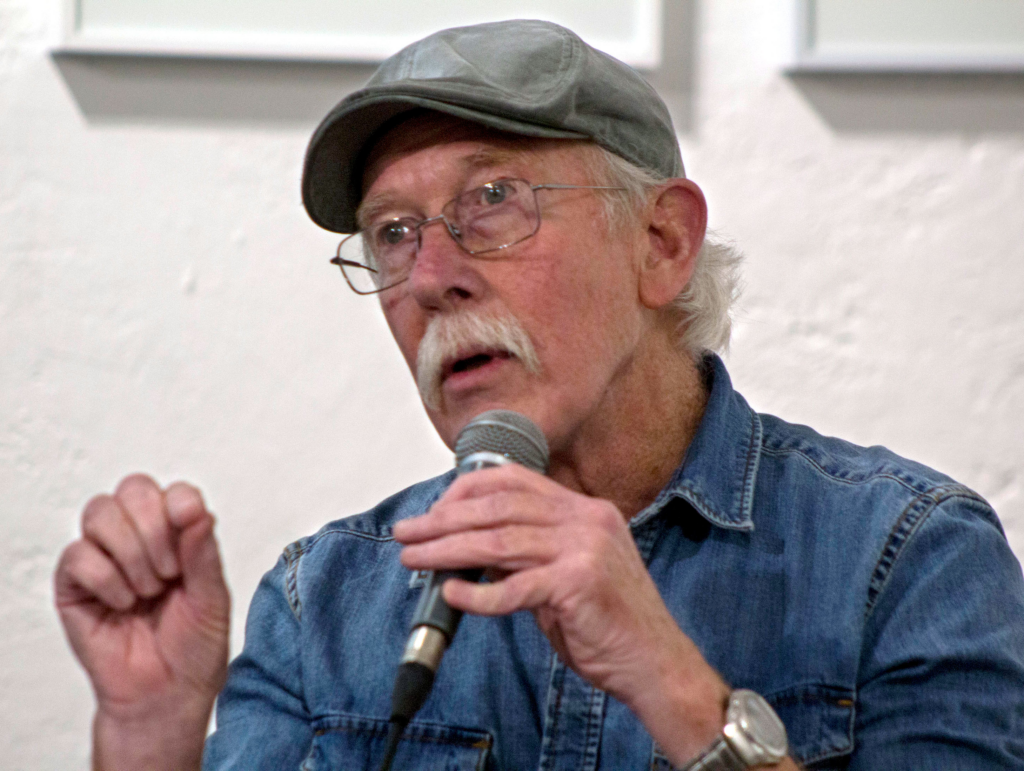
DAVID BACON
David Bacon is an American photojournalist, author, political activist, and union organizer who has focused on labor issues, particularly those related to immigrant labor.