


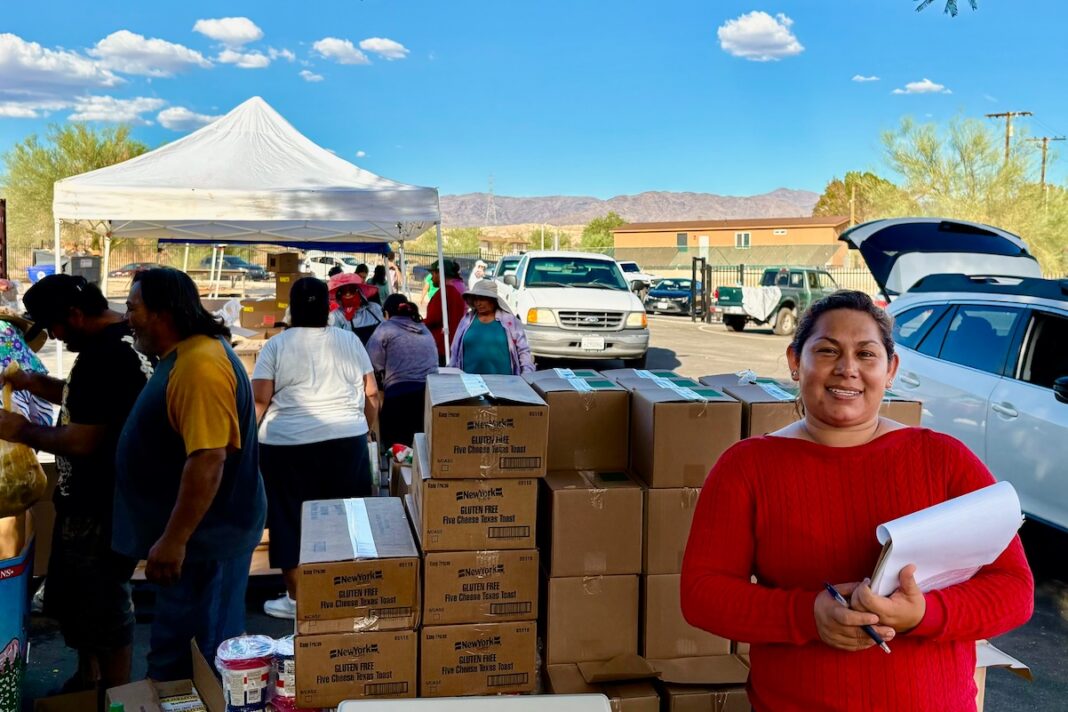

NORTH SHORE, Calif. – It’s Monday morning, and the temperature in North Shore is already nearing triple digits. At the San Juan Diego Mission, farmworker Solangel Cruz and her team have begun distributing food to hundreds of families at a local food drive.
The event is one of five Cruz holds each month for farmworkers in this unincorporated Riverside County community, where food insecurity far exceeds the national average.
“We are living through difficult times,” Cruz told ACoM, explaining in Spanish that many farmworkers have seen their shifts decrease. Her account is consistent with reports that some employers are cutting workers’ hours to offset the cost of California’s overtime requirements. Many others, she said, “do not want to leave their homes” for fear of being detained by federal immigration agents.
Food insecurity
Those factors are contributing to a growing need in a region where 26% of adults already experience food insecurity, 9 percentage points above the national average and nearly double the countywide average of 13.8%.
Rising costs for essentials like rent, groceries and gas — hovering around $6 per gallon in much of California — as well as drastic cuts to federal assistance programs are adding to the pressure on families already struggling to make ends meet.
Cruz, in her early 40s and with an infectious smile, says she launched her food distribution network after a knock on her door in 2023. Waiting on the other side were Father Rosendo Herrera of Our Lady of Guadalupe church in the nearby town of Mecca and Reyes Lopez, community organizer with the non-profit Inland Congregations United for Change (ICUC).
The pair approached Cruz because of her involvement in her children’s schools and her community activism. After initially hesitating, thinking of the commitment required in organizing a food distribution network, Cruz accepted.
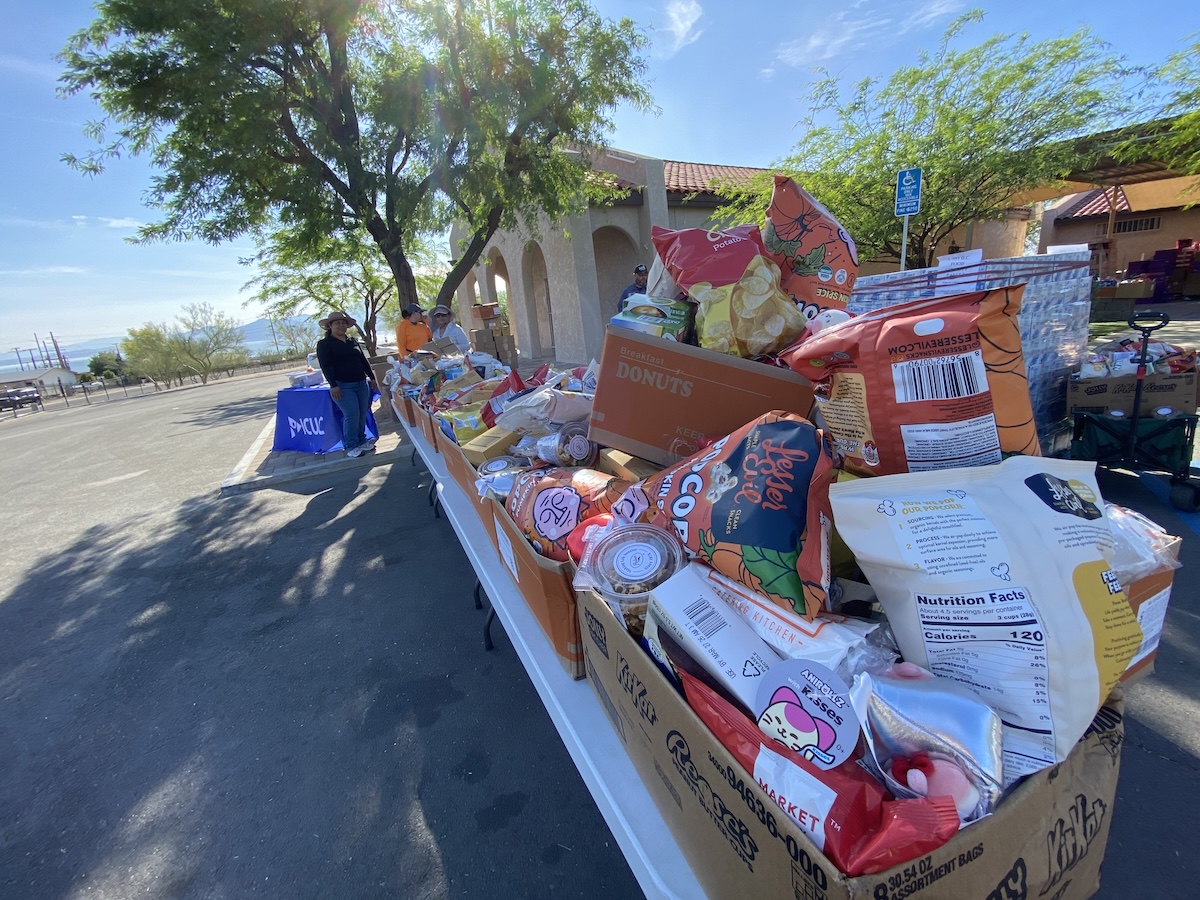
ICUC provided food and supplies for the program’s first drives, which were limited to one a month. But as demand grew, Cruz connected with Find Regional Food Bank, which now supplies four additional food drives, bringing the total to five each month: two during the first week and one during each of the remaining three weeks.
“We are always united”
“We are a community that does not have access to as much assistance, and when the opportunity arose to receive these additional foods … I accepted,” said Cruz.
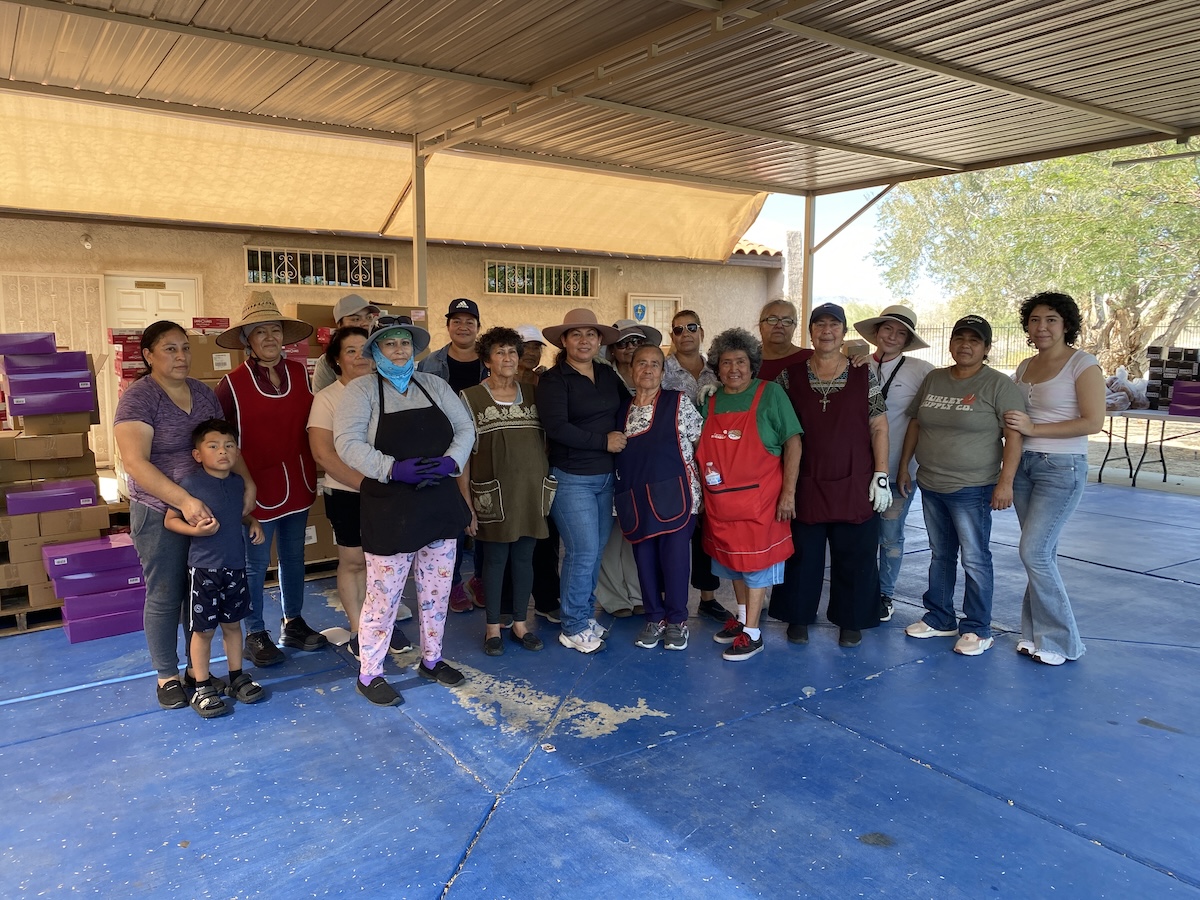
Much of the work depends on local volunteers, many of them farmworkers who spend as much as 6 hours of their free time at a single drive helping other families put food on the table.
For many, said Cruz, the distribution site has become a gathering place where volunteers can see familiar faces, stay connected, and feel useful in supporting their neighbors. That network has also carried volunteers through some of their most difficult moments.
Rita, a longtime volunteer, has continued showing up even while undergoing treatment for cancer, Cruz said. Another woman first came into the group after losing her daughter to suicide. Volunteers organized a community fundraiser to help her pay for funeral expenses. Afterward, she began volunteering, returning to the same group that had rallied around her in grief.
“More than a team, we are like a family, because we are always united, and one person’s needs affect the others as well,” said Cruz. “We always look for solutions so that we can help one another and move forward, both as individuals in the community and as a team.”
A growing network
Cruz first came to Thermal, about 15 miles from North Shore, when she was 19, shortly after she and her husband arrived from Mexico in 2003. The couple began work in the sprawling date palm groves surrounding the area, starting years of agricultural labor that brought Cruz closer to the farmworker families she now serves.
“People feel safe and protected here at the church, at Mission San Juan Diego, and the number of people who come to pick up food has continued to increase. It is no longer one hundred families, as it was at the beginning, but more than four hundred families each week,” indicated Cruz.
Each month her team hands out more than 22 pallets of food, she said.
More than a team, we are like a family, because we are always united, and one person’s needs affect the others as well.
— Solangel Cruz
What Cruz has built has also begun to extend beyond North Shore. She has helped train women coordinating food drives in adjacent communities, including Desert Hot Springs, Cathedral City, and Indio.
Cruz has accompanied teams through their first drives, answering questions and helping them navigate the work — from meeting program requirements to record-keeping and organizing volunteers.
‘Faith and affection’
As Cruz discusses her work, Imelda, a volunteer in her late 70s, steps into the room to say that she has prepared quesabirria — a traditional Mexican stew typically served in a folded tortilla — for Cruz’s children. It’s a small gesture, but one that reflects the bond Cruz shares with her team.
According to Imelda, her faith and affection are what keep her going. She says she thinks of the many families struggling to stretch their limited incomes as she prepares boxes, ensuring they are “full enough” to help parents feed their kids.
“That is one of the relationships I have built, and one that I feel truly honored by,” said Cruz, her voice trembling slightly. “I have not been back to my country in twenty-three years. I left behind my grandmother and my mother, I see them now through a screen, but it is very difficult for me not to be able to be with them in their old age.”
Then she paused before explaining what the women at the mission have come to mean to her.
“What I am unable to do for my mother, I do for them,” Cruz said. “I always include them, I am always looking out for them, and they do the same for me.”
Whereas Cruz initially set out to distribute boxes of food to neighbors in need, the work has in turn given her something she did not expect: a community that cares for her as deeply as she cares for it.
“Those are the fruits of what I have sown,” she said. “That is the harvest I receive.”
*Correction: An earlier version of this story misidentified Reyes Lopez as director of the non-profit Inland Congregations United for Change (ICUC). He is a community organizer with the organization.
ROXSY LIN
Roxsy Lin is a California Local News Fellow with the UC Berkeley Graduate School of Journalism. Based in California’s Inland Empire, Roxsy is guided by a deep belief that access to information and local accountability are essential to a healthy democracy. Her reporting centers on Latino communities, with a focus on local leaders, artists, and organizations driving meaningful change.