



GRATON, Calif. – It’s 6:30 a.m. and Karym Sanchez and his team are already preparing for the day ahead. Despite the early morning hours, the space begins to fill with men and women hoping their names will be called for a day of paid work.
Sanchez is the lead organizer with the Graton Day Labor Center, a nonprofit serving low-income immigrant workers in West Sonoma County, located an hour north of San Francisco.
“We’re a center that cares deeply about social justice,” Sanchez told ACoM. Speaking in Spanish, he added, “We understand that many of our members are facing difficult financial circumstances.”
Situated on a well-kept campus in the unincorporated community of Graton, the center is surrounded by trees and lush vegetation, providing a calm and welcoming atmosphere for the 40 or so people who come through its doors each day.
About 30% of Sonoma County residents identify as Latino. Nearly 10% work in agriculture, primarily in the region’s extensive wine industry. Many are now confronting a perfect storm of challenges, including rising costs of living, a tightening labor market, and the impacts of the Trump administration’s ongoing federal immigration enforcement policies.
According to the Congressional District Health Dashboard, California’s 2nd Congressional District, which includes Graton, has an estimated unemployment rate of 6.7%. Among Latino residents, the rate is higher, at 7.5%, well above the national average.
Sanchez says the high cost of rent is one of the biggest challenges. A typical one-bedroom here averages north of $2000 per month, while the average farmworker in California makes less than $50,000 a year, sometimes far less.
California Gov. Gavin Newsom this week signed a bill that would raise the minimum wage for certain agricultural workers to $19.75 per hour beginning in 2027.
But according to Sanchez, for workers in Sonoma County the math just doesn’t add up.
That’s partly due to the fact that demand for wine – a key driver of the local economy – is drying up especially among younger consumers. Wine sales have fallen 20% over the past five years, prompting growers to lower their prices and leave more fields to lie fallow.
That means less work for migrant workers and more people coming to the day labor center, often desperate for even a day’s wages.
According to Sanchez, new arrivals add their names to a list, and assignments are made based on how long each person has been waiting, typically between 3 and 4 days. Those who have waited the longest receive priority when an opportunity becomes available.
The center connects job seekers with prospective employers. A representative typically gathers details about a job, explains the rates, answers questions, and creates an order. Staff then match the opportunity with an available worker.
For day laborers, the process allows them to avoid having to linger in public spaces looking for jobs, which in this era of heightened detentions and deportations brings with it increased risk of exposure to federal immigration agents.
That risk was made all too apparent in late September when four day laborers were detained by what appeared to be federal immigration agents in a Home Depot parking lot in Concord, about 40 miles east.
Manuel Vicente is with the National Day Laborer Organizing Network and director of Radio Jornalera, which offers programming targeted to migrant workers. He explains that many people these days carry with them that fear, both when looking for work and when on the job.
“It goes beyond simply saying, ‘I don’t want to go out because I run the risk of being detained,’ said Vicente. “Those who take that risk also remain silent in the face of other abuses and injustices [by employers] because of that same fear.”
He called spaces like the Graton Day Labor Center “a lifeline” for the community.
Anita Noriega, 52, agrees. “I feel taken care of here,” she said in Spanish. “When they look for work for me, they also look for a job where I won’t be at risk of getting hurt any further.”
Noriega injured her knee in 2024 while working the grape harvest. The injury left her unable to continue with a job she did for years prior. She tried applying at local stores but said employers were reluctant to hire her because of her injury.
Later that year, a friend introduced her to the Graton Day Labor Center. Through the organization, she began cleaning houses a few hours a week and has since become a leader within the organization.
“As a leader here at the center, it makes me feel proud. It makes me feel accomplished and fulfilled,” she said.
The nonprofit uses an evaluation system to track how participants perform on assignments. Employers receive a yellow card where they can rate the service provided and leave comments about their experience. Staff use that feedback to identify areas where someone may need additional training and to develop classes that strengthen participants’ skills.
“They’ve given us first-aid training, English classes, botany classes, and training on how to use a chainsaw, as well as health and safety,” Noriega said. “They give us a lot of training to make sure we’re prepared to go out and do the work. They also tell us about the resources available through the city and the county, and the classes they offer us are free.”
Sanchez said the training is key to helping participants. “We’re always looking for creative ways to help them improve their skills so they can stay employed,” he said.
That emphasis on support also shapes how the center handles wages. Workers keep the full amount they earn from each job; the organization does not take a percentage or charge a fee from their earnings.
Members set rates for different services collectively during general assemblies, giving them a direct role in deciding how their time and skills are valued.
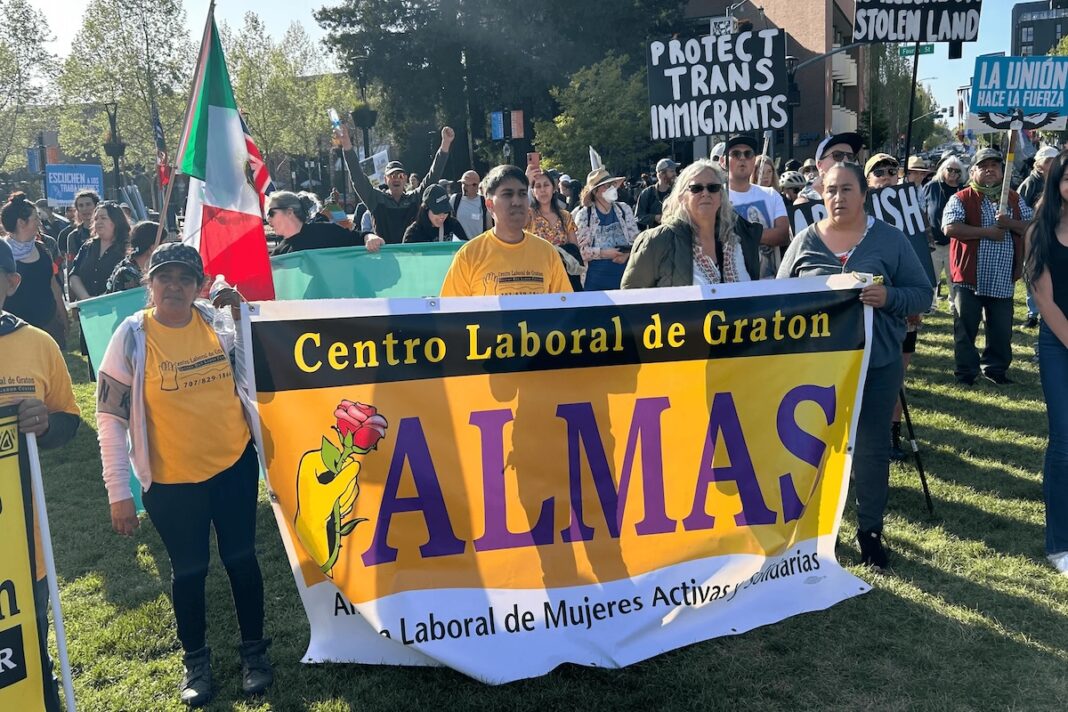
The organization also runs ALMAS, or Alianza de Mujeres Activas y Solidarias (Women’s Action and Solidarity Alliance), a program serving people who provide domestic and caregiving services. Members receive training on the safe use of cleaning products to help reduce exposure to harmful chemicals. Staff also provide information about wage theft and assist people with filing complaints.
“[Some employers] think that because you don’t know your rights, they can treat you however they want, unfortunately. But now I know that’s not the case. I want other people to realize that there are people out there who can help you,” Maria, an ALMAS leader, said in Spanish.
For Sanchez, that peer support is key. “Vulnerable workers would be even more vulnerable” without it, he said.
Other services include the CLG Assist initiative, which provides free in-home support for low-income and vulnerable residents, including yard and garden care, home safety and fire mitigation, and house cleaning. By January of this year, CLG Assist had served 359 households, while also creating paid opportunities for laborers.
There is also a monthly community health clinic and mobile dental services for members, along with regular food distributions.
“The sense of camaraderie we have here is really important,” said Noriega. “If someone is going through a hard time, we support them. That kind of support means a lot to me… because I know there are people out there who genuinely care about us as people and look out for us.”

ROXSY LIN
Roxsy Lin is a UC Berkeley California Local News Fellow. Her reporting centers on Latino communities. She covers issues affecting farmworkers, including unsafe working conditions, sexual violence, and wage theft. Her work has appeared in the LA Times, CALÓ News, Palabra, Boyle Heights Beat, and Refinery29 Somos.