


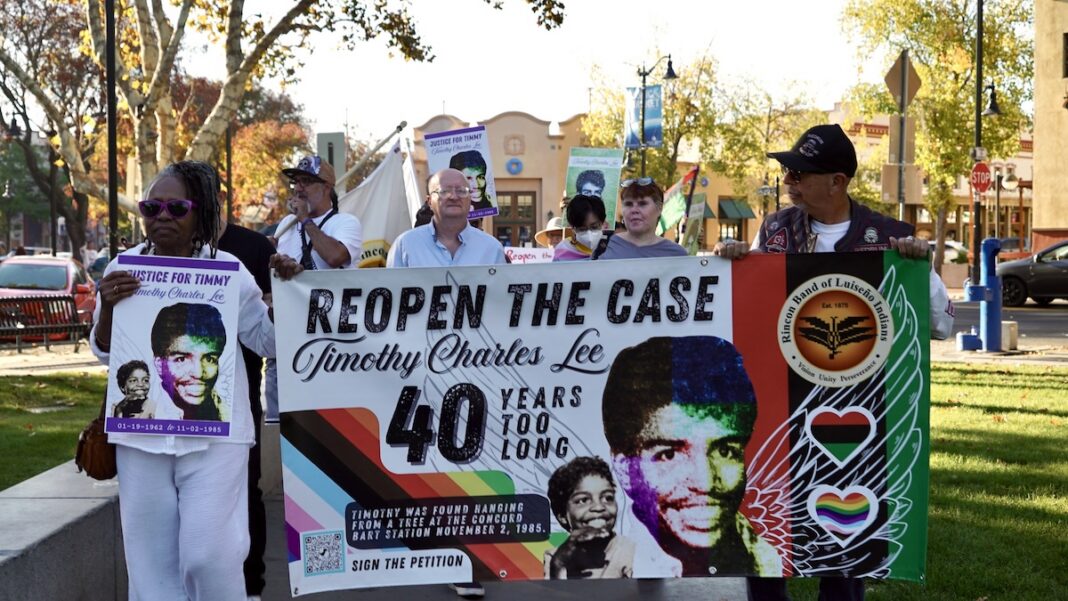

CONCORD, Calif. — Forty-one years after Timothy Charles Lee was found hanging outside a train station in Concord, California, his family is not giving up on pushing to have his death, which was quickly ruled a suicide, investigated again.
While Lee’s case is more than four decades old, it has gained renewed significance in light of the alarming rise in hangings of Black people nationwide.
Lee, 23 at the time of his death, was a Black, gay member of the Rincon Band of Luiseño Indians and a fashion design student at the Academy of Art in San Francisco, on track to study in Milan. On Nov. 2, 1985, he was out celebrating a future that looked bright, his family members say.
Riding a Bay Area Rapid Transit, or BART, train that night, Lee dozed off, missed his stop and woke up at the Concord station, about 30 miles east of San Francisco, where he reportedly called for someone to pick him up. No one came.
Later that night, he was found hanging from a fig tree outside the station with a noose around his neck. He was later pronounced dead. He is now buried in a cemetery on his tribe’s reservation in Valley Center, north of San Diego.
More than four decades after Lee’s death, his relatives say the authorities’ ruling still doesn’t add up.
‘Keep Timmy’s name alive’
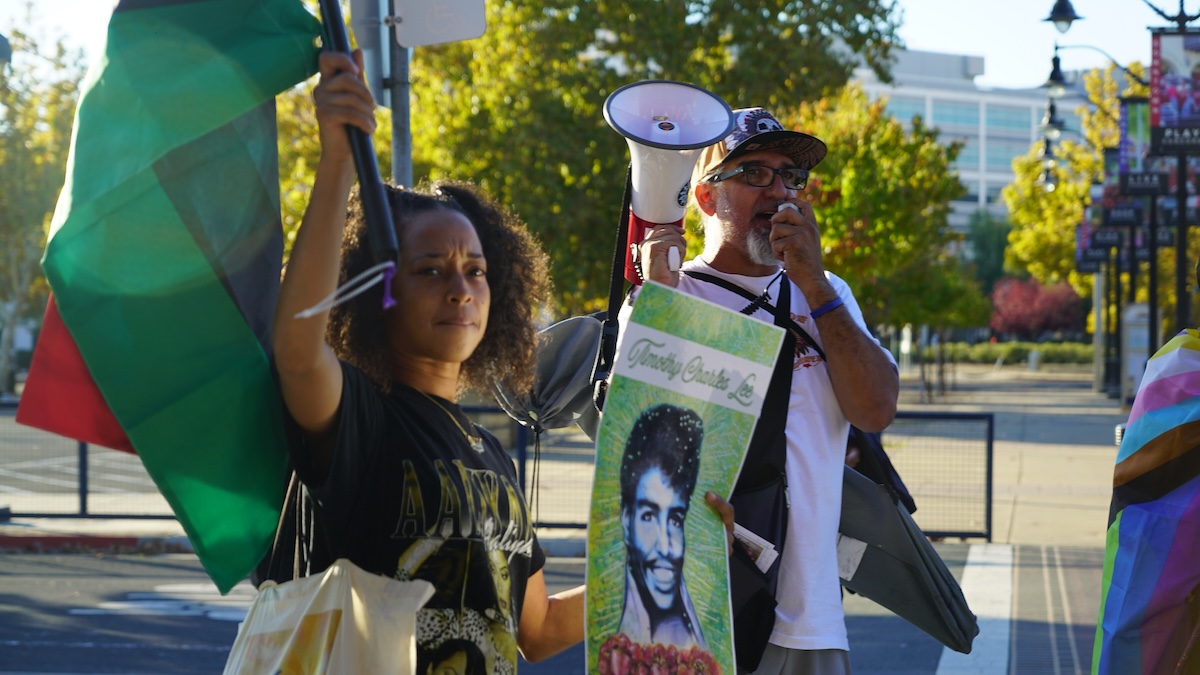
“I knew something had happened to my cousin, but I feel like my parents kept the details from me,” said Frank Sterling, Lee’s first cousin, who was 12 when Lee died.
Decades later, a colleague of Sterling’s at KPFA Radio in Berkeley reported a story about the history of lynching that ended with a mention of a well-dressed man found hanging from a tree outside the Concord BART station. The description sounded eerily familiar.
“I realized he was talking about my cousin. I started asking my dad about what had happened and doing my own investigation. I read one affidavit that really struck me,” Sterling explained. “An eyewitness said that there was a group of young men surrounding a young man that I believe was Timmy, and a uniformed officer close by.”
If those accounts are true and the young men were close in age to Lee, they would now be in their 60s, Sterling estimates.
“They could be living here in one of the houses in this surrounding area,” he said, standing in front of the tree where Lee was found. “If I can get some living people held accountable, that’s my ultimate goal. If not, I want to keep Timmy’s name alive and remember that his story is a part of Concord history.”
Modern day lynchings
In its 2026 report, A Crimson Record, the civil rights organization JULIAN documented some 70 suspected modern-day lynchings of Black people between 2000 and 2025 across southern states. Many of them — as in Lee’s case — were promptly ruled suicides.
A string of similar cases this year has prompted calls for renewed investigations.
In September, some 38 members of congress submitted a letter to Attorney General Todd Blanche and FBI Director Kash Patel demanding an investigation into a series of Black people found hanging from trees in multiple states across the country.
“For decades, the DOJ and FBI ignored widespread lynchings which motivated more killings. Inaction by the federal government is tantamount to complicity,” the Congress Members wrote in their letter. “This is part of the legacy of racial terror in the United States, and this neglect has long-term consequences.”
Missing and Murdered Indigenous People
Back in Concord, Sterling began organizing an annual “Justice for Timothy” walk outside the Concord station five years ago. This year, Sterling and a group informally known as the Justice for Timothy Lee Coalition added a “Living Timmy’s Dream” fashion show in nearby Walnut Creek.
The event raised funds for the Rainbow Community Center, which supports LGBTQ+ youth and young adults in Concord. It sits just blocks from where Lee died.
For Sterling, his cousin’s death also points to the issue of Missing and Murdered Indigenous People (MMIP) and the continued failure by public officials and law enforcement to resolve cases involving members of Native American and Alaska Native communities.
Sterling says he in fact wants the case reopened and investigated as an MMIP case.
“Timmy was a member of the Rincon Band of Luiseño Indians. He’s buried right now in their cemetery, along with my aunt Vicky, his sister Tammy and his older brother Tommy,” Sterling says. “To me, he’s my cousin who died too soon, but I very much think of him as an MMIP, and I’d love the full backing of our tribe.”
Documentary filmmaker Maria Judice is now making a film about Lee’s life, his legacy and the fight for justice in his name. At Sterling’s 2025 justice walk, she poured a libation of water before the tree, near an altar set up in Lee’s honor.
“We’re going to remind (Timmy) that we are still out here working hard for you,” Judice said. “We’re looking for those who took your life. We’re looking for all the people who disregarded your murder as nothing more than a suicide. We’re loving you as our brother right now, and we’re all here for you.”
A call for unity
Lynnette Grey Bull is the executive director of Indigenous Youth Voices, which helps Native youth connect with the outdoors and their roots, and Not Our Native Daughters, dedicated to helping the loved ones of Missing and Murdered Indigenous People.
A mother of three mixed race Black and Native children, Bull says she can’t help thinking of her own children and the youth she works with when she hears stories like that of Timothy Charles Lee.
“I don’t need to know all the details of (Lee’s) story to know that it was a great injustice,” Bull said, adding in cold cases such as these, the most effective strategy involves bringing family, friends and allies together to collectively pressure local officials.
“When a family is trying to get a cold or closed case open in any demographic, in any community, it’s an uphill battle,” Bull said.
But she continued, “If partners, allies and community members collectively meet with elected officials and pressure them to take action, there is more fire behind it.”
An annual tribute and walk to remember Timothy Charles Lee are scheduled in downtown Concord on Nov. 15 at 11am. Those with information about the case or interested in getting involved in the Justice for Timothy Lee movement can contact Frank Sterling at justice4timmy@gmail.com.
Sharon K. Sobotta recently joined American Community Media where she helps manage a new Native/Indigenous Voices initiative. She is as an editing fellow with the UC Berkeley California Local News Fellowship.