


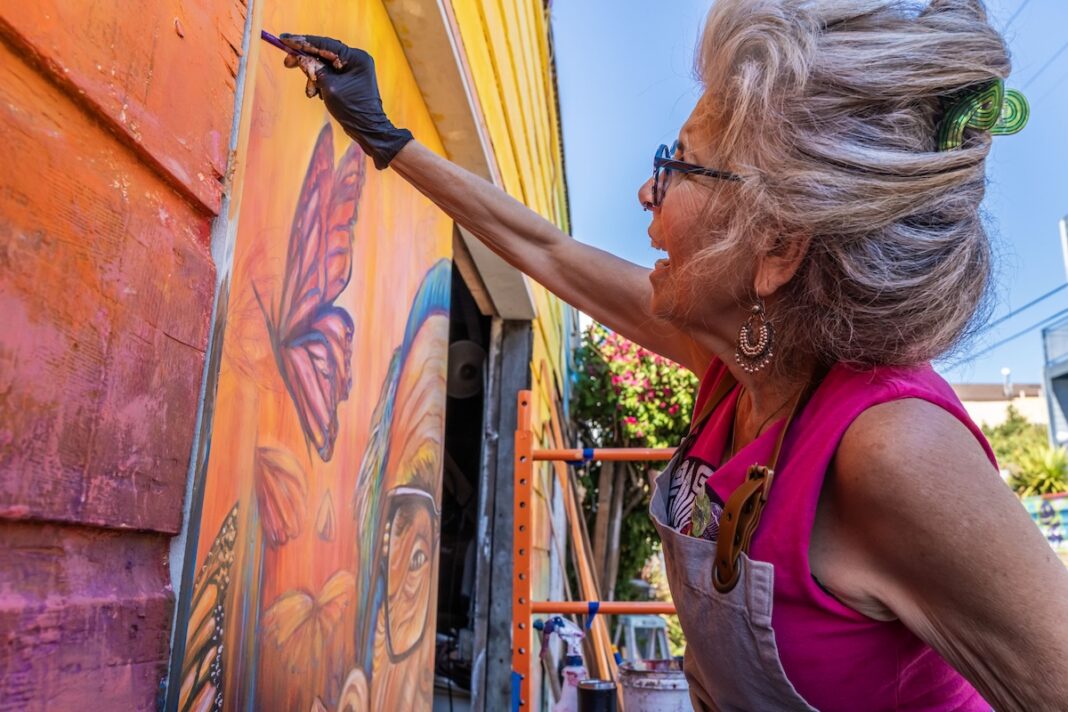
Juana Alicia and Tirso G. Araiza are two of San Francisco’s most respected muralists and artists and were early contributors to the murals that now decorate Balmy Alley in the heart of the city’s Mission District. The alley and the works that decorate it — many of them inspired by the neighborhood’s Latino roots — are viewed by some as a birthplace of San Francisco’s modern muralist tradition. The artists spoke with photographer and journalist David Bacon as they worked on a new mural about the significance of the alley and the movement it helped launch in a city that is today vastly transformed from the one they began their careers in decades earlier.
How would you describe Balmy Alley to somebody who’d never seen it?
JUANA ALICIA: Originally, the alley was just an alley — it didn’t have the murals. Now there are fifty-three murals on this little stretch between 24th and 25th Streets, between Treat and Harrison Streets. At the end of the alley, on 24th Street, there’s Acción Latina and the Medicine for Nightmares bookstore. Galería de la Raza used to be there too. And there’s Brava, for Women in the Arts, our fiscal agent for this project.
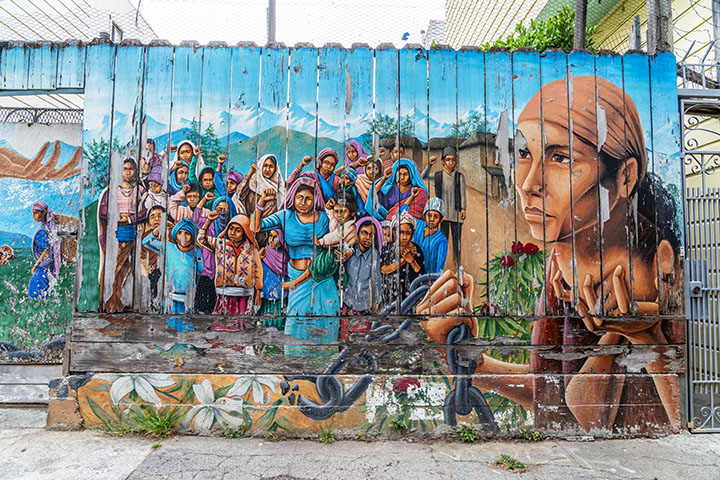
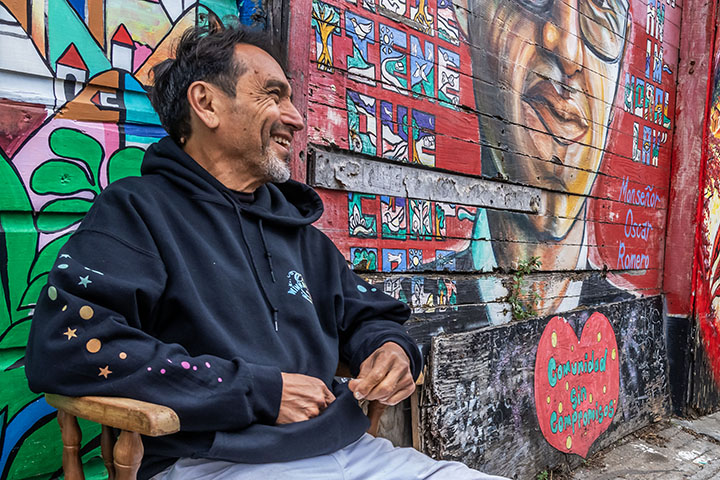
TIRSO G. ARAIZA: They’re different murals from different times. At the start of this project, we were walking down this alley, looking at the murals, lamenting their condition, saying to our friends, we should do something about this, we’re going to lose these murals.
The mural Irene Pérez painted [in the 1970s] was restored once, I think in the ’90s, and then it was forgotten. We decided to restore it because we knew its history. We knew it had been painted so long ago, and she was the only one left from that generation of ’70s muralists. So we found Irene Pérez and asked if she’d be interested in restoring her own piece. She had the courage to go back and redo it and was happy we’d managed to get the funds.
Then there’s Juana Alicia’s, done in the ’90s — also a pretty old mural, and I don’t think it has ever been restored in almost thirty years. Three others were also in bad shape, the paint peeling and fading. Sometimes the city would rather fund a brand-new mural than restore an existing piece. That forces the artist to sacrifice a piece with tremendous historic and cultural value. It gets forgotten, and eventually the mural’s gone. Most murals restored in the Mission have been restored by the artists themselves. But artists can’t afford to do the restoration work themselves. When there’s no support, it doesn’t get done. Our original proposal was actually to restore ten — we didn’t get all ten approved, but we got six. I think we should keep forming a collective around this, to show that it’s possible.
Tell me about the subject of the mural you’re painting here.
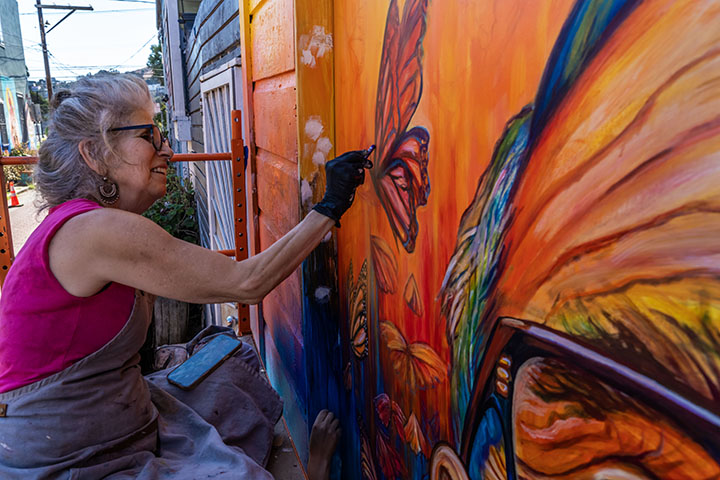
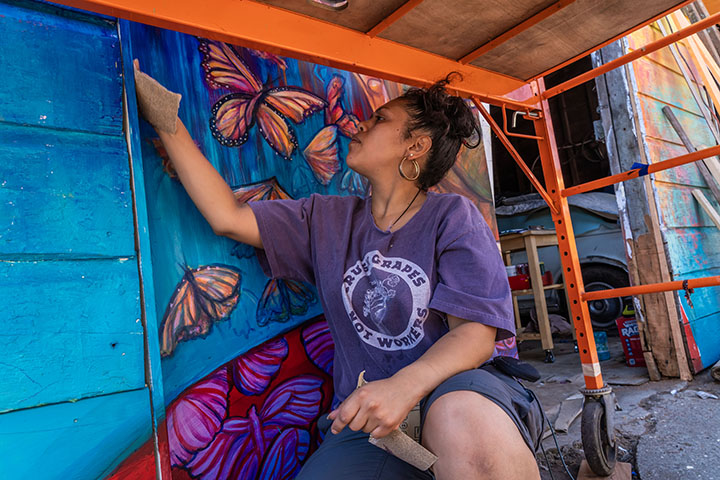
JA: This is a memorial — an homage, a song — to Monsignor Óscar Romero. He was an amazing human rights defender, assassinated while saying mass in his church in El Salvador, in the mid-1980s, by a CIA-trained murderer. He’s beloved in El Salvador, but his legacy belongs to all the people who struggled against the repression in El Salvador, Nicaragua, and Guatemala, and who continue to do so, because it isn’t over.
I painted my first homage to Monsignor Óscar Romero here in Balmy Alley thirty years ago, in 1996. I wanted to restore that mural, but the wall is crumbling — it’s not really restorable. So I reinvented the mural. Thirty years later, I have better painting skills, I hope, than I did then.
The butterflies embroidered in his cloak are an immigrant-rights symbol, aren’t they?
JA: In Mesoamerican tradition, when someone dies, the butterflies carry their soul to the next life. They’re a symbol of migration. We migrate, and butterflies migrate. You can see my granddaughters have already started to paint them, because they couldn’t keep their hands off it. We’re going to organize some community events so people can bring their children to paint more.
What’s the story of the murals on Balmy Alley? How did this all start?
JA: Irene Perez painted one of the first murals in Balmy Alley, in 1973, I think. Then there was Patricia Rodriguez, who was one of the original Mujeres Muralistas, and Ray Patlán, who was a muralist here too. They both lived on the alley, and they got together with a bunch of us to form a collective called PLACA, in 1984. There’s a lot of history here on Balmy. I first did an earlier mural about the genocide in Guatemala, in 1985. And then I did this first one of Romero in 1996, because the Guatemala mural had gotten pretty badly tagged by then.
How would you describe yourself — a cultural worker, a muralist? And why are you doing this?
JA: I’m doing it because I love it, and I love my neighborhood. I love my community, and I love the work — the human rights work. Monsignor Romero’s message is more pertinent than ever, given the current imperial administration we have in the United States — not that this country hasn’t always been an empire, because it has. But it’s very important to keep hope alive, to keep insisting on our rights, human rights, and to hold up the work of human rights workers all over the world, whether they’re artists, or priests, or farmworkers. Whoever is doing the work.
It sounds like your role as an artist is also kind of a historian’s role.
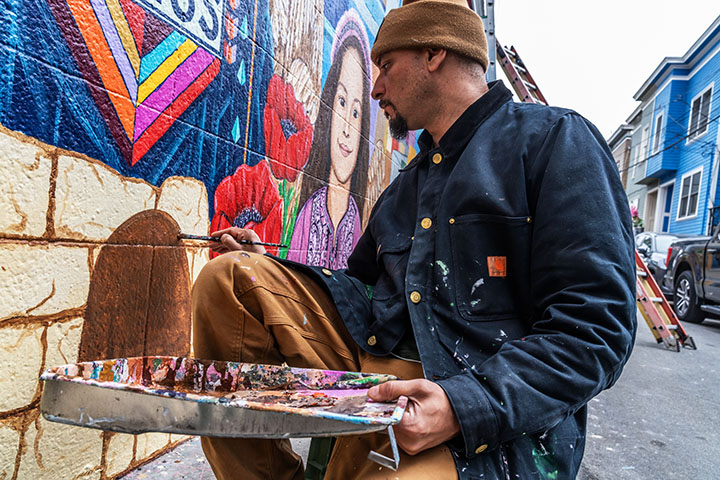
TA: This project was born out of a historical interest, not wanting to lose the legacy of the painters who came before us. Ray Patlán, Patricia Rodríguez, who was a member of Las Mujeres Muralistas; Chuy Campusano — are gone. Their work has disappeared with them.
We don’t want to lose our art, our legacy in this neighborhood. We’ve been here so many years, doing this work of painting the walls for so long. We want to keep it for future generations. Of course some murals will disappear, but new ones will come. Young artists are coming up — Lucia, the Twin Walls Mural Company, Trust Your Struggle — all these young people painting new murals, which is fantastic. The older generation is here to support them. So when a mural is gone, beyond restoring, it’s wonderful that someone new can come and paint a new one in its place.
You’re an example of a certain kind of cultural worker, a certain kind of artist. People look at you as combining art and politics in a particular way.
JA: Well, I think artists need to work from their conscience. To paraphrase Alice Walker — we need to leave the world more beautiful. But we have to activate ourselves in times of repression. We have to illuminate and lift up the voices of resistance to the daily waves of despair, the daily ugliness we’re fed in the news. We need to give people alternate images.
I don’t know about being a cultural worker or political artist, I’m not trying to go for a label, and I’m not a pamphleteer. I don’t want my work to be so didactic that it becomes a pamphlet. My work connects to our human nature, and the nature all around us. It responds to things beyond the headlines. It responds to our spirit, and to the unity we’re all bound in.
Even more than that — maybe this is true of muralism in general, but your work in particular looks out, rather than looking in.
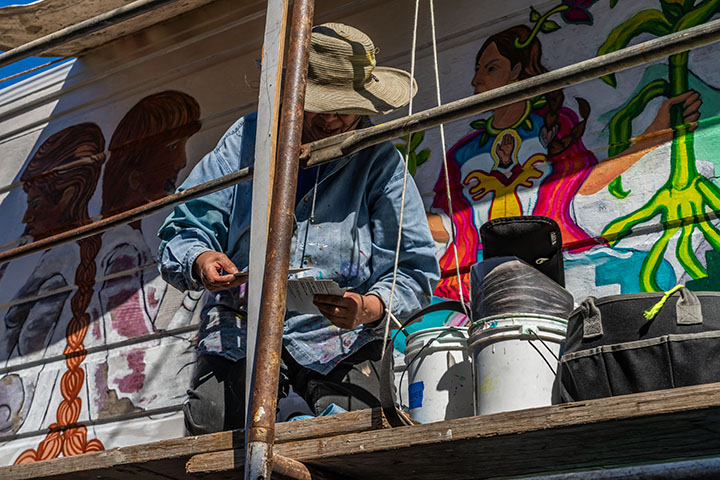
JA: I think it looks in, too. It needs to be introspective, but yes, it looks out as well. Not looking inward created some of the mistakes our movements made in the ’70s and ’80s — rolling over our interior lives, prioritizing a materialist interpretation of Marxism, of socialism, without really considering the role of the heart and the spirit as part of our movements. That alienated a lot of people — a lot of people of color, a lot of women — because it didn’t take into account the depth of our oppression, or our interior lives, or how we needed to respond in our personal lives — so that we could transform the world in a more sensitive way. The personal is political, right?
TA: I was a cartoonist for a newspaper in Mexico. Sometimes you see things going on that you’re not happy with, and you want to say something about it. The only way I had to do that was through a cartoon. And of course whatever you do is going to be read as political by somebody, because your work reflects who you are.
I see myself as an artist, and I think everything anybody does is, in a sense, political. What we do isn’t decoration — it’s not just about making the walls look nice. We make political comments with the work. We say things with it. When you look at a mural, you see a reflection of what’s going on. So in a way, we’re political artists. We’re political workers.
Was San Francisco kind of the seed that planted this movement?
JA: You talk about muralism being a certain political tradition, and we have that. That’s the legacy I step into: Los Tres Grandes in Mexico, and the muralists of the Black Power movement. But a lot of murals being done now have no narrative meaning at all — they’re mostly decorative. There’s this whole “pretty girls” school of mural-making. You can paint beautiful people of all colors, but if there’s no message beyond “we’re beautiful,” and we already know that it doesn’t push the debate or the public conversation forward.
I expect murals to stimulate people to action — to organize, to think, to debate, to argue. I want them to be provocative. It’s a new era, for sure, and the city’s become so gentrified. The population, the demographics, have changed a lot. We want to make sure the people who are still here are not invisible.
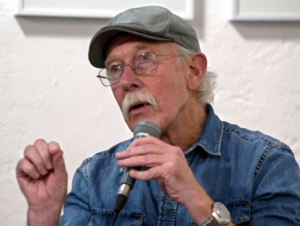
DAVID BACON
David Bacon is an American photojournalist, author, political activist, and union organizer who has focused on labor issues, particularly those related to immigrant labor. He has written several books and numerous articles on the subject.