


Also available in Spanish.
Maria Luisa Arredondo, Ethnic Media Services
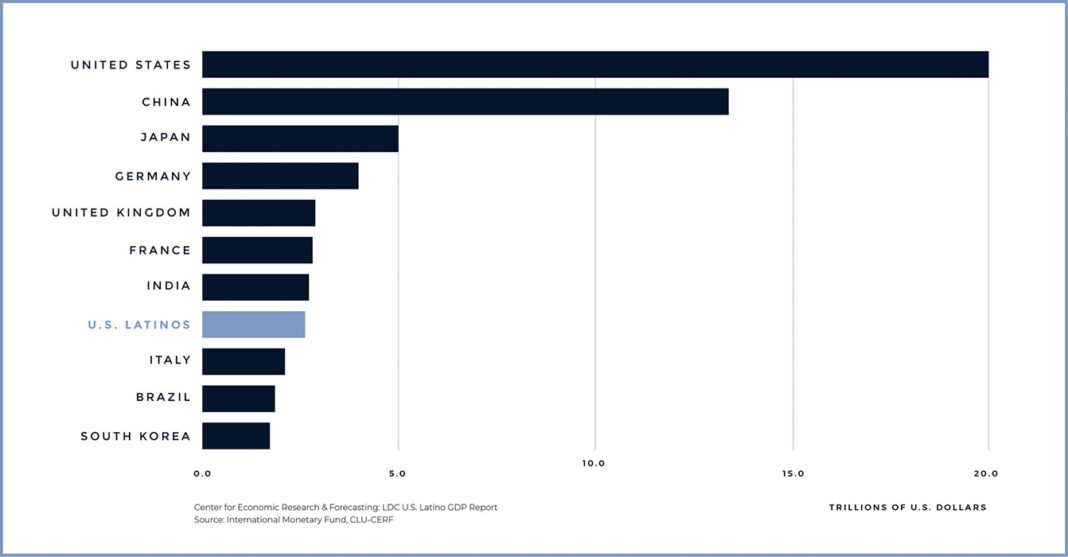
A new report presents compelling data that Latinos in the United States are performing economically far beyond expectations, contradicting long-held stereotypes. 2021 State Latino GDP Report reveals that their GDP in 2018 amounted to $2.6 trillion. If Latinos were an independent nation, they would rank eighth in the world, with a GDP higher than that of Italy, South Korea or Brazil.
Dr. David Hayes-Bautista, co-author of the study and director of the Center for the Study of Latino Health and Culture at UCLA, says the report puts the lie to the idea that Latinos come to the United States to commit crimes or live on public assistance: “We are not lazy or criminal, we come to work, and these figures prove it.”
The U.S. Latino GDP grew 21% faster than that of India and 30% faster than China’s. In California, the statistics are just as staggering. In 2018, the state’s Latino GDP was $706.6 billion, higher than Ohio’s total economic output.
Latinos are an enormous source of economic vitality because of their hard work, family values and solid health profile, Dr. Hayes-Bautista says.
His new report offers estimates of the economic contribution of Latinos in Arizona, California, Florida, Illinois, New Jersey, New Mexico, New York and Texas, states where nearly three-quarters of the country’s Latino population live.
An essential component of the great economic performance of Latinos is consumption — $1.36 trillion in 2018 alone in those eight states. From 2010 to 2018, real consumption in this group grew 135% faster than that of non-Latinos, primarily due to population growth and strong participation in the labor market.
Between 2010 and 2018, in California, for example, the non-Latino population grew 3%, while Latinos increased 13%, the growth, Dr. Hayes-Bautista says, driven not by migration but by a high fertility rate.
The report also highlights that from 2010 to 2018, the educational level of Latinos grew 2.5 times faster than that of non-Latinos in the state. And in that same period, Latinos’ labor force participation averaged 4.6 percentage points higher than that of non-Latinos.
Latinos in California have a longer life expectancy than non-Latino whites, too — 83.6 years compared to 80.8. This is due, according to Dr. Hayes-Bautista, to their health habits.
“In the case of the pandemic,” he clarified, “Latinos were very affected because they did not have the same access to Covid-19 vaccines as other groups and they could not be confined to their homes because many are essential workers.”