

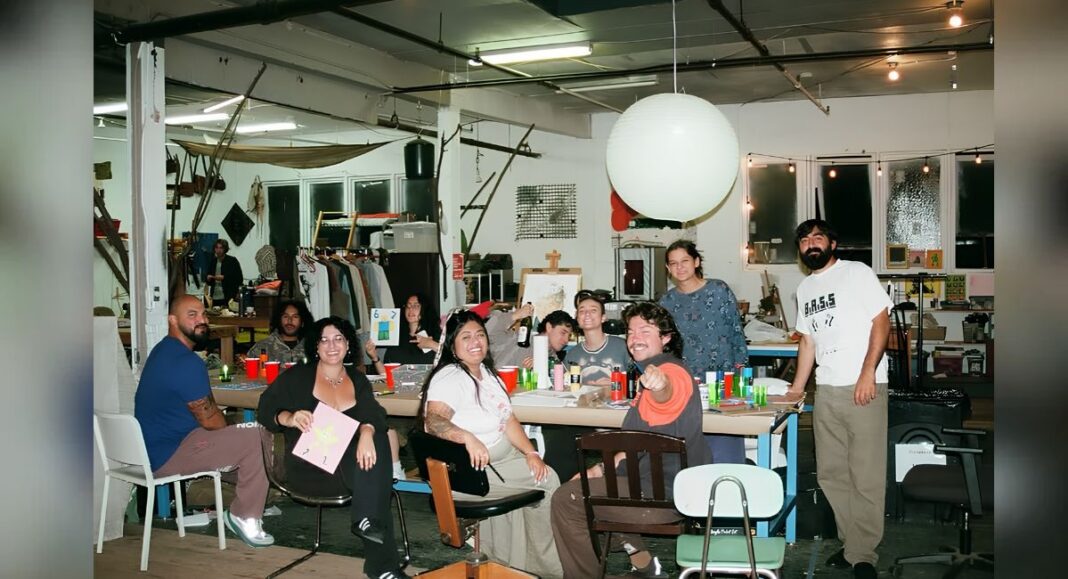
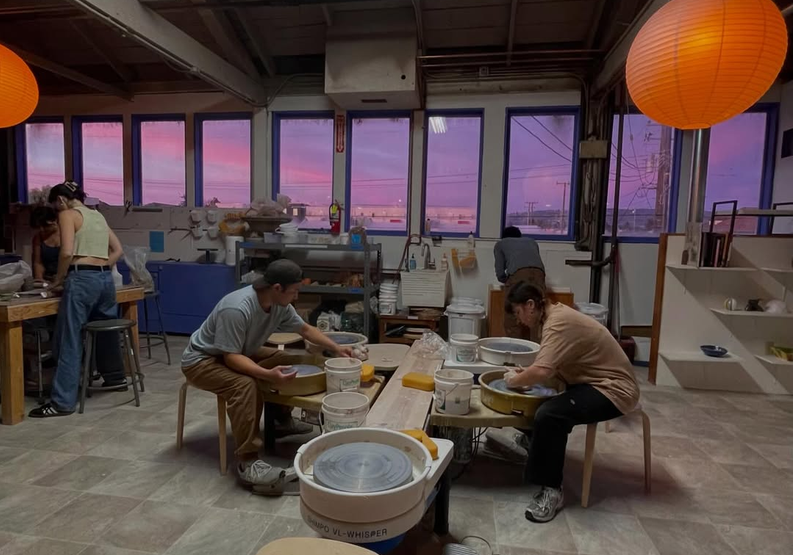
OAKLAND, Calif. — On a Wednesday in August, about a dozen people are spread across two creaking wooden floors in a spacious, well-lit warehouse in East Oakland near Jack London Square.
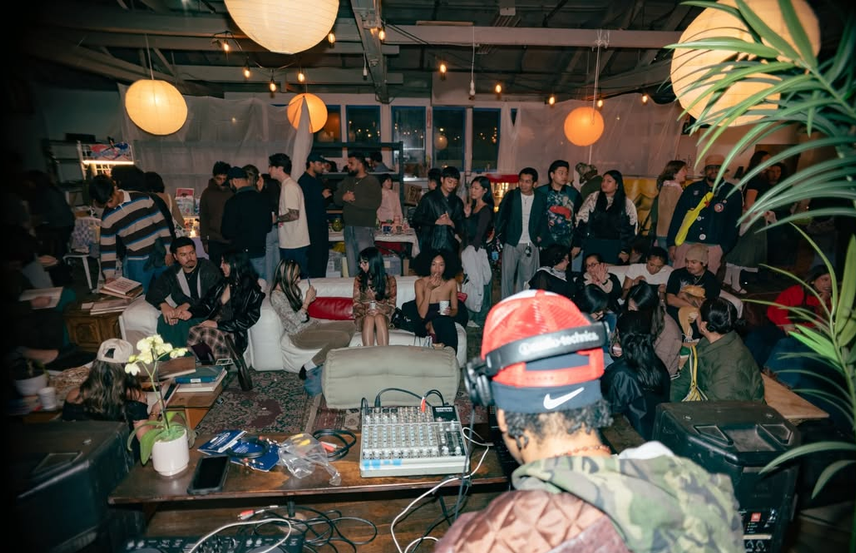
In one corner, someone crouches before a mannequin with a fistful of pins. In another, a few potter’s wheels spin, the smell of wet clay permeating the balmy air. At a long table, three people sit before their laptops and discuss knitting and graphic design projects. The sounds of a turntable, sewing machine and a bicycle mechanic’s creaking wrench fill the space.
In the middle of it all, Adeeb Haidari, a photographer and co-founder of the artists’ collective Safariii Camp, lounges on the sofa.
“The purpose is to have all different sorts of mediums around each other and let them naturally influence each other,” said Haidari. “Same with the people. We all come with the intention to collaborate. I think we all need each other, very literally and emotionally.”
‘We lost our soul’
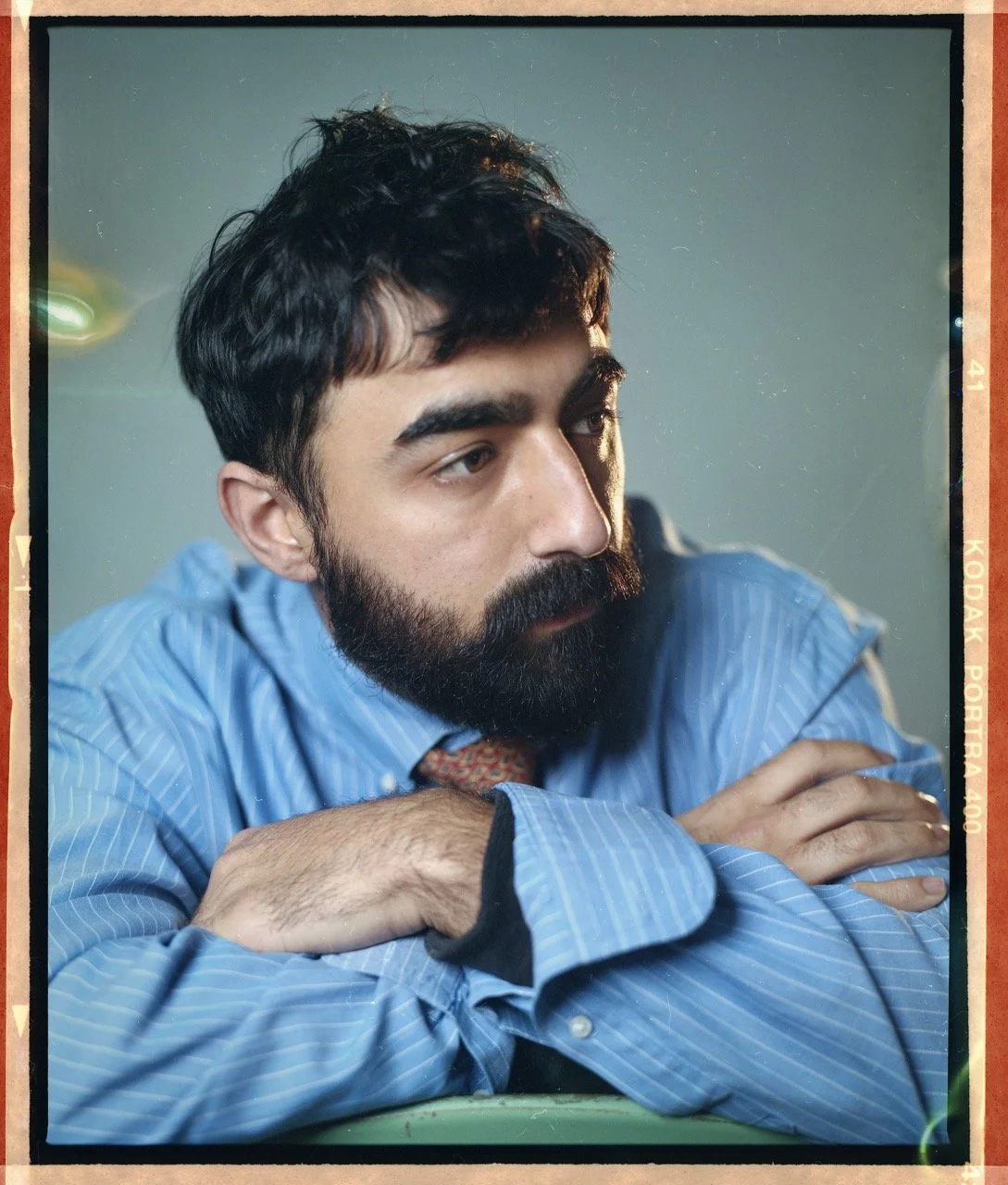
Haidari, 27, grew up in Fremont, a Silicon Valley suburb some 40 miles south and east of San Francisco. Like his own father, Haidari worked in tech for a time. But childhood memories of a Bay Area once replete with artists and street performers pulled at him.
Those days can feel like a distant memory, however, in one of the most expensive regions in the country, and one where the ongoing AI boom has driven rents to near sky-high proportions. The surge in costs prompted San Francisco Mayor Daniel Lurie to declare a rental emergency last week.
“Has tech corrupted the Bay Area? Yes, I think we lost a lot of our soul,” said Haidari. “It’s pushed people out of their homes, these communities, these artists.”
It’s that sense of displacement and disconnect that Haidari is hoping to counter with Safariii Camp.
“Being an artist can be very lonely in the sense that we’re all dreaming up our own worlds and visions,” said Cami Totah, a ceramicist and photographer who joined the collective to be around other artists. “Being able to release that … while other people are supporting you along that journey, is really motivating.”
As for AI, Totah acknowledges its administrative utility, but she draws the line at AI generated art.
“Do I think that it has helped arts organizations and nonprofits advance their technology? Yes,” she said, adding, however, that knowing AI was used in a piece makes her see it differently.
“It makes me question the artists’ morals and values and whether or not they dreamt up that world or creation on their own, or if they had the use of a robot and sourcing from other people’s ideas to actually bring something to fruition.”
AI to the rescue?
For young creatives like Totah, AI is also threatening their bottom line.
A 2025 study out of Stanford found the flood of AI generated art on the market is eroding the ability of young and newer artists to make a living, reducing opportunities for paid work while driving down costs more broadly.
In July, San Francisco broke ground on a $140 million affordable housing project for artists. The project, paid for through a combination of philanthropic funds and tax-exempt municipal bonds, will include 94 apartments, as well as rehearsal spaces, offices and a theater.
It comes on the heels of news that California College of the Arts (CCA) will shut its doors at the end of the 2026-2027 academic year. The school had long been a hub and incubator for aspiring artists.
In response, Nvidia CEO Jensen Huang announced a $75 million matching gift to Vanderbilt University to establish the Jen-Hsun and Lori Huang College of Art, Architecture and Design on the grounds of the former CCA campus. In a statement, Huang said the funds would “help San Francisco remain one of the world’s great centers of creativity, innovation and culture.”
Totah, whose sister attended CCA, is skeptical. “It’s basically to make themselves feel better about expanding AI in a place that is full of art and culture.”
‘I enjoy AI slop’
Still, not all artists here are as put off by AI.
At The Intersection of Art and Technology (TIAT), a downtown San Francisco gallery operating out of a space acquired through the city’s Vacant to Vibrant program, founder Ash Herr treats the technology as a medium for expanding self-expression.
“With our space, we support many different types of practices at this intersection,” said Herr. “Some of it could be AI, some of it could be hardware, live coding, live music, 3D mapping, projection mapping.”
She has her own definition of what AI art is: “I think in general it’s content generated to maximize visibility, attention, or maybe it’s associated with something that’s low effort … but effort is subjective, enjoyment is subjective. And I think that’s the beauty of it, and what makes it a great medium for people to discuss. I personally love it. I enjoy ‘slop’ content.”
The Thee Stork Club, an Oakland music venue and bar, made headlines last year when owner Billy Joe Agan banned AI-generated “slop” flyers out of frustration with how promotional art was being made in the local music scene. A flyer used to mean another artist got a job. The policy spread.
“I saw a bunch of small venues around the country take up the same policy,” Agan said.
But even Agan sees value in certain types of AI art, citing as an example electronic musician Holly Herndon, his former neighbor in Oakland.
Herndon studied music at Stanford’s Center for Computer Research in Music and Acoustics and has built software and machine-learning systems into her artistic practice. In collaboration with artist Mat Dryhurst, she has developed audiovisual systems incorporating AI, collective singing, digital identity and ownership.
Holly Herndon discusses her approach to making art with AI, what she calls Protocol Art: a process-based practice of designing the rule set that creates the conditions for art to be made. (Herndon’s talk begins at minute 2:20)
“She’s doing it in a very high-intellectual way. She uses it in her music, she uses it in art installations around the world,” said Agan, adding that his issue isn’t the technology itself, but the fact that its displacing a working person from the creative community.
“Somebody said that they used AI, and I was like, you better have a good justification,” he added, describing another venue flyer, “because other artists are not gonna really like that here.”
No replacing the creative process
Jay Elias, a Safariii Camp resident and self-described creative technologist, is more comfortable using AI than many fellow residents.
“I think technology has forever been a part of the art making process,” Elias said, holding up the camera as an example of a technology that was once considered advanced enough to replace painting, but just became a separate medium.
“When you pull out an actual definition of the word ‘technology,’ it includes hammers, it includes chisels, it includes paintbrushes,” said Elias. “Artists have always been the ones pushing technologies and ideas forward or using them in ways that have never been explored before.”
The problem, he elaborated, comes when AI is used primarily to eliminate labor.
“That’s why I think people are really critical of AI right now, because it’s this efficiency machine that’s really being leveraged by a capitalist system to accelerate profits, and in the process, automate jobs and separate people from labor.”
He added, “There are times in the creative process where AI can be a valuable tool, but it can also really dangerously replace that process.”
For graphic designer Indigo Hansen, AI has its uses, for example with the tedium of routine administrative work behind projects.
She says some of her clients also now arrive with undeveloped concepts using generative AI, but it’s “like the person that drives the $200,000 sports car but doesn’t know how to drive a stick,” she said. “You can make the image, but it looks like shit.”
And while she admits AI has helped her take on more work, the simmering economic tensions are never far beneath the surface.
“You have this industry that’s getting billions if not trillions of dollars being funneled eight miles away across the bridge,” said Hansen, who moved to Oakland in 2018. “You can really feel that tension.”

CHRIS ALAM
Christopher Alam is a California Local News Fellow with the UC Berkeley Graduate School of Journalism. A Lebanese print and audio journalist, Chris was born in California’s Central Valley and has a passion for telling stories about the challenges facing vulnerable communities.