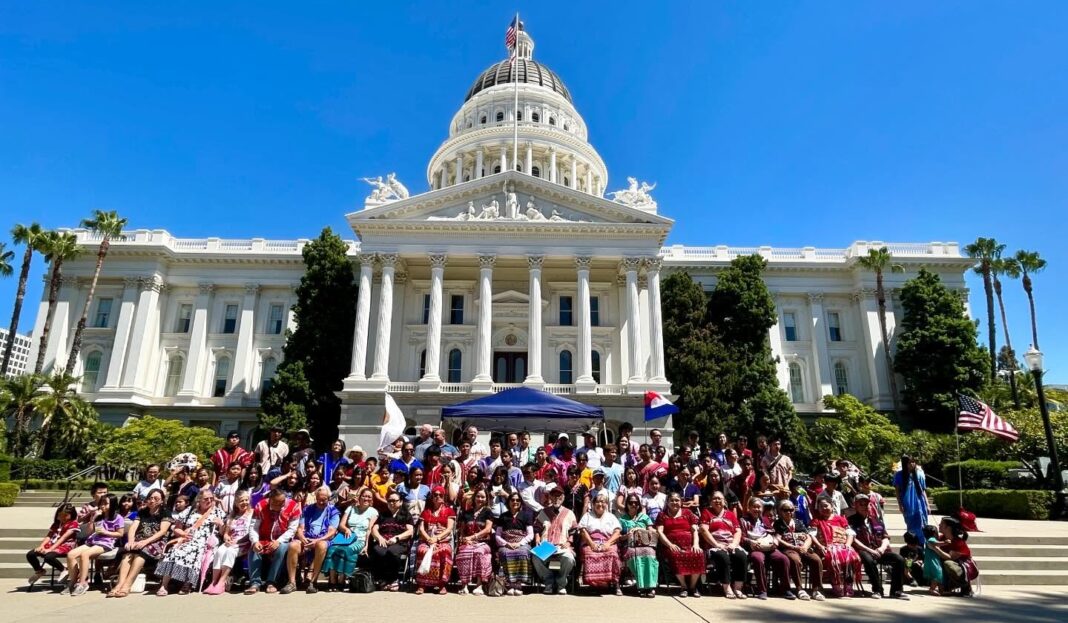
SACRAMENTO, CA — For California’s Karen people, an annual Martyrs’ Day gathering is a reminder of the support they are still fighting for.
Most ethnic minorities who have immigrated to the U.S. from Myanmar — including the approximately 1,600 Karen people living statewide — are refugees, primarily from camps along the Thai-Myanmar border. Karen people are the largest of these groups, having been displaced by the world’s longest-running civil war, which began after Myanmar gained independence from British colonial rule in 1948.
In remembrance of the war and in celebration of culture, the California Karen Youth Connection (CKYC) held its annual 75th Karen Martyrs’ Day event on August 9 at the state Capitol in Sacramento. With over 100 people in attendance, the event featured traditional songs, dances, a feast of Karen food, speeches honoring the day and a presentation of certificates for those who had completed Karen language courses through the organization.

Addressing the crowd, CKYC President Ko Ser Lu Htoo said the event took place at the Capitol as a way to express gratitude to the California government for providing homes, jobs and education for the Karen people, for whom “the state Capitol represents stability, freedom, democracy, justice and the rule of law.”
“We, Karen people, work together. We are unique, we have our own culture, we have our own language, we have our own nation — ‘Kawthoolei’ … or ‘Land Without Darkness,’” he continued, referring to the state that Karen people have sought to create since the beginning of the civil war.
CKYC, a charity organization established in 2021, is comprised of Karen youth from the Bay Area, Sacramento, San Diego and Bakersfield, with the aim of helping refugees resettle and navigate life in the U.S. through college and career help, civic engagement and cultural events.
The organization’s six board members and 12 volunteers have helped over 400 Karen seniors and youth to date.
“After living in refugee camps for eight or 10 years, coming to another third country to resettle is like entering a completely different world,” said Htoo, who came with his family to Oakland from a refugee camp in 2011 at the age of 12 and went on to graduate from UC Davis with degrees in political science, sociology and human rights. In his second year, he made history as the first Karen American student senator at the university.
“My family and I received food, education and health care in the camp because of the humanitarian aid provided by the U.S.,” he explained. “When this aid is cut off, how are they going to survive? Where do they go?”
Cuts to humanitarian aid under the Trump administration this year have devastated communities along the Thai-Myanmar border, which houses nine refugee camps. The International Rescue Committee (IRC) has already shut down medical clinics in seven of these camps.

In response, on July 21, approximately 50 Karen youth representatives partnered with CKYC and the Karen Organization of America (KOA) to visit Congress in Washington, D.C., sharing with legislators the impact of federal cuts on refugee camps and calling on legislators to pass the Brave Burma Act and the Burma Genocide Accountability and Protection (GAP) Act.
The Brave Burma Act would cut off the primary source of U.S. funding for the military junta in Myanmar which has killed at least 50,000 people — including at least 8,000 civilians — as of March 2024, since a 2021 coup.
The Burma GAP Act calls for the U.S. State Department to address the genocide against the Muslim Rohingya people in Myanmar through humanitarian aid and protection mechanisms for refugees.
“Humanitarian aid is not just for others; it’s also for the United States,” said Htoo. “This country is a home for millions of immigrants and refugees who came here for jobs and successful careers, contributing to our economy and the American story. That’s why this support is so important to continue providing.”
From 2002 to 2011, refugees from Myanmar comprised the largest refugee group to be resettled in the U.S., totaling 88,348 people — about 17% of the overall refugee population.
Over 12,800 Karen refugees were resettled in the U.S. between October 2006 and August 2007 alone, contributing to an estimated 215,000 Karen people now living in the U.S.
Even after migrating to the U.S., however, the Karen people are still struggling for recognition. For many, this battle continues on the U.S. Census form.
While the Census only lists “Burmese” as a recognized ethnic name for those from the region, Htoo recommended that Karen people fill in their ethnicity as “Karen” because census data is critical for a community’s needs to be recognized by its local, state and federal government, and because Karen people have their own distinct language and culture.
Htoo concluded his speech at the CKYC event by urging Karen youth to embrace their new roles and privileges as American citizens.
“You have the right to vote and even run for elected office,” he stated. “You may have come as a refugee, but once you are in the U.S., you have these opportunities … My hope is that one day we will have a Karen president, a Karen senator, a Karen governor, a Karen mayor and a Karen council member. I want to see our people represented at every level of elected office.”