


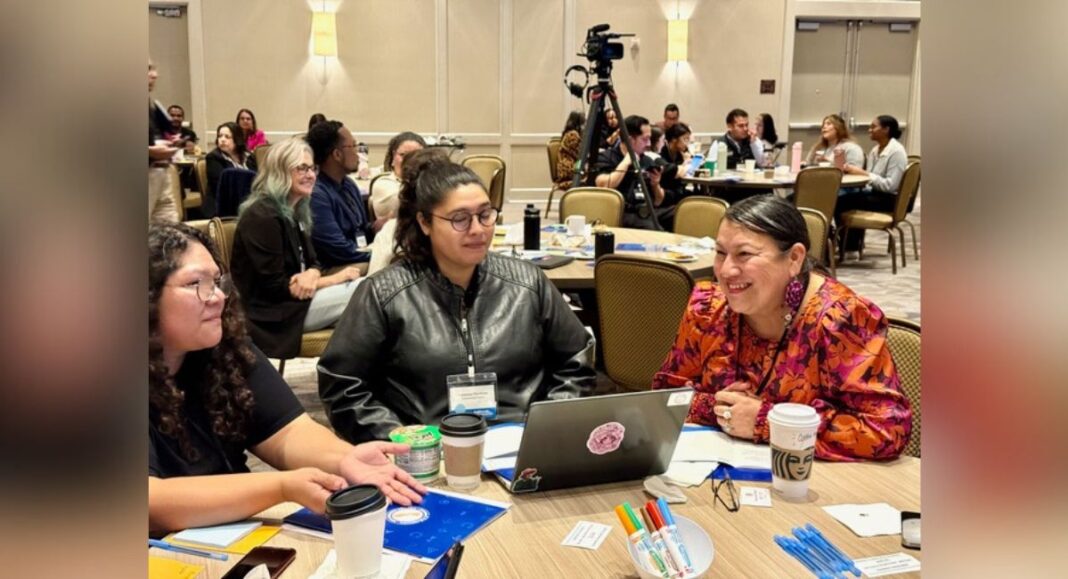
Over 150 civic leaders, activists, and community volunteers gathered Nov. 5 in San Diego for a Cal Connects convening. The event, one in a series of similar gatherings statewide, is part of a broader effort to connect community organizations that are often on the front lines when it comes to delivering vital services.
It comes as the Trump Administration continues its push to cut federal funding for a variety of programs essential to community well-being.
“We create safe spaces where people can come together to talk about social issues,” said Clara Olivas, executive director of Queer Casa, which serves the LGBTQ+ community in Imperial County, a largely immigrant enclave where attitudes about sexual orientation and gender identity tilt conservative.
“We created Queer Social Club where people come to celebrate, share their concerns and take different kinds of trainings to improve and secure their lives,” said Olivas, who identifies as queer and non-binary, adding her organization has already helped hundreds in the community since the start of the Trump Administration in January.
Olivas was among the first to arrive at the event and said her goal in coming is to give visibility to the people she represents, and to identify potential resources and funding to better serve her community.

More than 100 languages are spoken across San Diego, a city that straddles the U.S.-Mexico border and where nearly one third of residents struggle to meet basic living expenses.
Data show more than 400,000 San Diegans rely on Cal Fresh, California’s version of the federal Supplemental Nutrition Assistance Program, or SNAP (formerly known as food stamps), an indicator of the economic challenges households in the city face. The Trump Administration has proposed major cuts to SNAP, as well as to health and housing related support.
“We’re here today to make sure that you don’t just have resources and information about resources,” said Aubrey Fong, executive director of the Office of Community Partnership and Strategic Communications (OCPSC), the agency behind the Cal Connects convenings. “This is your space to build connections, meet new people and make a plan for how you’ll continue to work to make San Diego a better place.”
Among convening participants statewide, 37% have California Service corps members, 79% serve youth, 77% serve immigrants and refugees, 76% serve households with limited English proficiency, 62% serve in the education field and 55% provide services to children and families.
“It’s about working together in ways that save time, save resources and strengthen trust,” said Fong. “Today is not only about sharing information, but it’s also about listening.”
Arcela Núñez is the co-founder of Universidad Popular, which serves the Latino community in the City Heights neighborhood, providing educational support and promoting civic participation and voter engagement. She says the organization has seen a sharp increase in demand for basic services as a result of the current administration in Washington.
“There is hunger in our community, especially among the elders,” said Núñez. “Many of them are unsure whether they will even be able to get their medications. Those who suffer from chronic illness, like diabetes, are at serious risk every day because they cannot access medication due to lack of funds.”
Núñez adds the ongoing immigration enforcement raids have further traumatized communities. “In one case an elderly couple was separated, when the husband was picked up. He was a day worker, and during a raid at the work site, he was detained, leaving his elderly wife behind,” she said.
San Diego Mayor Todd Gloria explained that at the beginning of the year, he issued an executive order that the city of San Diego will not perform federal immigration enforcement.
“As the first person of color to serve in this role, I know personally that we are America’s finest city because of immigrants, and that we welcome immigrants because they make our city better,” said Gloria.
Thomisha Wallace, executive director of Youth Empowerment Commission, remarked that the impact of the immigration raids is being felt beyond the Latino and immigrant community.
“We’ve heard from young people who aren’t Latino but are affected because of their friends,” Wallace said. “They see their friends’ parents get deported, and the impact to those friends, or even the fear that agents might come into their schools or their neighborhoods, creates a great deal of stress and trauma for youth, even for those who are not Latino.”
According to Wallace, the biggest need in California is mental health, an issue she says is intertwined with homeless. The state has the nation’s largest population of unhoused people at more than 187,000, according to recent figures.
“Young people are on wait lists for over two years just to see or speak with a mental health professional, especially depending on their socioeconomic status,” said Wallace.
Mayor Gloria issued an appeal at the end of the event, encouraging San Diegans to reach out to the non-profit organizations that are supporting immigrant families.
“Now more than ever, they need our support,” said Gloria, who is of Native American, Filipino, Puerto Rican and Dutch descent.
“I know that building a strong and thriving community doesn’t happen by accident,” he added. “It happens when we choose to work together, across neighborhoods, across jurisdictions, across differences, toward a shared future that is hopefully better for everyone that we are privileged to serve here in San Diego.”