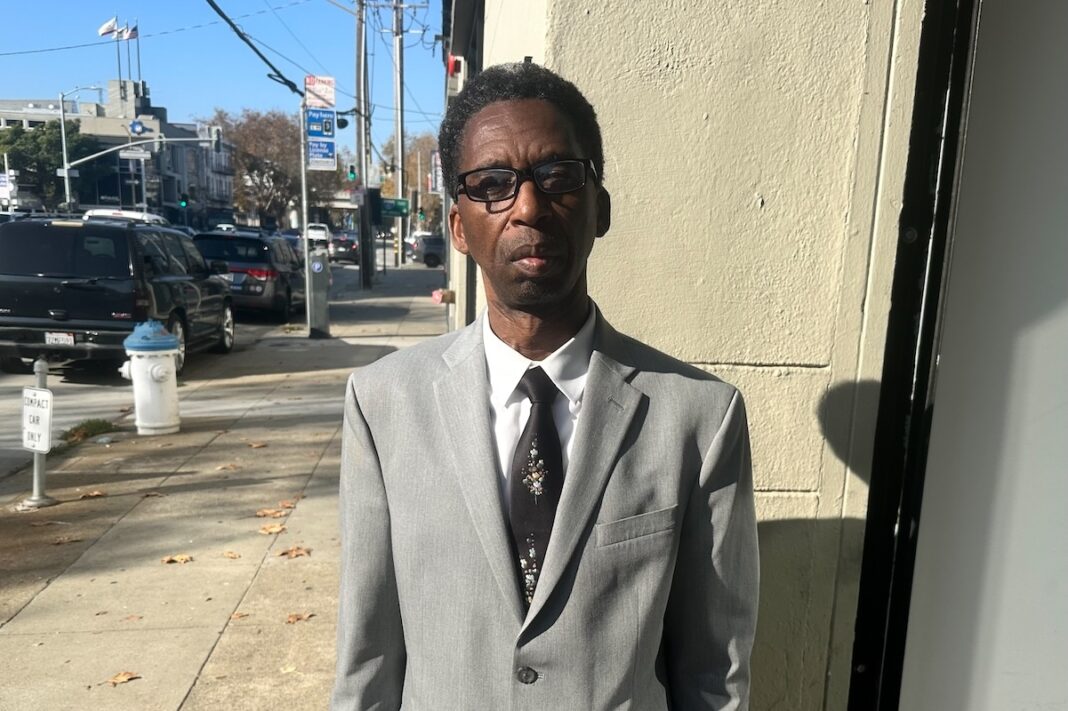
On the first day of December, filmmaker and activist Kevin Epps sat stoically in a San Francisco courtroom, trying to remain calm and composed as Jalea Hale, 23, a young woman he once considered part of his extended family, testified under oath about what she perceived to be his murderous intent to kill her step-father Marcus Polk, the night before Polk actually was slain by Epps.
Epps, 57, is facing first-degree murder charges in the 2016 shooting death of Polk, then 49, a troubled transient and chronic methamphetamine user with a long history of criminal infractions and parole violations. Since November 10th, the long-awaited trial has been playing out in San Francisco’s Superior Court, as the prosecution has presented a procession of law enforcement officers, expert witnesses, and Polk’s family members. On December 2nd, the prosecution abruptly rested. One witness who wasn’t called was Jason Fries of 3-D Forensic Inc., whose digitally-animated recreation of Polk’s shooting formed the basis for reopening the case in 2019 after it had been dropped due to “insufficient evidence.”
The SF DA’s office cited the emergence of new evidence to obtain a warrant for Epps’ arrest in 2019. Besides Fries’ animation – ruled inadmissible in a pretrial hearing – the only new evidence was amended testimony from Polk’s estranged wife Starr Gul and Hale, allegations absent from their 2016 interviews with SFPD investigators a day after the shooting. Both were potentially damaging to Epps’ claim of self-defense.
In earlier testimony, Gul claimed Epps pointed a gun at a door behind which Polk stood as the two men argued over Polk’s insistence to be let in to the residence Epps shared with Gul’s sister Maryam Jahn, and their two children. Hale, 14 at the time, was a frequent guest, along with Melina Polk and Gul’s two sons by another man. Polk, who had no permanent residence after being evicted from a Tenderloin SRO after violating his parole for drug use, was also a regular visitor.
A New Witness’ Dramatic Testimony
On the witness stand Monday, Hale said she witnessed the argument between Epps and Polk, recalling that Epps did not want to let Polk inside, complained about being disrespected, and made what she took as a threat to Polk’s life. “If (Polk) was somewhere else, where (Epps is) from, there’s consequences. Someone would put an end to (Polk),” she paraphrased Epps as saying.
Prompted by Assistant District Attorney Jonathan Schmidt, Hale said she understood the comment to mean Epps “killing (Polk), so (he) can’t do anything else.” However, Hale didn’t directly corroborate Gul’s recollection of Epps having a gun in his hand on that night.
On cross-examination, defense attorney Darlene Comstedt used Hale’s 2016 interview the day after the shooting to reveal more details than had been previously noted about the argument the night prior to the shooting. Polk wasn’t just being teased by Gul’s sons, as Melina Polk and Gul stated. “He called your brothers faggots. And that went on for a while.”
Comstedt did not directly challenge Hale’s interpretation of Epp’s alleged threats but instead focused on how Polk “refused to leave” and “kept yelling.” She confronted Hale with her prior testimony that her aunt, Maryam Jahn, refused to let Polk in, until he “barged through the door” – contradicting Gul’s recollection that Jahn “wanted to let him in.”
Key Witness Testimony Raises Credibility Questions
Short on direct physical evidence that would prove premeditation and disprove self-defense, the prosecution relied on testimony from key witnesses Gul, Hale, and Melina Polk. As the defense underscored in cross-examination, their statements were often inconsistent not only with their previous accounts, but with each other.
Another major challenge was that Gul was the only witness to claim to have seen the actual shooting. But her explanations of her exact location and precisely where Epps and Polk were in relation to each other at the time were unclear. She initially claimed the two men were facing each other. After prompting from Schmidt, she changed her testimony to say Polk stood off to the side of Epps. These and other inconsistencies raised doubts about her claim to have seen the second shot and her dramatic description of Polk being “spun around 180 degrees on his tippy-toes” before falling to the ground
The prosecution’s biggest advantage has been that Polk’s prior history of chronic drug abuse, domestic violence, sex offenses, and parole violations were largely ruled inadmissible by Judge Brian Ferrall. This limited the defense’s ability to question Polk’s family members and excluded testimony from parole agents and his former roommate – which could have provided significantly deeper insight into his character, state of mind, and whether he was capable of following through on his violent threats. It also allowed the prosecution and Polk’s family members to portray him in a way that may not have been entirely accurate, while also portraying Epps in a way that lacked full context.
In his opening statement, Schmidt stated that both Epps and Polk were “drug users – Epps with marijuana, Polk with methamphetamine.” In his direct examination of forensic toxicologist Dr. Luke Rodda, the prosecutor asked a series of questions that strongly implied the two substances were equivalent to which Rodda replied “correct,” without going into detailed explanations. Yet according to the DEA, meth is a highly-addictive drug that has been linked to fatal overdoses, violent behavior, homicidal and suicidal thoughts, and extreme paranoia. Marijuana can also increase paranoia and anxiety but isn’t linked to violent episodes or reported deaths from overdoses by the federal government.
Because Polk’s parole reports were excluded, jurors had no way to know that Polk’s methamphetamine use presented a “danger to public safety” days before his fatal confrontation with Epps.
Jurors did hear from multiple witnesses, however, that Epps kept marijuana at his residence, in large plastic bags which he removed after the shooting, before police arrived. The evidentiary value of this was unclear, as Epps reportedly had a medical marijuana card and wasn’t charged with possession.
To bolster Gul’s claim that Epps shot Polk in the back, Schmidt questioned Chief Medical Examiner Dr. Christopher Liverman who initially testified that the fatal shot entered through Polk’s left torso. When Schmidt asked him a second time the following day, Liverman changed his answer to “left posterior.”
During a discussion of blood splatter evidence by an SFPD gun technician, Schmidt suggested the shots could have come from 15 or 20 feet away – which would also have lined up with Gul’s account. But on cross-examination, the technician said the shots could also have been from between two and three feet away.
One watershed moment for the defense was Comstedt’s cross-examination of Starr Gul, who had painted a “menacing” picture of Epps’ demeanor and behavior on the night before the shooting.
Referencing Gul’s prior testimony in 2016 and 2019, Comstedt said, “At no time in those interviews did you share that Mr. Epps was walking around with the gun in his hand for 20 minutes. You didn’t say anything about the gun the day after the shooting, correct?”
“Yes,” Gul replied.
Comstedt further challenged the prosecution’s depiction of Polk’s state of mind the day of the shooting when she cross-examined maintenance worker Anthony Walker about his encounter with Polk that afternoon. She read back a transcription of a 2016 police interview where Walker stated Polk had made violent threats, telling him, “I’ll Fuck You Up.”
On cross-examination, SFPD forensic toxicologist Dr. Luke Rodda also conceded that “meth has high potential for addiction” and that the level of the drug in Polk’s body could be the remainder of a “prior binge.” Now that the prosecution has rested, the defense will present its case. The sole confirmed witness is Dr. Judy Melinek, a highly credentialed forensic pathologist whose testimony in a 2025 preliminary hearing led directly to Fries’ animation being ruled inadmissible. Melinek is expected to challenge the findings of the prosecution’s expert witnesses, specifically Dr. Liverman.
This story was produced in collaboration with California Black Media. It is part of ACoM’s ongoing coverage of the Kevin Epps trial.