


Deliberations and a verdict are all that remain in the month-long murder trial of filmmaker and editor Kevin Epps in San Francisco Superior Court.
Epps, 57, is accused of killing then 48-year-old Marcus Polk in October 2016, following an altercation at 137 Addison, a Glen Park subsidized-housing unit rented by Epps’ common-law wife Maryam Jahn, the mother of two of his children. Whether Epps was the shooter was never in question. At issue is whether the killing was justifiable self-defense or cold-blooded murder.
Prior to closing arguments, the jury received instructions from Judge Brian Ferrall. The jury can find Epps guilty of first-degree murder, second-degree murder, or manslaughter. They can also find him guilty of being a felon in possession of a gun — a charge which carries a lengthy 25-year sentence enhancement. But to do so, the jury must find that every element in the criminal counts applies beyond a reasonable doubt. If the prosecution hasn’t proven its case to this extent, Epps must be acquitted.
Epps has claimed self-defense. In order for the killing to be legally justifiable, there must be evidence of an imminent threat of great bodily harm.
Epps did not testify, so his state of mind at the time of the incident could only be ascertained from second-party accounts.
In his closing argument, prosecutor Jonathan Schmidt said, “Mr. Epps was not allowed to possess a gun. He had a gun. He used that gun to shoot and kill an unarmed man. On those facts alone, Mr. Epps is guilty of murder.”
There was “no basis for the immediate use of deadly force,” Schmidt said. “It just wasn’t necessary to shoot and kill Mr. Polk.”
Polk, he insisted, was an “integral part of the household. He was welcome. He was a warm presence.”
Epps, he said, shot Polk “because of a simmering dispute” over Polk’s frequent visits, and Polk’s disparaging critique of Epps’ relationship with Maryam Jahn, the house’s leaseholder.
In a closed session without the jury, defense attorney Darlene Comstedt argued that Schmidt had stated things he knew “to be false” because evidence about Polk’s prior history had been ruled inadmissible in pre-trial evidentiary hearings. Calling the prosecutor’s conduct “improper,” Comstedt pressed for a mistrial. Judge Ferrall denied her motion, noting “I allowed the defense to introduce other evidence about Polk’s violent convictions. But there would have been consequences” — such as allowing the prosecution to reference Epps’ criminal history.

“The prosecution has spent a lot of time trying to present a picture of Marcus Polk as a family man,” Comstedt told the jury in her closing argument, including showing a family photo that was taken 22 years prior to the shooting. “He may have been at one time. That’s not who Marcus Polk was at the time.”
In 2016, “Marcus Polk was unhoused, he was on parole, and his parole has just been revoked for methamphetamine. He was in jail and got a new ankle monitor. After he got out of jail, he went right back to using meth. We know because he had drugs in his system,” she added.
In summarizing the case for self-defense, Comstedt quoted Epps’ frantic words immediately following the shooting: “’He came at me. He came at me. He came at me’ … This isn’t something being said for the first time after three years or nine years. This was his state of mind immediately after the shooting … The prosecution is relying on a narrative that does not withstand scrutiny.“
Comstedt challenged Gul’s description of Epps becoming so agitated the night before the shooting that he grabbed a gun and waved it at Polk. But when Gul first told the police the details of that Saturday night, she never mentioned that Epps had a gun. “She left out the most important detail because that never happened.”
Neither of Gul’s daughters mentioned Epps having a gun the night before, Comstedt added.
The next day, “Polk refused to leave. We know there was a commotion upstairs …Any testimony that he entered peacefully is simply not credible. This is an unlawful and forceful entrance. Certainly Marcus Polk is not part of the household. We see the GPS records. Mr. Polk didn’t have keys to the house.”
Epps, Comstedt concluded, “had the right to defend himself even if possession of the gun was unlawful. The burden is on prosecution to disprove these elements of self-defense.”
Before jury deliberations could begin, the prosecution was entitled to a rebuttal of the defense’s closing argument. Schmidt attempted to explain away discrepancies in Gul’s account: “Why would she lie?” he asked.
He returned to the testimony of maintenance worker Anthony Walker, who said on the witness stand he didn’t consider Polk a threat. But Schmidt didn’t mention that on cross-examination, Walker was confronted by a 2016 interview where he said Polk threatened him twice.
Schmidt concluded his rebuttal by saying, “Mr. Polk might have been on drugs, he might have been unhoused, and he may have been on parole. But he was also a father to his children.”
Before sending the jury off to deliberate, Judge Ferrall reminded jurors that “arguments of counsel are not evidence.”
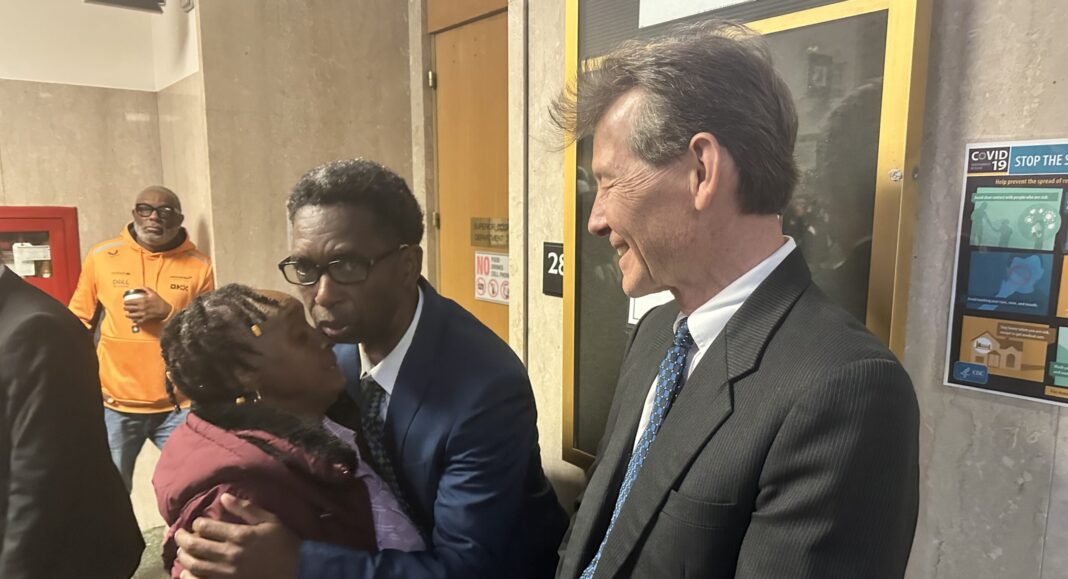
With that, Epps and his supporters filled out into the courthouse hallway. His future and freedom now lie in the hands of 12 jurors.