


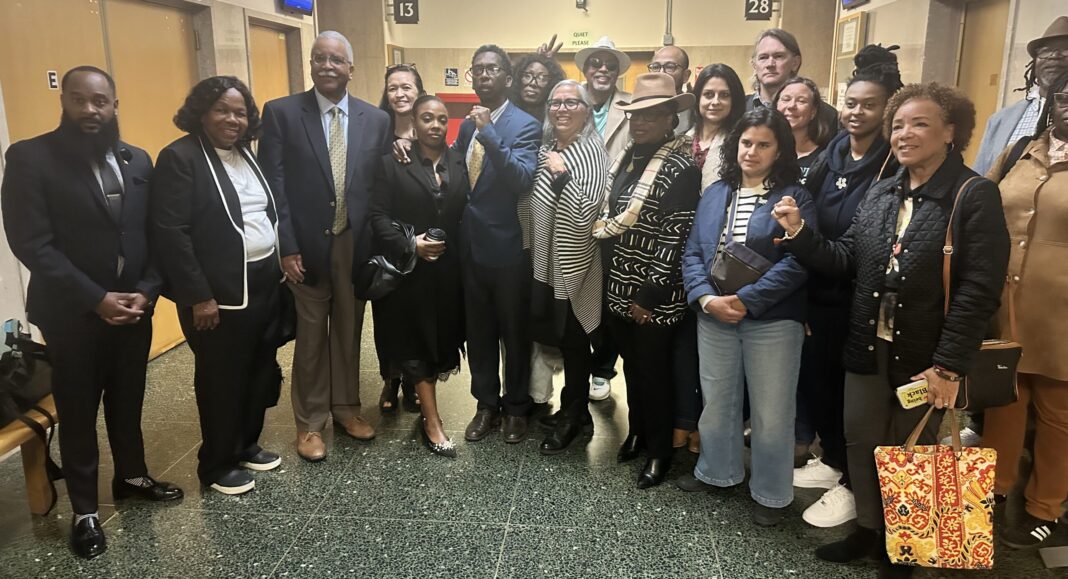
A San Francisco jury found filmmaker Kevin Epps not guilty of first- or second-degree murder on Monday December 15, as a nine-year-long legal saga reached a tipping point.
Epps, 57, was convicted of voluntary manslaughter in the 2016 shooting of Marcus Polk, 48.
A teary-eyed Epps told reporters he felt “relieved” at the not guilty murder verdict, but the case is far from over.
The voluntary manslaughter charge carries a prison term of between three and eleven years, but could be reduced to probation or doubled, depending on the judge’s ruling. Epps was also found guilty of being a felon in possession of a gun — a charge that could trigger a mandatory sentence enhancement of 25 years, or be dismissed for time served; Epps wore an ankle monitor for four years after being recharged in 2019.
The trial has raised controversy within San Francisco’s Black community, who have questioned the fairness of the proceedings and whether the prosecution of Epps amounts to unequal justice.
Malik Washington, a former editor at SF Bayview newspaper — where Epps serves as executive editor — has been reporting on the trial for the Davis Vanguard. He asked: “Why is District Attorney Brooke Jenkins going so aggressively out there after Kevin Epps? What’s going on here?”

While the SF District Attorney’s office has put considerable resources into prosecuting Epps, Washington noted that the same level of effort did not apply in the case of Keita O’Neal, an unarmed Black man killed by SFPD officer Christopher Samayoa in December 2017.
Jenkins has also declined to pursue charges in the 2023 killing of transgender man Banko Brown by a Walgreens security guard and in the case of Sean Moore who died from his injuries three years after being shot by an SFPD officer in 2017. Jenkins has not made any public statements on the Epps trial, but did show up to court one day and sit in the gallery during the trial proceedings.
Epps’ supporters have argued that his case should never have been reopened after an initial finding of insufficient evidence in 2016. At a 2019 preliminary hearing, the DA’s office presented what they claimed was new evidence — amounting to amended testimony by Polk’s estranged wife Starr Gul that differed substantially from the account she told police investigators the day after the shooting, and a commissioned digital recreation of the shooting which was later ruled inadmissible.
Epps’ supporters and his attorneys have continually railed against the credibility of the prosecution’s case, alleging misconduct and judicial error relating to Assistant District Attorney Jonathan Schmidt’s conduct and Judge Brian Ferrall’s seeming bias in favor of the prosecution. Epps supporter Tobee Vanderhall maintains the judge made comments and rulings inexplicably beneficial to the prosecution at the 2019 preliminary hearing and during evidentiary hearings in 2024 and 2025.
“The power of the judge has such an impact on what the jury is going to hear,” Vanderhall said. “You’re seeing the judge do a favor for the prosecution.” Her takeaway? “Justice is supposed to be blind. That is not what has happened.”
Attorney Julian Davis, who has organized community rallies for Epps along with a website, alleges that both prosecutorial misconduct and judicial error have been evident in trial proceedings from the beginning. “The voluntary manslaughter conviction is the result of a flawed process that has been barred by false witness testimony, prosecutorial misconduct, and judicial error,” Davis said.
The most egregious misconduct, he said, happened during closing arguments, when the defense made a motion to dismiss, charging that prosecutor Schmidt had acted improperly. The main issue here,” Davis said, “is when a prosecutor asked the jury or leaves the jury to infer things the prosecutor knows to be false, and in this case, he misled the jury into believing that Marcus Polk was a calm and peaceful man that could be easily deescalated.”
In actuality, Polk was a registered sex offender with domestic violence charges brought by Gul, a restraining order brought by his former roommate, and more than 30 parole violations, mostly for chronic methamphetamine use. The prosecution had to be aware of this, the defense argued, because it referenced every single one of Polk’s legal transgressions in a 2025 legal brief arguing for the inadmissibility of this evidence.
“It’s textbook prosecutorial misconduct because this very same prosecutor set the standard for prosecutorial misconduct,” Davis said.
In its motion to dismiss, the defense referenced the U.S. Vs Blueford case from 2002, in which Schmidt — then an Assistant U.S. Attorney — was chastised by the 9th Circuit Court of Appeals and Blueford’s conviction was overturned: The prosecutorial misconduct “violated defendant’s right to a fair trial,” and was “prejudicial,” the Appeals court ruled, adding, “the prosecutor’s job isn’t just to win, but to win fairly, staying well within the rules.”
The Blueford case, Davis said, is often cited as a precedent “included within handbooks for appellate practice as textbook prosecutorial misconduct. The prosecutor may ask the jury to draw reasonable inferences from the evidence, but may not, per Blueford, … ask the jury to infer things known by the prosecutor to be untrue.”
However, the judge denied the defense’s motion, and also denied the request for an admonition from the prosecution. Davis said this is a clear case of prosecutorial misconduct and judicial error which he believes should be given strong consideration in the event of an appeal.
Davis likened Ferrall’s routine denial of defense objections during the trial to being on “auto-pilot.” He believes the judge’s limited experience in criminal court played a role in his deference to the prosecutor — at the expense of Epps receiving a fair trial: “Unfortunately in this case, the judge had a hand in suppressing evidence that the defense wanted to put on. Marcus Polk’s parole officer, for instance, was not allowed to testify. There were expert medical witnesses that were not allowed to testify.”
The defense ultimately presented a single witness, forensic pathologist Dr. Judy Melinek, after the judge ruled most of its proposed witnesses inadmissible.
While the jury did not find the criminal element of “malice aforethought” to be applicable, the voluntary manslaughter charge implies they believed Polk’s killing was unlawful, and happened in the heat of passion. That inference may have happened because an alternate theory of the shooting was never fully articulated — in part because Epps didn’t testify, and also because the jury never heard the full context of Polk’s background, which could have shed light on Epps’ state of mind at the time.
An appeal is likely, which could take weeks or months or years to wind its way through the judicial system. In the immediate aftermath of the verdict, Epps told media reporters he is “grateful” to have been granted bail as he prepares for his sentencing hearing, expected in six to eight weeks. He’s hopeful, he said, of obtaining letters of support from Governor Gavin Newsom, Congresswoman Lateefah Simon and other high-profile supporters.