


LOS ANGELES — Restaurants in Los Angeles Koreatown are facing a severe downturn. Business owners cite a range of factors — rising rents, inflation, immigration enforcement — that they say are putting them under even greater strain than during the COVID 19 pandemic.
Home to the country’s largest Korean population, LA’s Koreatown acts as a barometer pointing to mounting pressures facing Korean American small-businesses nationwide.
“Back then, there were opportunities to recover because of the Paycheck Protection Program and other government assistance,” said Yongho Kim about support restaurants like his received during the pandemic.
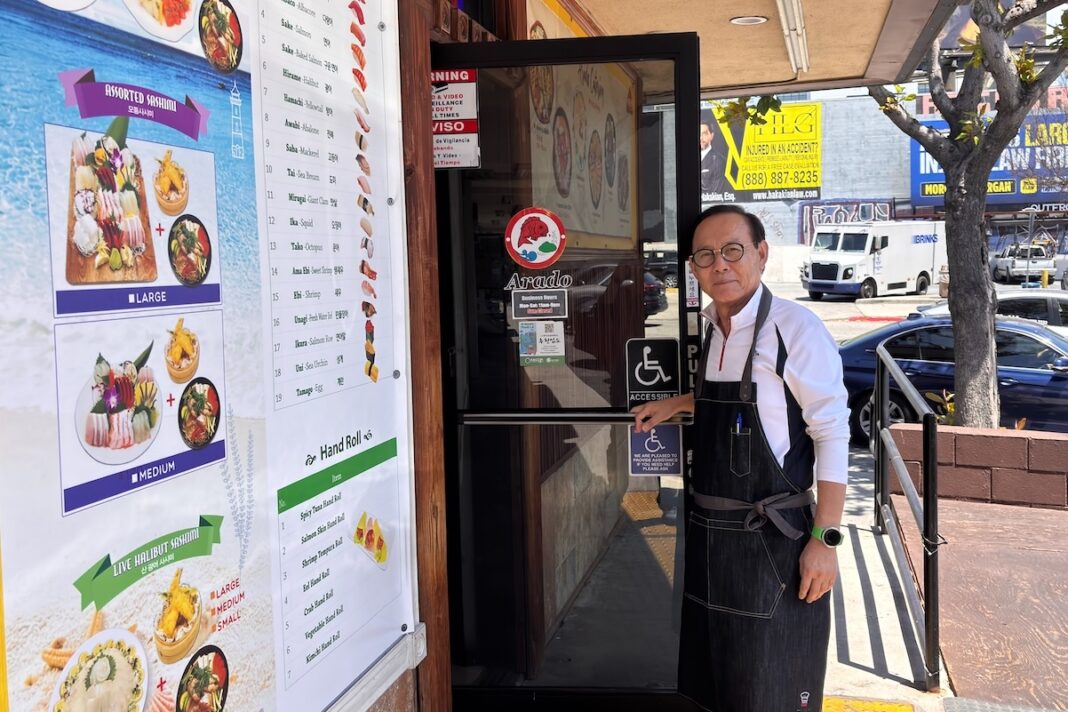
Kim is president of the Korean American Food Industry Association. He is also the owner of Arado Japanese Restaurant, which has operated in Los Angeles Koreatown for 31 years.
“Now, taxes, insurance, food costs and rent have all gone up at the same time, creating a structure in which small businesses can barely survive,” he added. “There are so many closures now that it is hard to even count them.”
Data suggests a slight increase in commercial rents in Koreatown this year, while vacancies remain high. Food prices have also increased by nearly 3% year-on-year following sharp inflationary spikes starting in 2022. The cumulative effect suggests increases as high as 19% compared to several years earlier.
Koreatown’s main dining corridors bear this out. Once filled with customers in the evening, business owners say that except for a few local hotspots, the neighborhood quickly loses its energy after 8 or 9 p.m. As residents cut back on dining out and families tighten their spending, restaurant sales have fallen sharply.
Kim says that’s an important indicator for the strength of the local economy.
“When a restaurant cannot pay rent, that means it is also difficult to pay suppliers and employees on time,” Kim said. “This is not just one problem. Multiple pressures are hitting businesses all at once.”
The high costs of immigration enforcement
Korean-owned businesses rely heavily on Latino workers, and their customer base is closely tied to immigrant communities. When fears of enforcement rise, labor supply and consumer spending weaken.
Audrey Casillas, community economic development director at Koreatown Youth Community Center (KYCC), said the uncertainty has changed individual and household spending patterns.
“Because of immigration enforcement, many residents are not going out on the streets,” noted Casillas. “Instead of shopping or eating out as often as before, some families are sending only one person out to buy what they need.”
The shift is affecting not only adults but also young people. Casillas said participants in KYCC’s youth programs have reported that their families no longer go to parks or walk around the neighborhood as they once did. For mixed status homes, where one or more members is undocumented, just going out poses risks.
The net effect is reduced foot traffic along key business corridors.
A UC Irvine study suggests immigration enforcement led to a decrease in foot traffic in immigrant heavy neighborhoods of between 8%-10%. Countywide losses totaled an estimated $625 million.
KYCC has also seen an increase in Korean business owners looking for counseling on a range of issues, including loans, credit lines, cost-cutting, marketing, labor law, food regulations and financial management.
“Korean business owners often know their industry and products very well, but they may not know what outside resources are available to help them reduce costs or increase revenue,” Casillas said.
Glimmers of hope
Still, Kim says the 2026 World Cup and the 2028 Los Angeles Olympics could provide opportunities for Koreatown businesses to regain momentum.
“The Olympics will bring visitors from around the world to Los Angeles, so restaurants need to start preparing now by adding English to menus, improving service and getting ready to welcome international customers,” Kim explained. “With interest in Korean food growing, Koreatown restaurants can turn this moment into an opportunity.”
Kim is also making changes at his own restaurant. Arado, long known for its Japanese menu, has expanded its Korean offerings, including Korean-style braised short ribs (galbi), as well as other popular seafood items.
“As K-food becomes more widely known, customers’ expectations are changing,” Kim said. “Even small changes, such as adding popular dishes and making the menu easier to read, are important.”
Experts say Korean small-business owners need to move beyond simply trying to endure the downturn alone. They should review their cost structures and actively seek available resources, including free counseling, legal support, digital marketing training and financial guidance.
“Asking for help does not mean a business has failed,” Casillas said. “In a time of uncertainty like this, it is important for business owners to get reliable information and review their financial situation before it is too late.”
Kim said Koreatown’s broader economy depends on the survival of its small businesses.
“Small businesses have to survive for Koreatown’s economy to remain intact,” Kim said. “Things are difficult now, but with major events ahead, we need practical support and promotion so local businesses can be ready to welcome customers again.”