

By Ricky Rodas | Boyle Heights Beat
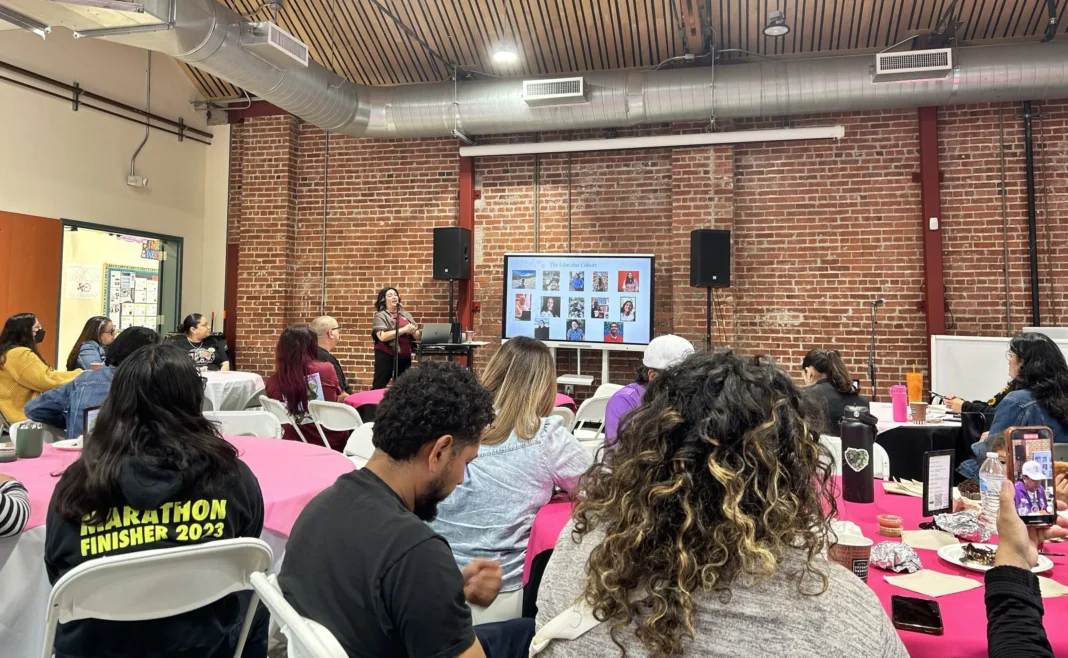
Teachers in Los Angeles gathered Saturday at Jane B. Eisner Middle School to celebrate the unveiling of the Central American Studies curriculum that teaches K-12 students about the region’s culture, practices, and history.
“Central American students only get to learn about themselves in classes as relics of the past,” said Cindy Cecilia Mata-Villalta, director of the UC Irvine History Project.
Now, she said, the tides are turning with educators building “culturally relevant” and “community sustaining” curriculum.
Mata-Villalta spearheaded the Central American Studies curriculum project to support a new law in California, signed by Gov. Gavin Newsom in 2021, that mandates public schools in the state to offer ethnic studies courses by the 2025-26 school year. The law takes effect with the 2029-30 graduation class.
The initiative, which received funding from the California Subject Matter Project, included assistance from the Cal State Northridge Writing Project and Camino Nuevo Academy. The Central American Studies curriculum was created as a resource to help guide teachers across the state.
About 40 attended the “Central American Studies Showcase: Celebration, Education y Comunidad” event on Saturday, which featured a curriculum fair, workshops for parents and families, and a panel featuring Central American scholars and educators.

The curriculum was created by 13 educators who identified as Central American or have had experience teaching in schools with a predominantly Central American population. Mata-Villalta said the curriculum’s units are aligned with ethnic studies and adhere to common core literacy standards. The curriculum focuses on L.A. given that the county is home to the largest Central American population in the U.S. The units, however, can be taught in any classroom, according to educators.
Lesson plans are designed to be incorporated into various subjects, including social sciences and English. The curriculum highlights the cultural practices of the region’s ethnic groups and helps students document their migration stories through writing and art. It includes discussions about art, politics, economics, and Indigenous-led environmental movements. These units will be made available online for others to use as reference.
Emily Grijalva, a community school coordinator at Mendez High School, participated in the curriculum project and believes it will be useful for students in Boyle Heights, especially as she’s noticed more and more Central American youth enrolling in local schools.

“I think what’s interesting about these current students, is that a lot of them are coming from rural areas, and they’re Indigenous, and a lot of them speak Indigenous languages. So something that I’ve been thinking about is, ‘How do we best support Indigenous linguistic practices in schools?’” said Grijalva, who is Guatemalan and Salvadoran.
Floridalma Boj Lopez, an assistant professor at UCLA who helped organize the curriculum project, has worked to ensure Indigenous voices from countries like Guatemala and Honduras are included in these academic units.
“That’s what brings me to this project, a deep commitment to ethnic studies with the understanding that ethnic studies helps students understand the world, and their lives while also creating change,” said Boj Lopez, who migrated from Guatemala to South Central as a child and has spent most of her life as an organizer and educator advocating for ethnic studies.
For Mata-Villalta, a Salvadoran migrant who grew up in the San Gabriel Valley, this initiative is a dream come true. Early on in her educational career, when she was a social science teacher in 2008, she quickly noticed that the California curriculum barely included Central American studies.

She sought to incorporate lessons on Central American culture and history as much as possible, but she could only do so much.
“I couldn’t fit it into the curriculum because we had state testing and the test didn’t have [knowledge of] Central Americans in it,” Mata-Villalta said.
Mata-Villalta is hopeful that teachers in L.A. will incorporate these lesson plans to help the growing Central American population understand their identities within a larger historical and cultural context.
“My hope is by educating teachers or facilitating spaces for teachers, we can all work collectively to give students some backgrounds so that they can put their own pieces back together,” she said.
This resource is supported in whole or in part by funding provided by the State of California, administered by the California State Library in partnership with the California Department of Social Services and the California Commission on Asian and Pacific Islander American Affairs as part of the Stop the Hate program. To report a hate incident or hate crime and get support, go to CA vs Hate.